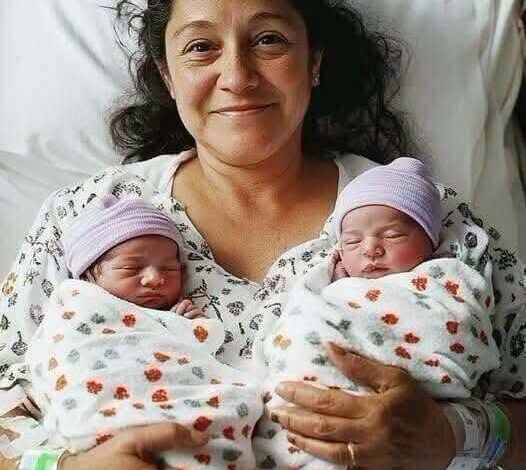
For most of her life, she imagined motherhood as something that would happen “one day.”
There would be time.
Time to build a career.
Time to find stability.
Time to create the kind of home she had always pictured.
But the years moved more quickly than she expected. Plans changed. Opportunities came and went. Relationships ended, new beginnings appeared, and somehow the chapter she had always believed would arrive naturally kept drifting just beyond reach.
By the time she was 58, many people assumed that dream had quietly come to an end.
Doctors were honest with her about the realities.
Female fertility declines significantly with age. The chances of conceiving naturally become much lower, pregnancy complications become more common, and every step requires careful medical evaluation. They explained the risks with compassion rather than discouragement, making sure she understood both the possibilities and the challenges that lay ahead.
She listened carefully.
Then she made a decision.
As long as there was a safe path forward, she wanted to try.
What followed wasn’t a miracle that happened overnight.
It was months of appointments, blood tests, ultrasounds, medication schedules, and conversations with specialists who monitored every stage with extraordinary care. Hormone levels were checked repeatedly. Timing became important. Every small milestone brought cautious optimism, balanced by the understanding that nothing was guaranteed.
The process demanded patience.
It also demanded resilience.
There were moments when she questioned whether she was asking too much of herself. Friends encouraged her, while others quietly wondered if she was chasing something impossible. She understood their concerns, but hope has a way of surviving even when statistics seem discouraging.
Eventually, something remarkable happened.
Her body responded to treatment.
Rather than releasing a single egg, it released more than one.
Against considerable odds, fertilization occurred.
Then came another anxious wait.
Would either embryo implant successfully?
Days passed.
Then the long-awaited phone call arrived.
The pregnancy test was positive.
Relief quickly gave way to another surprise during an early ultrasound.
The technician grew unusually quiet while studying the monitor.
Then she smiled.
“I think you should take a look.”
There, on the screen, were two tiny gestational sacs.
Two developing babies.
Twins.
For a moment, no one in the room spoke.
She laughed.
Then cried.
Then laughed again.
The doctors explained that multiple pregnancies can occur for several reasons, including fertility treatments, natural variations in ovulation, and hormonal changes. While twins become more common in some medically assisted pregnancies, every successful pregnancy still depends on countless biological events unfolding exactly as they should.
There was every reason to celebrate.
There was also every reason to proceed carefully.
Twin pregnancies require closer medical monitoring because they carry higher risks for both the mother and the babies. Throughout the months that followed, her healthcare team closely observed growth, blood pressure, nutrition, and fetal development, adjusting care whenever necessary.
She approached each appointment with cautious gratitude.
Every healthy heartbeat felt like a gift.
Every reassuring scan became another reason to believe the journey might truly end with two children safely in her arms.
When delivery day finally arrived, the room filled with anticipation.
Doctors, nurses, and specialists worked together to ensure both babies entered the world as safely as possible.
Then came the cries every parent longs to hear.
First one.
Then the other.
Two healthy newborns.
Born on the same day, only minutes apart.
The emotions were overwhelming.
Years of waiting, hoping, worrying, and persevering suddenly became tangible as she held each child for the first time.
But the surprises weren’t over.
As doctors reviewed the family’s medical history, they discovered that the twins shared a rare inherited genetic marker associated with a pattern of multiple births that had appeared elsewhere in her family.
It didn’t mean the marker alone had caused the pregnancy.
Human reproduction is influenced by many genetic, hormonal, environmental, and medical factors working together.
Still, the finding created a remarkable connection across generations.
The twins were linked not only by birth, but by a family history stretching back decades.
It felt as though the past had quietly reached forward to greet the future.
Stories that grandparents once shared suddenly carried new meaning.
Family legends about twins no longer seemed like distant anecdotes.
They had become part of a living legacy.
Yet despite the fascinating genetics and the medical complexity surrounding her pregnancy, those details eventually became secondary.
What mattered most wasn’t how unusual the pregnancy had been.
It was what the pregnancy had become.
Two children.
Two lives.
Two futures waiting to unfold.
Her experience also became a reminder that fertility is deeply personal and often unpredictable. While medicine has dramatically expanded the possibilities available to many families, no treatment can promise success. Age, overall health, reproductive biology, and countless other factors influence every pregnancy differently, which is why specialists emphasize individualized medical care and realistic expectations.
Science helps explain many of these processes.
Researchers understand far more today about hormonal regulation, ovulation, assisted reproductive technologies, and inherited traits than previous generations ever imagined.
Yet even with all that knowledge, every pregnancy still contains elements that cannot be perfectly predicted.
Every successful birth carries its own story.
Behind every medical chart is a family navigating uncertainty.
Behind every statistic is someone hoping for good news after difficult conversations and long months of waiting.
Her journey was never truly about defying the odds.
It was about refusing to let those odds become the only story she believed.
When people now ask about having twins later in life, she rarely talks first about hormones, genetics, or medical procedures.
She talks about gratitude.
About the doctors who guided her safely.
About the family members who never stopped believing.
About the first time two tiny hands wrapped around her fingers.
Because in the end, the most extraordinary part of her story wasn’t that she gave birth to twins at an age many considered unlikely.
It was that after years of uncertainty, hope became something she could finally hold.
Science helped explain how the pregnancy happened.
Medicine helped protect it.
But the greatest joy arrived in the simplest form imaginable: two healthy babies, safely welcomed into the world, proving that while statistics can describe possibilities, they can never fully measure the meaning of a dream fulfilled.