I Ordered a Late-Night Pizza and Found Something Terrifying Hidden Under the Melted Cheese That Made My Heart Stop!

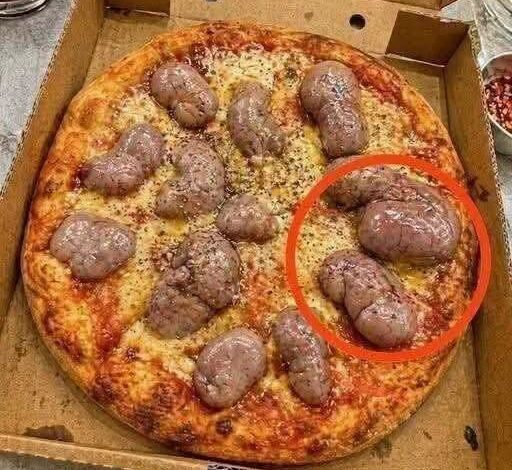
I stood alone in the kitchen, staring at the pizza as though it had suddenly become evidence in some mystery I couldn’t solve.
The oven had long since fallen silent, but my thoughts had not.
A few oddly shaped bubbles on the melted cheese were all it had taken. Minutes earlier, they had seemed unsettling—too large, too uneven, somehow different from what I expected. The longer I looked at them, the more convinced I became that something had gone wrong.
Maybe the food had spoiled.
Maybe the packaging had been damaged.
Maybe I had overlooked some warning sign before putting it in the oven.
The possibilities multiplied with astonishing speed.
It’s remarkable how quickly the mind fills gaps in understanding.
When we don’t immediately recognize something, imagination often rushes in before reason has a chance to catch up. Every unfamiliar detail becomes another clue supporting a story we never intended to write.
I almost threw the pizza away.
Instead, I stopped.
I took a breath, picked up my phone, and decided to do the one thing anxiety quietly tries to prevent.
I checked the facts.
Within minutes, the frightening mystery began to dissolve.
Those strange bubbles weren’t signs of contamination or anything dangerous. They were simply the result of trapped air, moisture escaping during baking, and cheese expanding under high heat. Different ovens distribute heat differently, frozen pizzas vary from one batch to another, and small changes in temperature can create perfectly harmless blisters across the surface.
In other words…
The pizza hadn’t changed.
Only my interpretation of it had.
I looked back at it with entirely different eyes.
The same bubbles that had seemed almost threatening only moments before now appeared completely ordinary. In fact, they looked a little funny, like tiny blisters puffing up on a familiar face I’d somehow stopped recognizing.
Nothing about the pizza itself had transformed.
Knowledge had transformed me.
That realization lingered as I carried the plate to the table.
For a moment, I hesitated.
Then I took the first bite.
It tasted exactly as it always had.
Warm.
Salty.
Comforting.
Perfectly ordinary.
I laughed quietly to myself.
Not because the experience had been foolish, but because it reminded me how persuasive uncertainty can be. The unknown often feels far more dangerous than it actually is, especially when fear is allowed to fill in the missing pieces.
Our brains evolved to notice potential threats.
Most of the time, that instinct protects us.
Occasionally, though, it also convinces us that harmless things deserve extraordinary suspicion.
An unfamiliar sound in the house.
An unexpected medical symptom that turns out to be minor.
A strangely shaped pizza bubble.
The pattern is often the same.
We don’t merely observe something unfamiliar.
We build an entire story around it.
And once that story begins, every detail seems to confirm what we already fear.
The antidote isn’t pretending fear doesn’t exist.
It’s giving curiosity a chance to speak before panic finishes the sentence.
Sometimes that means asking questions.
Sometimes it means looking something up from a reliable source.
Sometimes it simply means pausing long enough to let evidence replace assumption.
That evening stayed with me for reasons that had very little to do with frozen pizza.
It became a reminder of how easily perception can drift away from reality when uncertainty is left unchecked.
Facts don’t always erase fear immediately.
But they often shrink it back to its proper size.
They remind us that the world is usually less mysterious—and far less frightening—than our imagination first suggests.
By the time I finished dinner, nothing in the kitchen had actually changed.
The same oven hummed softly.
The same plate sat on the table.
The same pizza had disappeared slice by slice.
The only real difference was inside my own mind.
What had begun as an imagined threat had become an ordinary meal once again.
And in that simple shift was a lesson worth remembering: fear often grows in the space where knowledge is missing. The moment we choose to replace assumptions with understanding, the world itself can seem to change. In reality, it was never the pizza that needed explaining. It was the story I had unknowingly written around it—and how easily a few simple facts were able to rewrite it into something I could finally see, trust, and enjoy.