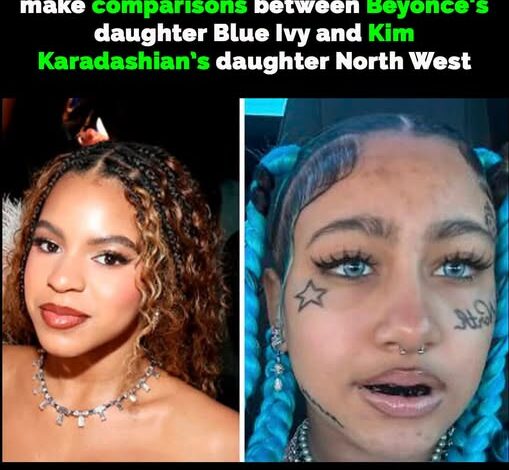
What began as a discussion about two celebrity children quickly became something much more troubling.
A viral comparison between Blue Ivy Carter and North West spread rapidly across social media, with strangers dissecting their appearances and using them to make sweeping claims about parenting, family life, and childhood. What could have remained a harmless conversation about Halloween costumes and personal style instead became another example of how easily children are pulled into adult debates they never asked to join.
North West’s playful, spooky costume was interpreted by some commenters as evidence of deeper problems within her family. Others responded by praising Blue Ivy’s appearance as proof of supposedly better parenting or a healthier home environment.
Neither conclusion was grounded in facts.
Both relied on assumptions drawn from a single photograph.
Lost beneath thousands of comments was a simple reality.
Both girls are children.
They did not create the online arguments.
They did not volunteer to become symbols in conversations about divorce, parenting, or celebrity culture.
They were simply living moments of their own childhoods.
Social media often encourages people to draw dramatic conclusions from carefully selected images. A photograph can capture a hairstyle, an outfit, or a facial expression—but it cannot reveal the quality of a family’s relationships, the values being taught at home, or the love children receive behind closed doors.
Those are realities no camera can fully capture.
Children naturally experiment as they grow.
They try new hairstyles.
They wear costumes.
They imitate favorite musicians, movie characters, or friends.
They discover who they are through creativity and play.
Those ordinary experiences shouldn’t become evidence in public arguments about their families.
Many people online recognized that distinction and urged others to step back.
Rather than comparing the girls or assigning meaning to their appearances, they reminded audiences that celebrity children deserve the same basic respect afforded to any other child: the freedom to grow, make mistakes, express themselves, and mature without being constantly judged by millions of strangers.
That perspective reflects an important principle.
Children should not bear responsibility for adult conflicts.
Whether their parents are married, divorced, co-parenting, or living entirely different lives, children remain individuals with their own identities—not reflections of public narratives built around their families.
Celebrity status doesn’t erase that truth.
If anything, it makes protecting children’s privacy and dignity even more important.
Public figures often accept intense scrutiny as part of their careers.
Their children never made that choice.
They inherit attention without consent, growing up under cameras, headlines, and endless commentary that can follow them for years.
The responsibility for changing that culture belongs not to the children, but to the adults watching.
It’s worth asking ourselves a simple question before sharing or commenting on images involving minors:
Does this discussion protect the child—or merely use the child to make a larger point?
If the answer is the latter, perhaps the conversation deserves reconsideration.
Families come in countless forms, each shaped by experiences, relationships, and circumstances far too complex to be judged from a photograph or a brief social media clip. Love, stability, guidance, and support cannot be measured by appearances alone.
In the end, the story isn’t really about Blue Ivy or North West.
It’s about how easily adults forget that children are not symbols, arguments, or click-generating headlines.
They are simply children.
And perhaps the most meaningful measure of our own character is whether we allow them the space to grow without turning their lives into battlegrounds for opinions that were never theirs to carry.