Sad Black Girl Married to a 70-Year-Old Man—10 Days Later She Uncovered a Hidden Truth That Changed Everything

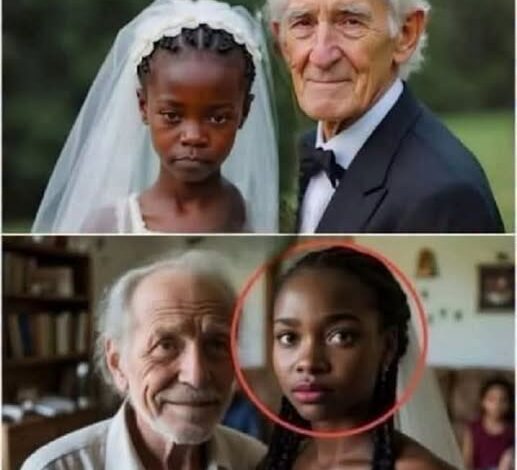
Edward and Amara’s story was never about money, convenience, or obligation.
It was about two people who found each other at a time when both believed life had already taken its greatest joys away.
When Amara first entered Edward’s home, she came as his caregiver. Her job was to help with medications, meals, and the countless daily tasks that had become difficult for him after years of declining health. She expected professionalism, kindness, and little more.
Neither of them expected their lives to change.
Edward was living beneath the long shadow of grief, still carrying the absence of the wife he had loved for decades. The house was filled with memories—photographs on the mantel, favorite books left exactly where she had placed them, and routines that had survived long after she was gone.
Amara never tried to replace any of it.
She simply listened.
She sat with him through quiet afternoons, encouraged him to share stories he feared no one wanted to hear anymore, and brought warmth back into rooms that had grown accustomed to silence.
Without realizing it, she became something far greater than a caregiver.
She became his companion.
Their friendship developed slowly, built not on dramatic declarations but on ordinary moments that gradually stitched two wounded lives together. A shared cup of tea. A familiar joke. An evening spent remembering happier days instead of mourning what had been lost.
Love arrived quietly.
It asked for nothing.
It simply stayed.
When Edward eventually shared the letter his late wife had written before her death, Amara unfolded it with trembling hands, unsure of what she was about to read.
She expected suspicion.
Perhaps even resentment.
Instead, she found grace.
The letter carried no bitterness, no jealousy, and no impossible promises. His wife had written with remarkable clarity, acknowledging that grief should never become a prison for the person left behind.
She hoped Edward would laugh again.
She hoped he would find peace.
And if someone kind entered his life after she was gone, she hoped he would have the courage to let love find him once more.
Then came the words that changed everything.
She welcomed the woman who might one day stand beside him—not as a replacement for what they had shared, because no one could ever take that place, but as someone who could offer comfort when she no longer could.
It wasn’t permission.
It was a blessing.
Amara wept as she finished reading.
The fear she had quietly carried—that loving Edward somehow dishonored the woman who came before her—began to disappear.
His wife had understood something profound.
Love does not erase love.
The heart simply learns to carry more.
Their years together were never marked by grand gestures or public declarations.
They were defined by quieter things.
Evenings spent talking long after dinner had ended.
Gentle laughter echoing through a house that had once known only silence.
The comfort of sitting beside someone who understood that companionship often speaks loudest without words.
Those moments became the true measure of their happiness.
When Edward’s life finally came to an end, Amara remained in the home where their story had unfolded.
From the outside, some people continued to whisper.
They questioned what they never truly understood.
They reduced a deeply human story to gossip because speculation was easier than empathy.
Inside the house, however, the truth remained untouched.
Every room held memories of kindness freely given.
Every photograph reflected a life rebuilt through patience rather than convenience.
Every quiet corner testified to the simple fact that genuine love often arrives when people least expect it.
Time softened the voices outside.
The rumors faded.
What endured was something far stronger.
Amara continued living in the home not because it represented wealth or security, but because it held the life she and Edward had carefully created together—a life rooted in compassion, trust, and the courage to embrace happiness after unimaginable loss.
Their story reminds us that love cannot be measured by timing or judged by appearances. Sometimes it grows from shared sorrow, quiet understanding, and the willingness to open a heart that once believed it would never heal again. In the end, Edward and Amara did not prove that love replaces what has been lost. They proved something far more beautiful: that even after profound grief, the heart can make room for hope, and that the greatest gift we can give those we love is the freedom to keep living long after we are gone.