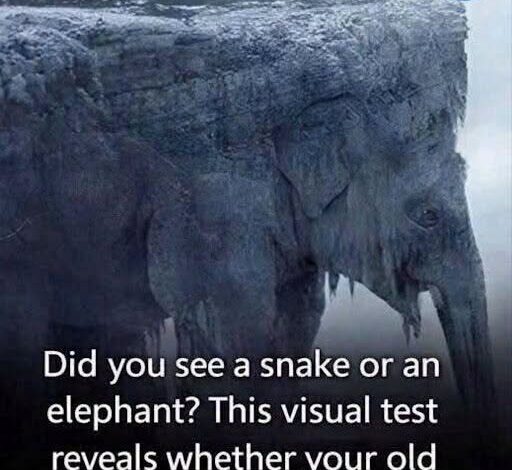
The most fascinating part of an optical illusion isn’t whether you spot the snake, the elephant, or any other hidden image first. It’s the realization that two people can look at the exact same picture and genuinely experience something completely different. That moment serves as a powerful reminder that human perception is far more complex than simply seeing what is in front of us.
It’s tempting to believe that the first thing you notice reveals a hidden personality trait or uncovers some secret about who you are. While these playful interpretations can be entertaining, they aren’t scientific measures of character. What they do highlight, however, is something equally remarkable: our minds don’t passively record reality. They actively interpret it.
Your brain isn’t a camera capturing every detail with perfect accuracy. It’s more like a storyteller, constantly sorting through enormous amounts of information, deciding what deserves attention, what can be ignored, and how separate pieces fit together into a meaningful picture. Every second, it filters countless visual signals before presenting you with what feels like an objective view of the world.
That process is so seamless that we rarely question it.
Then an illusion appears.
Someone immediately points to a snake winding through the image, while another person insists there isn’t one at all. Moments later, someone else identifies an elephant that suddenly becomes impossible to ignore. Once you see it, you may wonder how you ever missed something that now appears so obvious. Yet another viewer continues searching, genuinely unable to perceive what everyone else claims is right in front of them.
None of these reactions necessarily means one person is more observant or more intelligent than another. Instead, they demonstrate how perception is shaped by attention. The brain naturally prioritizes certain patterns, contrasts, and familiar shapes while overlooking others. What seems immediately obvious to one individual may remain hidden to someone else until their attention is directed toward it.
This remarkable difference extends far beyond optical illusions.
Every day, people move through the same environments, attend the same events, hear the same conversations, and still walk away with completely different impressions of what happened. Two friends can witness the same interaction yet remember it differently weeks later. Family members can recall a childhood event from opposing perspectives. Colleagues can leave the same meeting convinced entirely different priorities were discussed.
These differences aren’t always the result of dishonesty or poor memory.
More often, they reflect the deeply personal way each mind processes experience.
Our backgrounds influence what we notice first. Past experiences teach us which details feel important and which fade into the background. Memories shape our expectations. Emotions color our interpretations. Even something as ordinary as being tired, stressed, hopeful, or distracted can influence what captures our attention and what quietly slips by unnoticed.
Expectation plays an especially powerful role. Once the brain anticipates finding a certain pattern, it becomes remarkably efficient at locating it. That’s why, after someone points out the hidden elephant in an illusion, it suddenly dominates the image. Your brain has updated its interpretation, making it difficult to return to the original way you saw the picture only moments before.
Life often works in much the same way.
The stories we tell ourselves about people, situations, and even our own identities shape what we notice next. Expectations become filters, quietly influencing what feels true long before we consciously evaluate the evidence. Sometimes those filters help us navigate an overwhelmingly complex world. At other times, they limit our ability to recognize perspectives different from our own.
Perhaps that is the most valuable lesson hidden inside a simple visual puzzle.
An optical illusion isn’t really asking who is right.
It’s asking us to recognize that perception itself is wonderfully, sometimes frustratingly, human.
Understanding this can change the way we approach disagreement. When someone describes seeing something we completely missed, our first instinct is often to assume they’re mistaken. Yet many disagreements begin not because people refuse to look, but because they have genuinely been looking through different lenses all along. Their experiences, memories, assumptions, and expectations have guided their attention toward details that never stood out to us.
Recognizing that possibility doesn’t require abandoning our own perspective. Instead, it encourages curiosity. It reminds us to pause before insisting that our view is the only accurate one and to consider that another person’s experience may be just as sincere, even when it differs from our own.
In an increasingly divided world, that quiet insight may be more valuable than the illusion itself. We don’t all notice the same things, remember the same moments, or interpret the same events in identical ways. Our minds are constantly shaping reality through countless invisible choices made beneath the surface of awareness.
Perhaps the greatest lesson isn’t learning to spot the hidden image more quickly.
It’s learning to appreciate that two people can stand in front of the same picture, see entirely different things, and both be responding honestly to what their minds reveal. Sometimes understanding begins not with changing what we see, but with recognizing that someone else may be seeing something we simply haven’t noticed yet.