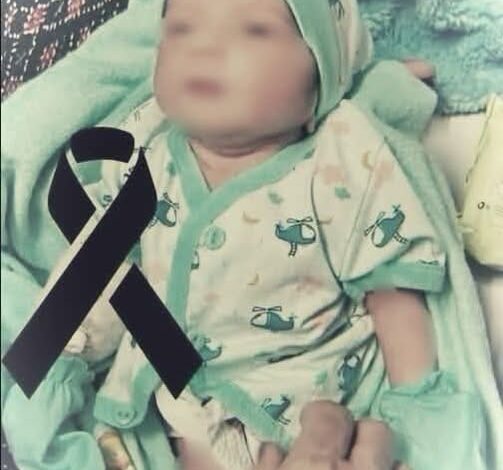
The Night Everything Changed
The silence was the first thing he noticed.
Only hours earlier, the house had been alive with the small sounds that come with caring for a baby—the rustle of blankets, the clink of a bottle being placed on the table, soft footsteps crossing the hallway, and cries that could pull an exhausted parent from sleep in an instant.
Now there was nothing.
No crying.
No hurried footsteps.
No whispered attempts to soothe a restless child.
Just silence.
In the days after the tragedy, that silence seemed to settle into every room.
The father found reminders everywhere.
A tiny blanket remained folded where someone had left it. A bottle sat on the kitchen counter, painfully ordinary and suddenly unbearable to look at. Clothes waited in drawers for a child who would never wear them again.
And then there was the crib.
He could barely enter the room where it stood.
The nursery had once represented everything ahead of them: sleepless nights, first words, first steps, birthdays, scraped knees, school photographs, and all the ordinary milestones parents assume they will eventually witness.
Now it represented everything that would never happen.
The night itself replayed endlessly in his mind.
Grief has a cruel habit of turning memory into an interrogation.
What if he had noticed something sooner?
What if one decision had been different?
What if someone had entered the room five minutes earlier?
What if the night could somehow be rewound?
He returned again and again to the moment when ordinary life ended and something unimaginable began.
There had been no warning that the house was about to become the center of an investigation.
No indication that the next few hours would divide his entire existence into two permanent chapters.
Before.
And after.
Investigators arrived carrying notebooks, cameras, evidence bags, and questions.
They moved carefully through rooms that still looked like a family home, documenting details that might help explain what happened. Objects that had been part of everyday life suddenly became evidence.
Where had everyone been?
Who had last checked on the baby?
What time had someone heard crying?
What happened immediately afterward?
Had there been any warning signs?
Every answer mattered.
Statements were compared.
Timelines were reconstructed minute by minute.
Medical professionals examined findings that might offer clarity where memory could not. Investigators studied the physical evidence while trying to separate shock, confusion, and incomplete recollections from facts that could be independently established.
For the family, the process was agonizing.
They wanted answers immediately.
Investigations rarely work that way.
Evidence requires analysis. Medical findings can take time. Witnesses may remember additional details only after the initial shock begins to fade. Investigators must resist the temptation to decide what happened before all available information has been examined.
Was it a terrible accident?
Was negligence involved?
Had something happened that nobody recognized until it was too late?
Those possibilities hung over the family, each one carrying its own kind of pain.
Outside the house, the neighborhood gradually returned to normal.
The first few days were different.
Cars slowed as they passed.
Neighbors stood in driveways speaking quietly.
Curtains moved when unfamiliar vehicles arrived.
People brought food because they didn’t know what else to bring.
Some left flowers.
Others sent messages they rewrote several times before finally pressing send.
“I’m so sorry.”
“I’m thinking of you.”
“Please tell me if you need anything.”
There are moments when language feels embarrassingly inadequate.
This was one of them.
Eventually, however, ordinary life resumed around the family.
Garbage trucks returned on schedule.
Children rode bicycles along the street.
Lawns were cut.
Packages appeared on porches.
People left for work each morning and came home each evening.
The neighborhood recovered its rhythm because neighborhoods always do.
The father couldn’t.
For him, time had changed shape.
Morning no longer meant beginning another day.
Night no longer meant simply going to sleep.
Every hour existed in relation to what had happened.
He could walk into the kitchen and suddenly remember an ordinary morning from weeks earlier. He could hear another baby crying in a supermarket and feel his chest tighten before he understood why.
The smallest things became the hardest.
Passing the baby aisle.
Seeing a stroller.
Finding a tiny sock beneath a piece of furniture.
Grief did not always arrive dramatically.
Sometimes it appeared as an object small enough to fit inside his palm.
People occasionally told him that someday things would become easier.
He understood what they meant.
But “easier” felt like the wrong word.
Nothing could make the loss acceptable.
Nothing could restore the future he had already imagined.
Perhaps, with time, he would learn how to carry it.
That was different from leaving it behind.
Meanwhile, investigators continued their work.
Eventually there would be reports.
Conclusions.
Perhaps charges, depending on what the evidence established.
There would be official terminology describing the circumstances surrounding the death. Pages would contain dates, times, medical observations, statements, and findings.
Those documents would matter.
Truth matters.
Accountability matters when evidence shows that someone failed in a responsibility or caused harm.
But even the most complete investigation could accomplish only so much.
No report could restore the sound of a baby crying in the middle of the night.
No conclusion could return the weight of that child to a father’s arms.
No courtroom, investigator, physician, or carefully reconstructed timeline could return the family to the moment before everything changed.
That was the cruel boundary between justice and grief.
One can search for answers.
The other must learn to live without what was lost.
Months later, the house would look different.
The flowers outside would change with the seasons.
Some belongings would eventually be packed away, not because they mattered less, but because looking at them every day became impossible.
The crib might eventually disappear from the room.
The bottle would be removed from the table.
The blanket would be stored somewhere safe.
Yet absence would remain.
Not always as sharply as it did during those first terrible days, but quietly woven into the family’s life.
Because some tragedies do not truly end when investigations close.
They become part of the people who survive them.
Someday, the official case file may sit untouched in an archive, reduced to a number on a shelf or an entry in a database.
But that will never be the whole story.
The real story will remain inside that house and inside the people who loved the child who once lived there.
It will exist in remembered cries, unfinished plans, photographs, and moments when someone instinctively reaches toward an absence before remembering.
Investigators may eventually determine what happened that night.
They may explain the sequence of events with painstaking precision.
But the deepest consequence requires no investigation at all.
A father once held his child and imagined an entire lifetime ahead.
Now he must learn how to carry that love forward without the future that was supposed to accompany it.
That is what remains after the sirens disappear and the reports are filed.
Not the headlines.
Not the speculation.
Just love with nowhere familiar to go—and a family slowly discovering how to survive the moment that divided their lives forever into before and after.