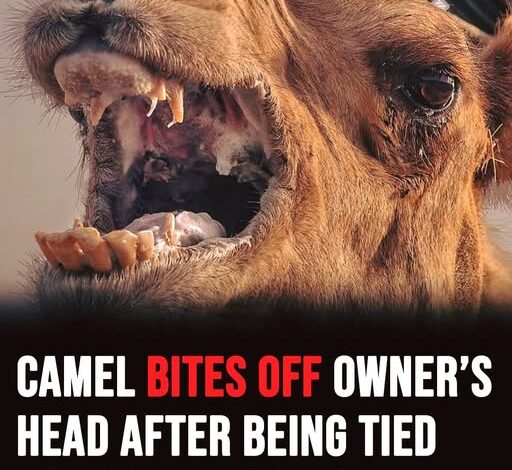
The internet has a predictable relationship with stories involving animals and violence.
The more shocking the claim,
the faster it spreads.
Especially when the story combines extreme weather, human negligence, and a dramatic act of revenge-like retaliation from an animal people already perceive as mysterious or dangerous. That is exactly why the viral reports surrounding the alleged camel attack in Rajasthan captured so much global attention so quickly.
At the center of the story sits a deeply emotional image:
a camel left restrained for hours under brutal desert heat,
slowly becoming distressed,
dehydrated,
and overwhelmed before allegedly reacting violently when approached by its owner.
The setting itself intensifies the emotional impact immediately.
Rajasthan’s Barmer district is one of the harshest inhabited desert environments in India. Summer temperatures regularly climb beyond 45°C, and during severe heatwaves, the landscape becomes physically punishing for both humans and animals. Under those conditions, survival depends heavily on access to water, shade, and rest.
Camels are famous for endurance, but endurance is often misunderstood.
People hear that camels survive deserts and assume they are immune to suffering there.
They are not.
Camels evolved remarkable adaptations for arid environments:
water conservation,
temperature tolerance,
fat storage,
efficient hydration recovery.
But biological adaptation does not eliminate physical limits entirely. Prolonged restraint in extreme heat without relief can still produce severe stress responses, dehydration, panic, and physiological breakdown.
That reality is important because many viral versions of this story frame the camel almost like a calculating monster or mythical avenger. The animal becomes transformed into a symbol of rage rather than what it actually is:
a large working animal potentially pushed beyond tolerance under dangerous environmental conditions.
And yet, separating truth from exaggeration becomes difficult very quickly online.
One version of the incident describes extraordinarily graphic violence.
Another alters key location details.
Others change timelines, witness accounts, or outcomes entirely.
That inconsistency matters.
Despite widespread circulation, no major internationally recognized news organization has consistently verified the most extreme claims attached to the story. Fact-checkers and animal experts repeatedly caution that social-media amplification often mutates emotionally shocking events into increasingly sensationalized narratives over time.
The internet rewards escalation.
Each retelling becomes slightly more horrifying,
slightly more cinematic,
slightly more emotionally addictive.
Eventually, audiences stop asking:
“What happened?”
And begin consuming the story primarily as spectacle.
Still, beneath the sensationalism lies a legitimate and important conversation about animal stress, environmental cruelty, and human misunderstanding of large working animals.
Because although camel attacks are rare, documented cases absolutely do exist.
And nearly all of them share similar contributing conditions:
mistreatment,
improper restraint,
physical exhaustion,
agitation,
pain,
or environmental stress.
Camel handlers across India, the Middle East, and North Africa understand something tourists and distant audiences often do not fully appreciate:
camels are immensely powerful animals.
Adult camels can weigh anywhere from 600 to over 1,000 kilograms. Their necks, jaws, and legs generate tremendous force. Even a defensive movement—not necessarily a deliberate “attack”—can cause catastrophic injury simply because of the animal’s size and strength.
Yet despite that physical power, experienced handlers consistently describe camels as intelligent, social, and generally calm when treated properly.
That distinction matters enormously.
Wildlife experts repeatedly emphasize that camels are not naturally aggressive predators looking for opportunities to harm humans. Their behavior usually changes under conditions involving fear, prolonged stress, physical discomfort, or poor handling.
And in desert environments, heat itself becomes a major physiological pressure.
Extreme heat affects animals psychologically as well as physically. Just as humans become irritable, exhausted, and cognitively impaired under severe heat stress, animals can become increasingly reactive and unpredictable when their bodies struggle to regulate temperature effectively.
Add restraint to that situation—being tethered without the ability to seek shade or water independently—and stress escalates rapidly.
Animal welfare specialists often compare prolonged tethering under severe heat to a form of environmental panic. The animal loses control over basic survival behaviors:
it cannot move toward cooler ground,
cannot access water,
cannot escape exposure.
Over time, distress accumulates physically and neurologically.
This broader context is what many experts believe deserves more attention than the viral horror framing itself.
Because the deeper issue is not whether camels are secretly dangerous.
It is whether humans consistently underestimate the emotional and physiological needs of working animals.
In many rural communities, camels remain economically essential:
transport,
farming,
tourism,
cargo movement.
Families depend on them for survival and livelihood.
But dependence sometimes creates normalization around harsh treatment. Long working hours, inadequate hydration, poor veterinary access, and environmental neglect can become accepted simply because they are common.
That normalization creates risk for everyone involved:
the animal,
the handler,
and surrounding communities.
The Rajasthan story spread globally partly because it taps into an ancient emotional narrative humans understand instinctively:
nature retaliating against cruelty.
People are psychologically drawn toward stories where suffering eventually “answers back.” The image of an abused or neglected animal suddenly becoming dangerous feels symbolically satisfying to many audiences because it appears to restore moral balance dramatically.
But reality is rarely that simple.
Animal aggression is not revenge in the human sense.
It is stress response.
Fear response.
Pain response.

And treating such incidents purely as shocking entertainment obscures the practical lessons that actually matter:
safe handling,
humane treatment,
environmental responsibility,
and respect for the limits of living creatures.
There is also another uncomfortable truth underneath stories like this:
modern viral culture often dehumanizes both animals and people simultaneously.
The animal becomes a monster.
The owner becomes a cartoon villain.
Complex circumstances collapse into emotionally satisfying extremes.
Yet many cases involving animal neglect emerge not solely from cruelty, but from combinations of poverty,
heat,
lack of education,
cultural normalization,
and inadequate welfare infrastructure.
That does not excuse suffering.
But understanding causes matters more than creating villains if prevention is the goal.
And prevention is ultimately what animal behavior experts emphasize repeatedly.
Most dangerous incidents involving camels are avoidable through:
adequate hydration,
shade access,
rest periods,
gentle handling,
awareness of stress signals,
and proper restraint practices.
Experienced handlers watch carefully for warning signs:
restlessness,
vocal distress,
agitated pacing,
changes in posture,
resistance behaviors.
Ignoring those signs increases danger dramatically.
The same principle applies far beyond camels alone.
Horses,
elephants,
dogs,
cattle,
and other working animals all display behavioral warning signals under stress long before catastrophic incidents occur.
Humans often fail not because animals are unpredictable, but because warning signs are dismissed until conditions become extreme.
Perhaps that is the most valuable lesson hidden beneath the sensationalism surrounding the Rajasthan story.
Large animals are neither villains nor machines.
They are living beings operating under physical and emotional pressures humans sometimes underestimate dangerously.
And while shocking headlines attract attention quickly, the quieter reality matters far more:
responsible care,
environmental awareness,
and humane treatment remain the strongest protections against tragedy for both animals and people alike.