Most people choose a watermelon by tapping it a few times and hoping for the best.
But there’s a much easier way to tell whether you’re bringing home a sweet, juicy melon—or a disappointing one.
And the first clue is hiding underneath.
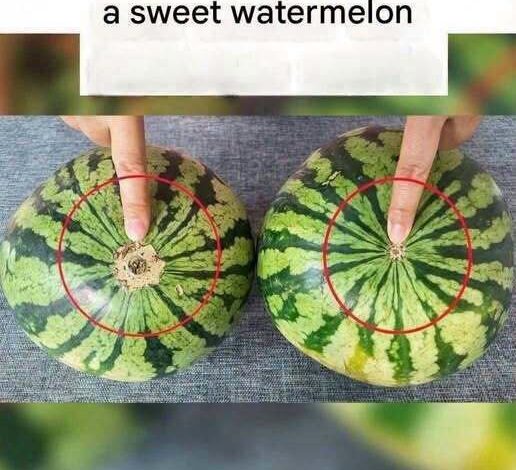
Turn the watermelon over and look for the large patch where it rested on the ground while growing.
This is called the field spot.
A ripe watermelon will usually have a creamy yellow or buttery golden field spot.
If that patch is very pale, white, or barely visible, the melon may have been harvested before reaching full maturity.
Why does this matter?
Because watermelons don’t continue ripening significantly after they’re picked.
Once separated from the vine, what you’ve got is largely what you’re going to eat.
So a well-developed field spot can be a useful sign that the fruit spent enough time growing before harvest.
But don’t stop there.
Pick up the watermelon.
It should feel surprisingly heavy.
When comparing several melons of approximately the same size, choose one that feels heavier than you expected.
That extra weight generally indicates plenty of water inside—which is exactly what you want from a fruit that’s more than 90 percent water.
Think of two watermelons that look nearly identical.
One feels relatively light.
The other makes you instinctively tighten your grip.
The heavier one is often the better bet.
Next, inspect the rind.
You want a watermelon that feels firm all the way around.
Run your hands across it.
Look for obvious damage.
Deep cracks, large bruises, or soft areas can indicate that the fruit has been damaged or has begun deteriorating.
Minor scratches and superficial marks aren’t necessarily a problem.
In fact, some of the ugliest-looking watermelons can be excellent.
Those rough brown lines or patches sometimes called “webbing” or “sugar spots” often attract attention because shoppers assume something is wrong with the fruit.
Usually, cosmetic surface scarring isn’t a reason by itself to reject a watermelon.
But don’t rely on internet claims that more webbing automatically guarantees a dramatically sweeter melon.
Treat it as a secondary clue rather than a sweetness meter.
Shape can help too.
You generally want a watermelon that looks symmetrical for its variety.
It doesn’t have to be perfectly round.
Some excellent varieties are naturally elongated.
What matters more is consistency.
Large irregular bulges or obvious deformities can indicate uneven development.
Then there’s the famous tapping test.
You’ve probably seen shoppers standing beside a watermelon display knocking on melons like they’re checking whether somebody is home.
There’s some logic behind it, but it’s easy to overestimate how reliable the technique is.
A ripe watermelon is often described as producing a deeper, more resonant or hollow sound when tapped.
An underripe or otherwise less desirable melon may sound flatter or denser.
The problem?
Unless you’ve tapped enough watermelons to recognize the difference, “hollow” can be surprisingly subjective.
So don’t make your entire decision based on sound.
Use tapping as one clue alongside the field spot, weight, rind condition, and overall appearance.
If the watermelon still has a piece of stem attached, examine that too.
A dry, brownish stem can be consistent with a mature harvested melon, whereas a very green stem may suggest it was picked relatively recently or before the stem dried naturally.
Again, don’t treat this as an absolute rule.
Commercial harvesting and handling can affect what remains of the stem.
The best approach is to combine clues.
Imagine you’re choosing between three similarly sized watermelons.
The first has a nearly white field spot and feels surprisingly light.
The second has a good yellow field spot but also has a large soft area.
The third has a creamy golden field spot, feels heavy, has a firm intact rind, and looks evenly developed.
Take the third.
No mysterious tapping ritual required.
Once you get your watermelon home, there’s another step that can make it considerably more enjoyable.
Chill it.
Cold watermelon can taste especially refreshing because temperature affects how we experience flavor and texture.
Then wash the outside before cutting.
That may sound unnecessary because you aren’t eating the rind, but your knife passes through the exterior before reaching the flesh.
Cleaning the rind helps reduce the chance of transferring surface contaminants onto the edible portion.
After cutting, look at what you’ve got.
Good watermelon flesh should appear fresh and juicy for its particular variety.
If you notice an unpleasant sour or fermented odor, significant sliminess, mold, or other obvious signs of spoilage, don’t eat it.
And once the melon has been cut, refrigerate the leftovers rather than leaving them sitting out for extended periods.
If you’ve chosen well, though, you probably won’t have much left.
Cold slices are hard to beat on their own.
But watermelon also works beautifully with contrasting flavors.
Try cubes with feta and mint.
Add lime juice.
Use a little chili for heat.
Blend frozen pieces into a slushy drink.
Add watermelon to a summer salad.
Or simply stand over the kitchen sink eating a giant slice while accepting that juice is going to run down both arms.
That’s part of the experience.
So the next time you’re facing a mountain of watermelons at the grocery store, don’t choose randomly.
Remember the easiest checklist:
Look underneath for a creamy yellow field spot.
Compare similar-sized melons and favor the heavier one.
Choose a firm rind without major soft spots, cracks, or serious bruising.
Look for an evenly developed shape.
Use the tapping test only as an additional clue.
And don’t reject a perfectly good melon just because its skin isn’t cosmetically flawless.
There is no method that lets you see through the rind with perfect accuracy.
Nature doesn’t provide guarantees.
But learning these signs can dramatically improve your odds.
And when you finally cut through that thick green rind and reveal crisp, juicy flesh inside, you’ll know your supermarket detective work paid off.
Choosing a watermelon doesn’t have to be a gamble.
Sometimes the sweetest one in the pile has been giving you clues all along.