I almost threw it away.
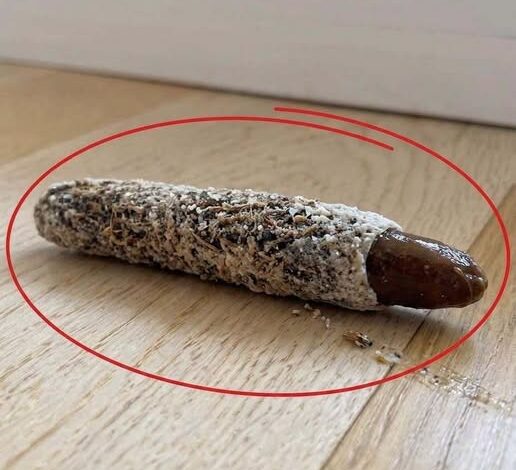
It was stuck to the wall near the corner of the room, a tiny grayish object that looked like a piece of lint, dried mud, or some strange bit of debris the vacuum had somehow missed.
Then it moved.
Not much.
Just enough to make me stop.
I leaned closer.
The little object wasn’t random at all. It had structure—a narrow, tube-like shape covered with tiny fibers, dust, hair, and other particles. It looked almost as though someone had carefully constructed a miniature sleeping bag from whatever could be found around the house.
For the next several minutes, I stared at it.
Was it an insect?
An egg sack?
Something dangerous?
And, perhaps most importantly:
How many more were hiding where I couldn’t see them?
Naturally, I started searching for answers.
The more photographs I compared, the clearer the mystery became.
What I’d found appeared to be the portable protective case made by a case-bearing moth larva, commonly associated with the creature people often call a plaster bagworm or household casebearer.
Suddenly, the strange little tube made sense.
The larva lives inside a case that it constructs around itself.
And the materials?
That’s the fascinating part.
Instead of arriving with a ready-made shell, the tiny creature uses material from its surroundings.
Lint.
Hair.
Dust.
Fibers.
Tiny fragments of debris.
It binds them together into a protective covering that helps conceal and shelter its soft body.
In other words, the thing I’d nearly brushed into the trash wasn’t simply dirt.
It was architecture.
On a scale small enough to overlook, an animal had gathered pieces of my environment and transformed them into a mobile home.
Once I understood that, disgust gave way to curiosity.
I watched more carefully.
The case itself seemed almost motionless, but the larva could extend part of its body from an opening and slowly pull its shelter along behind it.
Imagine carrying your entire house everywhere you went.
No moving boxes.
No rent.
No furniture.
Just a tiny protective structure assembled from whatever the world happened to leave lying around.
Of course, finding these creatures indoors can also tell you something practical about your home.
They tend to do well in places where suitable food and materials accumulate.
Corners.
Closets.
Baseboards.
Garages.
Storage areas.
Behind furniture.
Places where lint, hair, dead insects, spider webs, and other organic material may remain undisturbed.
That explains why regular cleaning can make a difference.
Vacuuming corners and edges removes not only visible cases but also some of the materials and potential food sources that allow these insects to thrive.
Reducing indoor humidity and checking stored natural-fiber fabrics can also be useful, particularly if you’re seeing them repeatedly.
One strange case on a wall isn’t necessarily cause for panic.
But finding many of them is a good reason to inspect the surrounding area more carefully.
Look behind furniture.
Check closets.
Vacuum along baseboards.
Remove old spider webs.
Inspect stored wool or other animal-based fabrics for signs of damage.
What you shouldn’t do is immediately assume you’ve discovered some terrifying new household invader.
That was certainly where my imagination went.
The internet has trained us remarkably well to transform any unidentified bug into a potential catastrophe.
You find something unusual.
You take a photograph.
Five minutes later, you’re convinced your walls need to be demolished.
But identification matters.
Many creatures that wander into or live quietly inside our homes are more nuisance than emergency.
And this particular discovery became fascinating precisely because of how ordinary its materials were.
Look closely at one of the cases and you may see the room reflected back at you.
A thread from fabric.
A strand of hair.
A tiny piece of lint.
Dust.
Fragments so insignificant that we’d never normally notice them.
To us, they’re debris.
To a creature only a few millimeters long, they’re building supplies.
That completely changed the way I looked at the object.
What initially seemed dirty suddenly looked almost ingenious.
The larva doesn’t have hands.
It hasn’t studied engineering.
Nobody teaches it how to construct the case.
Yet instinct directs an elaborate behavior: gather material, bind it together, create protection, carry it along.
Nature is full of structures like this.
Birds weave nests from grass and twigs.
Spiders create intricate webs from silk produced by their own bodies.
Caddisfly larvae build protective cases from sand, stones, and plant material underwater.
Hermit crabs occupy abandoned shells.
And inside our homes, almost unnoticed, another tiny builder can be assembling armor from lint.
The scale is different.
The principle is remarkably familiar.
Find resources.
Build shelter.
Survive.
There’s something humbling about realizing how much life exists beneath the threshold of our attention.
We think we know our homes intimately.
We know which floorboard creaks.
Which cabinet sticks.
Where the sunlight lands in the afternoon.
Then one day, a tiny object moves on the wall and reveals an entire biological story happening inside the same room.
It had probably been there before I noticed it.
That thought fascinated me.
How many times had I walked past?
How many times had I looked toward that wall without actually seeing what was on it?
The creature hadn’t suddenly appeared because I discovered it.
My attention had finally caught up with something already happening.
That may be why these small household mysteries are so compelling.
They remind us that seeing and noticing are different things.
A house isn’t only occupied by the people whose names appear on the paperwork.
There may be spiders behind cabinets.
Tiny insects beneath furniture.
Moths near closets.
Microscopic organisms on surfaces.
Entire ecosystems exist around us at scales we rarely consider.
Most of the time, we encounter them only when something crosses the boundary into visibility.
A web appears.
A moth flies toward a light.
A tiny case crawls across a wall.
Our first instinct is often alarm.
Sometimes alarm is justified. Certain household pests can damage property, contaminate food, bite, sting, or require professional treatment.
But unfamiliar doesn’t automatically mean dangerous.
Sometimes the appropriate response is simply:
Identify it.
Understand it.
Clean the area.
Monitor whether it returns.
That approach is considerably more useful than panic.
After identifying my mysterious visitor, I vacuumed the surrounding corners thoroughly and checked nearby fabrics and storage areas.
The mystery was solved.
Yet I found myself thinking about that tiny structure afterward.
Something I had initially dismissed as trash had been assembled piece by piece.
The materials had no value to me.
The builder saw them differently.
A strand of hair became reinforcement.
Lint became camouflage.
Dust became part of a wall.
Waste became shelter.
There’s a strange elegance in that.
Humans spend enormous resources designing buildings that protect us from the environment.
This tiny creature follows the same fundamental impulse using whatever happens to be lying beneath the sofa.
And perhaps that’s the real reason I couldn’t forget it.
The discovery began with discomfort.
Something strange was inside my home.
Then curiosity replaced fear.
Once I knew what I was seeing, the object stopped being creepy and became evidence of an astonishing survival strategy unfolding on a miniature scale.
That’s worth remembering the next time you discover something unfamiliar in a quiet corner.
Don’t immediately touch it if you don’t know what it is.
Take a clear photograph.
Observe it from a safe distance.
Identify it carefully.
Then decide what action, if any, is actually necessary.
Because sometimes that strange speck on the wall really is just debris.
Sometimes it’s a household pest worth addressing.
And occasionally, it’s something far more interesting:
A tiny animal carrying its entire world on its back, hidden inside a home constructed from the pieces of ours that we forgot were even there.
I nearly threw mine away without a second thought.
Instead, it reminded me to look closer.
Because nature doesn’t stop at the front door.
And sometimes even the dust in the corner has a story living inside it.