For a few seconds, nobody in the studio seemed to know how to react.
The puzzle was sitting there under the lights.
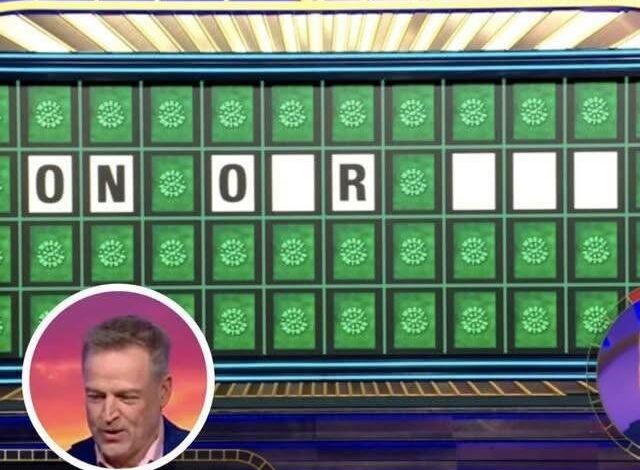
ON OUR WAY
To millions of people watching at home, the answer may have seemed almost painfully obvious.
But contestant Stephen Sporer wasn’t sitting comfortably on a couch.
He was standing on the Wheel of Fortune stage with bright lights in his face, a clock working against him, and tens of thousands of dollars hanging on the next words out of his mouth.
Then the buzzer sounded.
And just like that, the money was gone.
It was the kind of game-show moment that instantly reminds viewers of something easy to forget: solving a puzzle from your living room and solving one while being filmed in front of an audience are two completely different experiences.
But the night’s controversy had actually started earlier.
Contestant Megan Russell had been performing well, creating the feeling that the episode might become one of those satisfying nights when contestants repeatedly outsmart the board.
Then came a puzzle categorized as an Event.
The answer was:
SEEING THE GREEN FLASH
For some viewers, the reaction was immediate.
“What does that even mean?”
The green flash is a real optical phenomenon that can sometimes be observed around sunrise or sunset when atmospheric conditions are right. For people familiar with coastal sunsets, astronomy, or atmospheric phenomena, the phrase may not have seemed unusual.
For plenty of other viewers, however, it sounded incredibly obscure.
And that’s where the argument began.
The problem wasn’t necessarily whether the answer technically qualified as an event.
The debate was about what contestants should reasonably be expected to recognize on a game show built around familiar phrases, titles, places, people, and expressions.
Some fans argued that difficult puzzles are part of the game.
If every answer were immediately recognizable, there wouldn’t be much competition.
Others felt “Seeing the green flash” crossed an invisible line between challenging and obscure.
The category made the frustration worse.
When viewers see Event, many naturally expect something like:
ATTENDING A WEDDING.
WATCHING THE FIREWORKS.
GOING TO A CONCERT.
CELEBRATING A BIRTHDAY.
“Seeing the green flash” sounded different.
Technically possible.
Technically defensible.
But unfamiliar enough that many viewers were suddenly more interested in debating the puzzle writers than watching the contestants.
Social media has transformed moments like this.
Years ago, someone might have yelled at the television, complained to whoever was sitting beside them, and forgotten about the puzzle by morning.
Now thousands of viewers can react simultaneously.
Screenshots circulate.
Clips are replayed.
People search the phrase.
Arguments develop over category definitions.
Within minutes, an ordinary puzzle can become a miniature cultural dispute.
And then Stephen stepped up for the bonus round.
By that point, he had already secured $35,000.
That’s important.
Whatever happened next, he wasn’t walking away empty-handed.
He had played well enough to earn a substantial amount of money.
But game shows are built around the possibility of more.
The bonus round compresses that possibility into a few brutal seconds.
The contestant stands alone.
The wheel is behind them.
The audience can no longer help.
Letters appear.
The clock begins.
Suddenly, something that looks simple from home can become impossible.
Stephen’s puzzle contained the words:
ON OUR WAY
Once enough letters were visible, viewers began recognizing the phrase.
At home, people shouted the answer.
That’s another strange ritual surrounding Wheel of Fortune.
The contestant can’t hear you.
Yet almost everyone watching eventually does it.
“ON OUR WAY!”
You say it louder as the contestant struggles, as though increasing the volume in your living room might somehow transmit the answer through the television.
Stephen kept searching.
The seconds disappeared.
His mind seemed caught somewhere between possibilities.
Then came the sound every contestant dreads.
The buzzer.
Time was up.
The answer was revealed.
And the reaction in the studio felt painfully subdued.
There are game-show losses that make people laugh.
A ridiculous wrong answer.
An accidental pronunciation.
A contestant confidently saying something completely absurd.
This wasn’t one of those moments.
This was uncomfortable because the answer appeared so reachable.
Stephen had been standing inches from it.
That’s often harder to watch than someone missing an impossible puzzle.
Then came the envelope.
The missed prize was worth $40,000.
Suddenly, the buzzer carried considerably more weight.
Stephen had already won $35,000.
But solving that final puzzle could have dramatically increased his total.
That’s the moment viewers replay.
Not because the contestant didn’t know something.
Because almost everyone understands the feeling.
You’ve studied for an exam and forgotten the easiest answer.
You’ve walked out of an interview and immediately realized what you should have said.
You’ve spent ten minutes looking for your glasses while they’re sitting on your head.
Pressure does strange things to the brain.
Knowledge doesn’t always disappear.
Sometimes access to it does.
Psychologists often describe how stress and time pressure can interfere with working memory and flexible thinking.
The harder you try to force an answer, the more stubbornly your brain can remain stuck.
Then the pressure disappears.
And suddenly the answer is obvious.
That’s why viewers should be cautious about calling contestants stupid when they miss seemingly simple puzzles.
The person at home has advantages the contestant doesn’t.
No studio audience.
No production crew.
No cameras.
No host waiting.
No countdown.
And most importantly, no $40,000 attached to the next few seconds.
Remove those conditions and the puzzle becomes recreational.
Add them, and it becomes psychological.
That’s part of what has kept Wheel of Fortune compelling for generations.
The rules are simple enough that almost anyone can participate mentally.
You don’t need specialized trivia knowledge for every puzzle.
You look at letters.
Recognize patterns.
Guess phrases.
From your couch, you become a contestant.
Sometimes you’re faster than the people on television.
That feels great.
But occasionally the show reminds viewers that recognition isn’t always as straightforward as it appears.
The green-flash puzzle demonstrated one kind of difficulty.
Obscurity.
If you’ve never encountered the phrase before, revealing additional letters may not help much.
Stephen’s bonus puzzle demonstrated another.
Pressure.
The phrase may be familiar, but familiarity doesn’t guarantee retrieval when a countdown is running.
Placed in the same episode, those moments created an unusually frustrating combination.
First, viewers questioned whether contestants were being asked to solve something too obscure.
Then they watched a contestant fail to solve something many considered straightforward.
One puzzle felt too difficult.
The other felt too easy to miss.
And somehow both produced the same reaction:
Disbelief.
That contradiction is exactly why game shows remain fascinating.
They look controlled.
The wheel spins.
Letters appear.
Rules are followed.
Money is awarded.
But underneath that structure is something completely unpredictable:
The human brain.
People freeze.
They overthink.
They overlook obvious patterns.
They recognize obscure phrases instantly.
They make brilliant guesses from almost nothing.
And occasionally, they stand beneath studio lights while millions of people know an answer that simply refuses to appear in their mind.
Stephen’s loss wasn’t remarkable because he’d failed to understand the game.
He had already demonstrated that he could play.
He’d won $35,000.
The painful part was how close the additional $40,000 appeared.
A few words.
A few seconds.
One mental connection.
That’s all that separated him from the prize.
But that’s also the cruelty built into the bonus round.
There is no partial credit for almost recognizing something.
The buzzer doesn’t care that the answer might have arrived two seconds later.
Once time expires, it’s finished.
And somewhere afterward, perhaps backstage or on the drive home, there’s a good chance the phrase becomes impossible to stop seeing.
ON OUR WAY.
Three ordinary words.
Words Stephen may never hear quite the same way again.
Still, there’s another number worth remembering.
$35,000.
That’s what he had already earned.
It’s easy for viewers to define someone’s appearance by the money they didn’t win.
Game shows encourage that.
The envelope reveals the alternate ending.
Here’s what you could have had.
Here’s the amount that disappeared.
Here’s the difference between victory and regret.
But the contestant still walks away with what they actually won.
And Stephen had already accomplished something most viewers never will: he stood on that stage, solved puzzles under genuine pressure, reached the bonus round, and left with substantial winnings.
The missed $40,000 makes the better television moment.
The $35,000 tells the fuller story.
As for “Seeing the green flash,” viewers will probably continue arguing about puzzles like it whenever the show ventures beyond familiar expressions.
That’s part of the experience now.
Every puzzle has two audiences.
The contestant trying to solve it.
And the internet deciding whether it was fair.
Sometimes those audiences agree.
Sometimes they don’t.
But episodes like this explain why people keep watching.
You never know when an ordinary collection of blank spaces will produce celebration, controversy, embarrassment, or heartbreak.
One moment you’re confidently shouting answers from the sofa.
The next you’re wondering whether you’d perform any better with the lights on you and thousands of dollars at stake.
Because Wheel of Fortune has always looked like a game about letters.
It isn’t.
Not entirely.
It’s a game about what happens to people when the answer is somewhere inside their heads—
and the clock refuses to wait for them to find it.