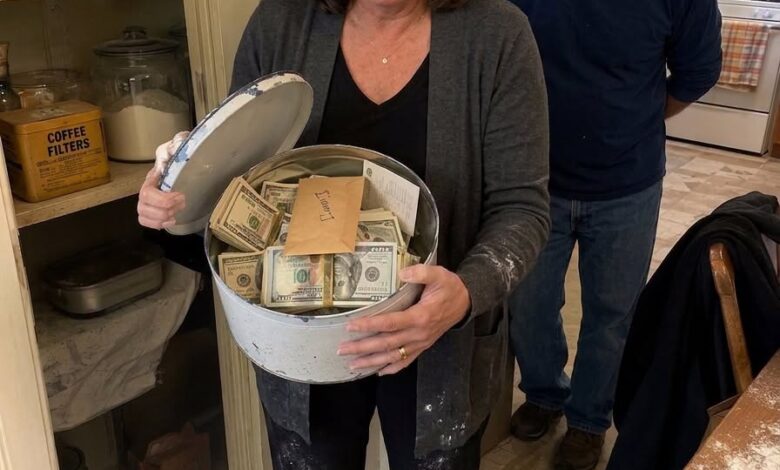
For more than forty years, my mother kept an old flour tin on the highest shelf of her pantry.
We weren’t allowed to touch it.
I finally opened it after her funeral.
Inside was $18,940 in cash—and a letter containing the four words that changed everything I thought I knew about my family.
I’m sorry, Linda.
My mother, Beverly Parrish, kept one of the most organized kitchens I’ve ever seen.
Her pantry was tiny, barely wide enough for two people, but everything had its place. Canned vegetables were arranged by expiration date. Spices sat alphabetically. Baking supplies occupied the middle shelves.
And at the very top was an old white flour tin decorated with a faded blue pattern.
It looked ordinary.
But Mama treated it differently.
I learned that when I was twelve.
One Saturday morning, I was making biscuits and discovered we’d run out of flour in the container beside the stove.
I reached toward the old tin.
“Linda, no.”
Mama’s voice was so sharp that I froze.
She almost never raised her voice.
“I just need flour.”
“Not from there.”
She took the tin from me, returned it to the highest shelf, and brought out another bag.
“What’s in it?”
“Nothing you need.”
That was the end of the conversation.
Five minutes later, she was making me cocoa as though nothing unusual had happened.
That was Mama.
There were invisible boundaries around certain parts of her life.
You learned not to cross them.
You didn’t necessarily learn why.
Decades passed.
I married, became a mother, and built my own life.
The flour tin stayed on that shelf.
Then Mama suffered a stroke.
She was seventy-eight.
Everything happened quickly.
One week I was talking to her on the telephone.
The next, my brother Russell and I were choosing clothes for her funeral.
Afterward, Russell wanted to clear the house immediately.
“I’ve got to get back to Memphis,” he told me. “I can’t stay here another week.”
He took the living room and garage.
I chose the kitchen.
Maybe I wanted to be surrounded by the part of the house that still felt most like her.
I emptied drawers.
Wrapped dishes.
Threw away expired food.
Then I entered the pantry.
There it was.
The flour tin.
For a moment, I was twelve again.
I could almost hear Mama.
Linda, no.
But there was nobody left to stop me.
I reached up.
The tin was surprisingly heavy.
My heart started beating faster before I had any reason to be nervous.
I carried it to the counter and lifted the lid.
There wasn’t a grain of flour inside.
There was money.
Bundles of it.
Twenties.
Fifties.
Hundreds.
Some bills looked decades old. Rubber bands around several stacks had become dry and brittle.
I stared for what felt like minutes.
Then I started counting.
When I finished, I counted again.
$18,940.
But the money wasn’t the thing that made my hands shake.
Beneath the final bundle was an envelope.
My name was written across it in Mama’s handwriting.
Linda.
Russell entered while I was staring at it.
“What did you find?”
I showed him the cash.
His eyes widened.
“Where was that?”
“In Mama’s flour tin.”
Then I showed him the envelope.
His expression changed.
“Probably something she forgot about.”
I knew immediately that wasn’t true.
Mama hadn’t forgotten anything about that tin.
I opened the envelope.
The first line read:
I’m sorry, Linda.
Then came the sentence that rearranged my entire childhood.
I should have told you what Wayne did with your settlement.
I had to sit down.
Wayne was our stepfather.
And suddenly I was seventeen again.
That year, a delivery truck had been involved in an accident that left me badly injured.
I spent weeks recovering.
For months afterward, ordinary things exhausted me.
There were medical appointments, physical therapy, paperwork, insurance representatives, and conversations I barely understood.
Wayne handled everything.
Eventually, he told Mama and me that the insurance company had settled for $42,000.
Most of it, he explained, had gone toward medical expenses.
Whatever remained had supposedly been placed into an account for me.
When I turned eighteen, I asked about it.
Wayne told me additional expenses had emptied the account.
I believed him.
Why wouldn’t I?
I was eighteen years old.
I didn’t understand settlement agreements or financial records.
Wayne was the adult.
So I got a job.
I moved forward.
And I never saw the money.
According to Mama’s letter, almost everything Wayne had told me was a lie.
The actual settlement had been $63,000.
And Wayne had taken it.
Mama didn’t discover the truth immediately.
Years later, she found paperwork he hadn’t meant for her to see.
She confronted him.
He admitted what he’d done.
I stopped reading.
Russell was standing across from me.
“Did you know?”
“No.”
He answered too quickly.
“Russell.”
“I knew something was wrong. I didn’t know this.”
I returned to the letter.
What hurt most wasn’t what Wayne had done.
It was what Mama had done afterward.
Nothing.
She hadn’t told me.
In her letter, she admitted why.
Fear.
Wayne controlled much of the household money. Their marriage was already unstable. She was frightened about losing the house and terrified of what confronting him publicly might do to the family.
But beneath all those explanations was the sentence that mattered:
I chose silence when I should have chosen you.
I cried when I read that.
Not because I hated her.
Because some part of me understood immediately how long she’d probably hated herself for it.
Then the letter explained the flour tin.
After discovering what Wayne had done, Mama started saving.
At first, she quietly took small amounts from money Wayne gave her for household expenses.
She saved portions of tax refunds.
Birthday money.
Christmas money.
Anything she could.
After Wayne eventually left, she kept going.
Twenty dollars here.
Fifty there.
Year after year.
Into the flour tin.
That was why I wasn’t allowed to touch it.
Mama wasn’t hiding flour.
She was trying to repay a debt she knew she could never fully repay.
The $18,940 wasn’t close to what I’d lost, especially after decades.
Mama knew that.
She wrote:
I cannot give you back the years when this money might have changed your life. I can only give you what I managed to save and finally tell you why.
Then came one final instruction.
Take the letter to First County Bank.
Ask for Gerald Watts.
I drove there that afternoon.
The flour tin sat on the passenger seat beside me.
When I gave the receptionist my name, something unexpected happened.
She disappeared into an office.
A few minutes later, a gray-haired man came out.
“Linda Parrish?”
“Yes.”
“I’m Gerald Watts.”
He looked at the tin.
Then at the envelope in my hand.
“I’ve been expecting you.”
Those words sent a chill through me.
He brought me into his office and closed the door.
Then he told me Mama had visited him fourteen months earlier.
Not once.
Several times.
She had brought paperwork.
Settlement documents.
Bank records.
Old statements.
She had explained everything.
Then she’d asked him to keep a folder secure until after her death.
Gerald opened a cabinet.
He placed the folder in front of me.
My name was written on it.
Inside was the proof.
The original settlement agreement showed $63,000.
There were records connected to the account Wayne had controlled.
There were copies of correspondence.
Dates.
Signatures.
Transactions.
Mama had spent more than a year reconstructing what had happened.
Then Gerald handed me another envelope.
On the front, Mama had written:
For Linda, when she is sitting across from Mr. Watts.
I laughed and cried at the same time.
That was so completely Mama.
Even her confession had been organized.
The second letter was shorter.
She didn’t ask me to forgive her.
I’m grateful for that.
She simply told me the truth.
She said she’d spent years imagining the life I might have had if the money had been available when I was eighteen.
Maybe college would have been easier.
Maybe I could have bought a house sooner.
Maybe I wouldn’t have worked two jobs during those first years of adulthood.
She knew she couldn’t repair any of that.
But she wanted me to possess something she’d denied me for decades.
The truth.
Gerald referred me to an attorney.
What followed wasn’t dramatic.
There was no courtroom revelation where someone slammed evidence onto a table.
Real legal and financial disputes move more slowly.
Records had to be requested.
Documents compared.
Questions investigated.
There were frustrating delays and several moments when I wondered whether reopening everything had been worth it.
Months later, the matter was resolved.
Between the eventual settlement and the $18,940 Mama had saved, I received roughly $60,000.
It wasn’t a fortune.
It wasn’t what the original money might have become after all those decades.
But when I saw the final amount in my account, I didn’t think first about Wayne.
I thought about Mama dropping twenty-dollar bills into an old flour tin.
One at a time.
Year after year.
Trying to repair something she was too frightened to confront directly.
When I returned to her house that first afternoon, Russell was sitting at the kitchen table.
He looked exhausted.
“I need to tell you something.”
I sat down.
He admitted he’d overheard arguments between Mama and Wayne when we were younger.
He remembered hearing my name.
He remembered Wayne saying something about money.
He hadn’t understood the details, but he’d known enough to suspect something was wrong.
“Why didn’t you tell me?”
“I was scared.”
There it was again.
The family inheritance nobody had written into a will.
Fear.
Silence.
Avoidance.
“I should’ve pushed harder,” he said.
“You were young.”
“So were you.”
That sentence stayed with me.
For years, we’d survived difficult things by moving around them.
We loved each other.
But love hadn’t automatically made us honest.
Sometimes we’d mistaken silence for peace.
Mama’s final act shattered that pattern.
Not elegantly.
Not in time to save her from responsibility.
But enough to give the rest of us a chance to behave differently.
I put most of the money into an account.
I used some for repairs I’d postponed for years.
I took my daughter on a modest trip we’d always talked about.
And I donated part of it to a scholarship program in Mama’s name.
But I kept the flour tin.
I cleaned it carefully.
The faded blue pattern around the rim was chipped in several places.
Now it sits on my kitchen counter.
Empty.
My daughter once asked why I kept it.
“It’s complicated.”
“Do you forgive Grandma?”
I didn’t know how to answer immediately.
Finally, I said:
“I understand her better than I forgive her.”
My daughter waited.
“Maybe forgiveness starts there. I’m still working on the rest.”
“What do you think she was most afraid of?”
I looked at the tin.
“That I’d think she chose Wayne over me.”
“Did she?”
That question hurt because children sometimes ask the clean questions adults spend decades avoiding.
“In that moment,” I said, “maybe she did.”
My daughter looked surprised.
I continued.
“But people aren’t only the worst decision they ever made. Afterward, she spent years trying to repair it.”
That didn’t erase what Mama had done.
Understanding isn’t erasure.
Forgiveness isn’t pretending.
Love doesn’t require rewriting someone’s mistakes into virtues.
Mama failed me when I needed her courage.
That’s true.
Mama loved me deeply.
That’s also true.
For years, I would have thought those statements couldn’t exist beside each other.
Now I know families are filled with truths that seem contradictory until you live long enough to understand them.
After everything was settled, I found one of Mama’s old recipe cards.
Biscuits.
Her handwriting was faded and stained with flour.
I hadn’t made them in years.
One Sunday morning, I decided to try.
I reached automatically toward the old tin.
Then I stopped.
There was no flour inside.
There never would be again.
I used the new container beside it.
As the biscuits baked, the kitchen began smelling exactly like Mama’s.
For a moment, I could see her standing in that tiny pantry.
I saw myself at twelve, reaching toward the highest shelf.
I heard her voice.
Linda, no.
For most of my life, I’d remembered that moment as my mother keeping something from me.
Now I understood it differently.
She had been keeping something for me.
Money.
Evidence.
Shame.
Responsibility.
And eventually, the truth.
She waited far too long.
I wish she’d told me while we could still sit across from each other and talk about it.
I wish I could have asked questions.
I wish she could have heard my anger instead of leaving me letters to absorb after she was gone.
That became perhaps the most important thing she taught me.
Not through what she did correctly.
Through what she didn’t.
So I started having harder conversations with my daughter.
Russell began doing the same with me.
Months later, he called and told me everything else he remembered.
No excuses.
No minimizing.
Just the truth.
Our relationship didn’t magically become perfect.
Honesty doesn’t erase history.
But it gives people something solid to stand on.
Mama left me almost $19,000 in an old flour tin.
She left documents that helped me recover more.
But those weren’t her greatest gifts.
Her greatest gift was accidentally teaching me what silence costs.
Families pass down more than jewelry, recipes, photographs, and money.
We pass down ways of coping.
Ways of arguing.
Ways of hiding.
We inherit fears we don’t even realize belonged to someone else first.
Unless somebody decides to stop.
Mama couldn’t quite stop while she was alive.
But before she died, she created an opening.
I decided to walk through it.
The flour tin remains on my counter.
Some mornings, it makes me miss her.
Sometimes it makes me angry.
Sometimes I run my fingers across those blue chips and think about all the nights she must have opened it alone.
Twenty dollars.
Another fifty.
A tax refund.
A birthday gift.
Trying to turn regret into something tangible.
The tin is empty now.
Yet somehow it holds more than it ever did when it contained money.
It holds Mama as she really was.
Not a saint.
Not a villain.
A frightened, imperfect woman who made a terrible choice and spent years wishing she’d made another.
A mother who waited too long to speak.
A mother who finally found a way.
And every Sunday, when I make her biscuits, I’m reminded of the lesson she left behind:
Some truths become heavier the longer we hide them.
Some mistakes cannot be undone.
Some opportunities cannot be returned.
But while there is still time, we can speak.
We can apologize.
We can stop passing silence from one generation to the next.
Mama couldn’t put the past back where it belonged.
But she could open the tin.
She could leave me the truth.
And now that truth sits in my kitchen, empty and visible, exactly where nothing in our family has to be hidden anymore.