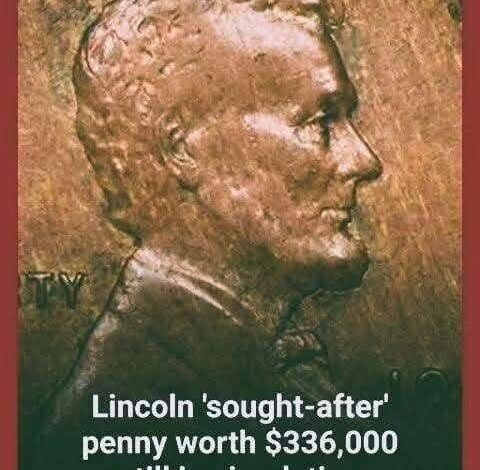
It looked like an ordinary penny.
But in 1943, an ordinary copper-colored penny was something that technically wasn’t supposed to exist.
America was deep in World War II, and copper had become far too important to spend on pocket change. The metal was desperately needed for military equipment, electrical wiring, communications systems, and ammunition.
So the U.S. Mint made a dramatic change.
Instead of the familiar bronze Lincoln cent, pennies dated 1943 were struck primarily from zinc-coated steel.
They looked completely different.
Fresh from the Mint, the new cents had a bright, silvery-gray appearance. To Americans accustomed to brown and copper-colored pennies, they barely looked like cents at all.
Millions upon millions entered circulation.
But somewhere amid the enormous wartime production effort, something went wrong.
A few bronze coin blanks from the previous year’s production apparently remained where they shouldn’t have been.
They were ordinary planchets—the round metal blanks that would become coins—but by 1943, they were made from the wrong metal.
Then the presses started running.
The new 1943 dies came down.
And at least a handful of those leftover bronze blanks were struck.
The result was one of the most famous mistakes in American coin collecting:
the 1943 Bronze Lincoln Cent.
At first, there was nothing particularly dramatic about the moment of creation.
No alarm sounded.
No worker necessarily stopped the machinery.
A tiny number of copper-colored cents simply slipped into an ocean of gray steel coins and disappeared into circulation.
That was precisely what made them so fascinating.
Somewhere in America, an incredibly rare coin could be sitting inside a child’s piggy bank, a cash register, or someone’s pocket.
Stories about copper-colored 1943 pennies soon began spreading.
By the late 1940s, reported examples were attracting serious attention, and the mystery quickly grew into a national collecting obsession.
Children searched their change.
Parents emptied coin jars.
Collectors examined rolls of pennies one by one.
Everyone wanted to discover the impossible cent.
The appeal was easy to understand.
You didn’t need to uncover buried treasure.
You didn’t need access to an exclusive auction.
In theory, all you needed was a penny.
That possibility transformed the 1943 bronze cent into something larger than a minting mistake.
It became a treasure-hunting legend.
And unlike many legends, this one was real.
Genuine examples eventually became some of the most desirable Lincoln cents ever produced.
But their fame created another problem.
Counterfeits.
Lots of them.
A normal 1943 steel cent could be coated with copper to make it appear bronze. Other counterfeiters altered the dates on genuine bronze cents from different years.
That means finding a copper-colored penny dated 1943 does not automatically mean you’ve discovered a fortune.
One simple clue is magnetism.
The standard 1943 steel cent is attracted to a magnet.
A genuine bronze example should not be.
But even passing that test doesn’t prove authenticity. Weight, date characteristics, metal composition, and other details must be examined by knowledgeable professionals or reputable coin-grading services.
And authentication matters enormously.
Because when genuine 1943 bronze cents reach the collector market, the amounts involved can be extraordinary.
Depending on the mint, condition, provenance, and individual specimen, authenticated examples have commanded enormous prices, with exceptional pieces reaching into the hundreds of thousands of dollars and beyond.
All because the wrong blank happened to remain in the wrong place at exactly the right moment.
Yet the value of these coins isn’t only financial.
Look closely at a 1943 bronze cent and you’re looking at a tiny artifact from an enormous historical transformation.
America’s factories were operating at extraordinary intensity.
Every material mattered.
Civilian manufacturing changed.
Families rationed.
Scrap drives collected metal.
Industries reorganized themselves around wartime production.
Even something as ordinary as a penny had to change.
The steel cent was evidence of that sacrifice.
The bronze error was evidence of something else.
Imperfection.
No matter how organized the system, no matter how enormous the machinery, human beings were still operating it.
Things were overlooked.
Old materials remained behind.
Unexpected objects slipped through.
And occasionally, those tiny mistakes survived.
That’s what gives the 1943 bronze cent its unusual emotional power.
It wasn’t deliberately created as a commemorative coin.
Nobody designed it to symbolize World War II.
It became a symbol accidentally.
The gray steel cents represent what America intended to do.
The rare bronze cents represent what happened when reality refused to be perfectly orderly.
More than eight decades later, that accident still sends collectors searching.
Old jars are emptied.
Inherited collections are examined.
Forgotten rolls of pennies are opened.
And whenever someone spots the date 1943 on a copper-colored Lincoln cent, there’s inevitably a moment of excitement.
Could this be one?
Usually, the answer is no.
But the possibility remains.
That’s the remarkable thing about the 1943 bronze Lincoln cent.
Its legend began with something almost unbelievably small—a leftover piece of metal that escaped notice.
A press came down.
Lincoln’s portrait appeared.
And an object that should never have existed entered the world.
Today, surviving genuine examples are treasured not merely because they’re rare or valuable, but because they capture something profoundly human about history.
Wars are remembered through battles, leaders, ships, aircraft, and monuments.
Sometimes, though, history survives in something small enough to disappear between the cushions of a sofa.
A penny.
The wrong penny.
Made from the wrong metal.
Struck in the right year.
And transformed by one unnoticed mistake into one of America’s most enduring numismatic treasures.