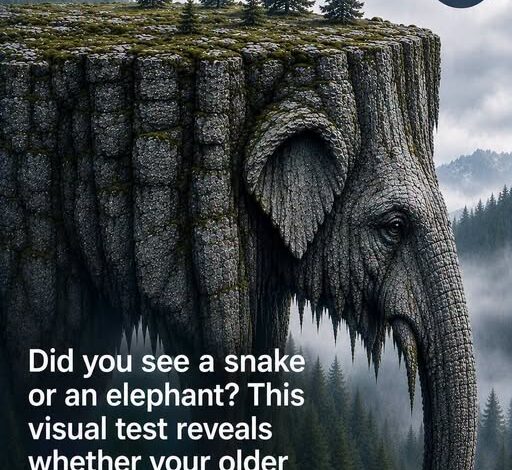
What do you see first?
A snake?
Or an elephant?
For years, images like this have raced across social media accompanied by irresistible promises:
“The first animal you see reveals your true personality.”
See the snake first and you’re supposedly cautious, intuitive, or suspicious.
Notice the elephant and you’re said to be loyal, intelligent, emotionally strong, or dependable.
It sounds fascinating.
There’s just one problem.
The picture probably isn’t revealing a hidden truth about your personality.
It’s revealing something arguably even more interesting:
how your brain creates reality from incomplete information.
Images that can be interpreted in two different ways are known as ambiguous or bistable images.
They’re deliberately designed so the same collection of lines, curves, shadows, and empty spaces can support more than one interpretation.
Nothing physically changes in the picture.
Yet your experience of it can change completely.
One second, the snake seems obvious.
Then suddenly you notice the elephant.
And once that happens, it can become difficult to understand how you didn’t see it before.
Look again and your perception may flip back.
Snake.
Elephant.
Snake again.
The drawing hasn’t moved by a millimeter.
Your brain has.
That’s because human vision isn’t simply a camera recording everything in front of us.
Your eyes collect visual information, but your brain has to organize it.
Which lines belong together?
What is the object?
What is the background?
Where does one shape end and another begin?
What familiar thing does this pattern most closely resemble?
Your brain makes those decisions extraordinarily quickly, usually without you noticing.
Most of the time, that’s useful.
If you had to consciously analyze every edge, shadow, color, and shape before recognizing a coffee cup, another person’s face, or an approaching car, ordinary life would become impossible.
So the brain uses previous experience, expectations, context, attention, and incoming sensory information to construct the most plausible interpretation.
Ambiguous images exploit that system.
They give your brain a puzzle with more than one reasonable answer.
Your attention may initially settle on a particular contour that makes the snake immediately apparent.
Someone else’s eyes may land elsewhere, allowing the elephant to emerge first.
Once your brain commits to one interpretation, other elements of the picture get organized around it.
Then something shifts.
Maybe your eyes move.
Maybe somebody tells you another animal is hidden there.
Maybe you stare long enough for your original interpretation to weaken.
Suddenly, the same lines reorganize themselves.
And there it is.
The second image.
That perceptual switch has fascinated psychologists and neuroscientists because it demonstrates an important principle:
Seeing is an active process.
We don’t experience the external world as untouched raw information.
Our brains continuously interpret that information.
That doesn’t mean reality is imaginary.
It means perception requires processing.
The famous Rubin vase provides another example.
Depending on how you organize the image, you may see a vase in the center or two faces looking toward each other.
The Necker cube produces a similar effect. Its orientation seems to reverse even though the drawing remains completely unchanged.
These illusions allow researchers to investigate attention, visual awareness, figure-ground organization, and other aspects of perception.
But somewhere between the psychology laboratory and social media, something else happened.
Ambiguous images became personality tests.
“See this first? You’re a genius.”
“Notice this animal? You’re secretly afraid of commitment.”
“Only highly creative people spot the hidden figure.”
Those claims can be entertaining.
They shouldn’t automatically be mistaken for psychological science.
A meaningful personality assessment requires considerably more than attaching personality labels to whichever object someone happens to notice first.
Researchers would need evidence that the test reliably produces consistent results and that those results actually correspond with the personality characteristic being claimed.
Without that evidence, the interpretation is essentially a story attached to an optical illusion.
Seeing the snake first doesn’t prove you’re dangerous, suspicious, anxious, analytical, or unusually intelligent.
Seeing the elephant doesn’t establish that you’re loyal, compassionate, patient, or emotionally mature.
Sometimes you simply saw the snake first.
And that’s enough.
Because the genuine phenomenon is already remarkable.
Think about what happens when the image flips.
The physical picture hasn’t changed.
The light reaching your eyes may be virtually identical.
Yet your conscious experience becomes different.
Something that was almost invisible seconds earlier suddenly becomes impossible to miss.
That tells us far more about human perception than an arbitrary personality label ever could.
It also offers a small reminder about everyday life.
Attention matters.
Expectations matter.
Context matters.
Two people can receive the same visual information and initially organize it differently—not because one is necessarily smarter or better, but because perception is an active negotiation between sensory information and the brain interpreting it.
So the next time an online image asks:
“What did you see first?”
Go ahead and answer.
Snake.
Elephant.
Whatever appeared.
Just be skeptical when someone immediately claims that your answer reveals your deepest fears, your intelligence level, or the hidden architecture of your personality.
The illusion doesn’t need that mythology to be extraordinary.
The truly astonishing part is happening inside your head.
A few lines sit perfectly still on a screen.
Your brain examines them.
It builds an elephant.
Then, without the outside world changing at all, it tears that interpretation apart and builds a snake.
That’s not a secret personality test.
It’s a tiny demonstration of one of the most remarkable things the human brain does every waking second:
It doesn’t merely receive the world.
It interprets it.