Most people see purslane growing between garden plants and have exactly one reaction:
Pull it out and throw it away.
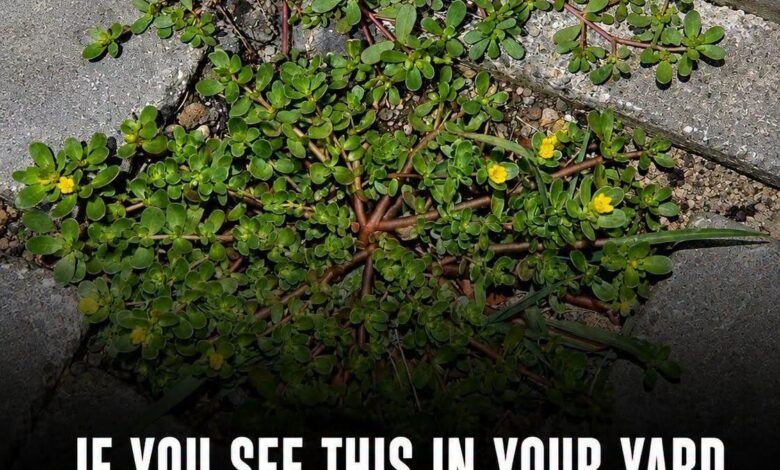
It creeps close to the ground, spreading fleshy green leaves across flower beds, vegetable gardens, driveways, and even cracks in sidewalks. It doesn’t look impressive. It doesn’t grow tall or produce spectacular flowers. To an inexperienced gardener, it can seem like nothing more than another stubborn weed competing for space.
But before tossing purslane into the compost pile, it may be worth taking a closer look.
Because this humble plant has something surprising hiding inside those thick little leaves.
Purslane, commonly known as Portulaca oleracea, is an edible plant that has been eaten in different parts of the world for generations. Despite its reputation as a garden nuisance, it contains an unusual nutritional profile for a leafy green.
One of its most interesting characteristics is its natural content of omega-3 fatty acids.
Omega-3s are commonly associated with foods such as fatty fish, walnuts, flaxseed, and chia seeds. Finding them in an ordinary leafy plant growing close to the soil can therefore come as a surprise.
Purslane primarily contains alpha-linolenic acid, or ALA, a plant-based omega-3 fatty acid. While plant-derived ALA isn’t identical to the EPA and DHA commonly found in fish, it can still contribute to a varied and nutritious diet.
And omega-3s aren’t the only reason purslane deserves attention.
The plant also provides a mixture of vitamins, antioxidants, and minerals, including magnesium, potassium, and calcium.
Those nutrients perform important jobs throughout the body.
Potassium plays a role in normal muscle and nerve function and helps support healthy blood-pressure regulation.
Magnesium participates in hundreds of biochemical processes and contributes to normal muscle, nerve, and energy function.
Calcium is best known for its importance to bones and teeth, but it is also involved in muscle contraction and nerve signaling.
Purslane also contains antioxidant compounds, adding another reason this seemingly insignificant plant has attracted interest as a food.
But perhaps the most remarkable thing about purslane isn’t what’s inside it.
It’s where it manages to survive.
Walk through a perfectly maintained garden and you may find it growing along the edges.
Look beside a driveway and it may appear there too.
It can thrive in dry, disturbed soil where more delicate plants struggle.
Its fleshy leaves help it retain moisture, allowing it to tolerate conditions that would quickly stress many other greens.
That toughness is partly why gardeners can become frustrated with it.
Pull it out, and another patch seems to appear.
Ignore it, and it spreads.
But the same qualities that make purslane persistent also make it fascinating.
Here is a plant capable of surviving heat, drought, footsteps, poor soil, and repeated attempts to remove it—and yet it continues producing edible leaves.
Once correctly identified and gathered from a safe location, purslane can also be surprisingly easy to use in the kitchen.
Its leaves and tender stems have a crisp texture and a slightly tangy, sometimes mildly lemony flavor.
Fresh purslane can add crunch to salads.
It can be chopped and mixed with other greens.
It can be stirred into soups or stews.
It can also be lightly cooked and incorporated into simple vegetable dishes.
However, there’s an important distinction between discovering an edible plant and immediately eating something growing beside the road.
Wild plants should never be consumed unless they have been positively identified.
Some plants can resemble edible species while being unsuitable or dangerous to eat. If identification is uncertain, an experienced local forager, horticulturist, or reliable botanical guide should confirm it first.
Location matters too.
Purslane growing beside a heavily traveled road, on chemically treated lawns, near contaminated soil, or in areas sprayed with pesticides or herbicides shouldn’t automatically be considered safe simply because the species itself is edible.
The best option is purslane grown intentionally for food or harvested from a clean area where its history is known.
And like virtually every nutritious food, purslane isn’t a miracle cure.
Eating a handful won’t suddenly prevent disease, erase nutritional deficiencies, or replace medical treatment.
Its value is much simpler—and more believable.
It’s another nutritious food that can contribute to a balanced diet.
Yet there is something almost poetic about where we find it.
We spend enormous amounts of time and money cultivating plants we consider valuable.
We fertilize them.
Water them.
Protect them.
Build raised beds for them.
Then purslane appears without being invited, surviving on almost nothing, and our first instinct is often to destroy it.
Perhaps that’s because we learned to recognize it as a weed before we learned anything else about it.
And “weed” is an interesting word.
It doesn’t describe a scientific category of plant.
Usually, it simply describes a plant growing somewhere humans don’t want it.
Change the location—or our understanding—and suddenly the nuisance becomes food.
That’s what makes purslane such a wonderful example of how easily value can hide in plain sight.
The next time you notice those small, fleshy leaves spreading across the edge of a garden, you may still decide to remove them.
But perhaps you won’t look at them quite the same way.
Because sometimes the difference between a weed and a treasure isn’t the plant at all.
It’s knowing what you’re looking at.