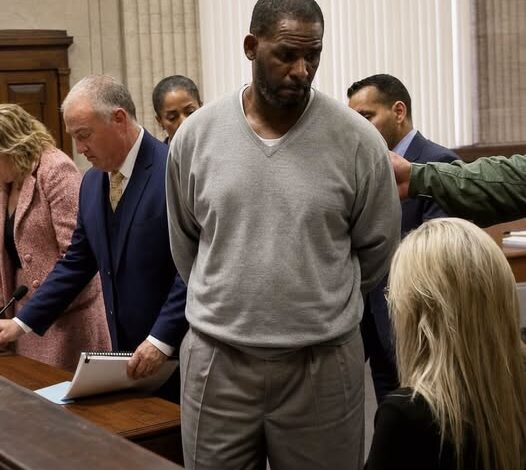
For a man already facing decades behind bars, a mysterious phone number was enough to make his world even smaller.
R. Kelly reportedly found himself removed from the general prison population and placed in special housing after officials discovered a phone number during a search of his cell.
The number was reportedly connected to a retired prison employee.
That discovery immediately raised questions.
Why did Kelly have it?
Had he been communicating with someone he wasn’t supposed to contact?
Was a former employee helping him circumvent prison rules?
Or was there a far less dramatic explanation?
Inside a federal correctional institution, questions like those aren’t treated casually.
Something that might appear insignificant outside prison—a name, a phone number, a scrap of paper—can trigger an investigation when officials believe it could point to unauthorized communication, contraband, or an inappropriate relationship.
Kelly was moved into special housing while officials investigated.
And suddenly, an already notorious federal inmate was at the center of another story.
Outside the prison walls, speculation spread quickly.
Inside, Kelly faced a far more immediate reality.
Isolation.
Special housing can radically change an inmate’s daily existence. Access to other prisoners, recreation, programs, communication, and ordinary movement can become severely restricted depending on the circumstances.
For someone accustomed to general population, the psychological difference can be enormous.
Kelly’s attorneys reportedly challenged the move and raised concerns about his treatment.
Then came the reversal.
According to reports, an internal review cleared Kelly of wrongdoing related to the phone number, and he was returned to the general population at Federal Correctional Institution Butner.
The development didn’t erase his convictions.
It didn’t shorten his sentence.
And it certainly didn’t rewrite the crimes for which he was prosecuted.
But it did resolve, at least according to those reports, the specific question that had triggered his removal from the prison’s ordinary population.
Kelly’s circumstances today are dramatically different from the life he once knew.
For decades, Robert Sylvester Kelly was one of the most commercially successful figures in R&B.
His songs filled radio stations.
His concerts attracted huge audiences.
His work earned major awards and generated enormous wealth.
But allegations surrounding his treatment of girls and women followed him for years, eventually becoming the focus of major criminal prosecutions.
In 2021, a federal jury in New York convicted Kelly of racketeering and violations of the Mann Act after prosecutors presented evidence describing a long-running system through which he and people around him facilitated sexual abuse and exploitation.
He was sentenced in 2022 to 30 years in federal prison.
A separate federal prosecution in Chicago produced additional convictions and a 20-year sentence, with most of that term ordered to run concurrently with the New York sentence.
That means Kelly’s incarceration is measured not in months but decades.
Against that backdrop, the dispute over a phone number might seem minor.
Inside prison, however, minor details can carry enormous consequences.
The difference between general population and special housing can reshape nearly every hour of an inmate’s day.
General population does not mean freedom.
It means returning to the institutional routines shared with other prisoners.
Meals.
Counts.
Recreation.
Movement between permitted areas.
Interactions with other inmates.
Programs and other activities available under prison rules.
It’s still incarceration, but it’s a profoundly different experience from spending much of the day isolated in a cell.
Kelly’s reported return therefore changes his immediate conditions without changing the larger reality awaiting him.
He remains a federal prisoner serving an extraordinarily long sentence.
That distinction matters because celebrity prison stories can easily become distorted.
A change in housing status can sound like a legal victory.
It isn’t the same thing.
Being cleared in an internal disciplinary matter does not overturn a criminal conviction.
Returning to general population does not mean release is approaching.
And a dispute about prison conditions does not erase the evidence underlying the convictions that put someone there.
What it does illustrate is how quickly life can change inside a correctional institution.
For most people, possessing an unexplained phone number would be meaningless.
Inside prison, it can be enough to raise suspicions and trigger scrutiny.
One moment, an inmate may be following the familiar routine of his housing unit.
The next, that routine can disappear.
That may be the most striking element of Kelly’s latest chapter.
He once lived in a world where entourages, recording studios, luxury travel, and screaming audiences were ordinary.
Now something as small as a telephone number can determine whether he spends his days around other prisoners or separated from them while officials investigate.
The contrast is difficult to ignore.
Yet Kelly’s return to general population should not be romanticized.
Federal prison remains a tightly controlled and potentially difficult environment.
The rhythms of daily incarceration bring their own tensions, relationships, rules, and risks.
For a celebrity inmate whose identity is widely known, navigating that environment can carry additional complications.
But isolation carries a different burden.
Whatever one thinks of Kelly personally, prolonged separation from ordinary human interaction is psychologically significant.
That is why prison housing decisions matter independently from questions of guilt.
Punishment imposed by a court and conditions imposed administratively inside a prison are not identical issues.
In Kelly’s case, the reported internal review ultimately determined that the phone-number incident did not justify continuing to hold him under those conditions.
So he returned.
Not to a stage.
Not to a studio.
Not to the celebrity life that once surrounded him.
To general population.
The gates remain locked.
The sentence remains.
The convictions remain.
Only the conditions of his everyday existence have shifted.
And perhaps that is what makes the episode so revealing.
Prison reduces life to boundaries most people rarely think about.
A telephone call.
A meal.
A few hours outside a cell.
A conversation with another human being.
The ability to walk into a common area.
Things that once would have seemed insignificant can suddenly become the architecture of an entire day.
For R. Kelly, the mysterious phone number reportedly turned that already restricted existence into an even narrower one.
Now that the inquiry has reportedly cleared him in that particular matter, one restriction has been removed.
But the larger consequence of his past remains unchanged.
He is back among the prison population.
And barring a major change in his legal circumstances, that—not the world of fame he once occupied—is where the long years ahead will continue to unfold.