Hayden Panettiere’s neighbor describes horrific scene inside apartment block after she had an apparent overdose

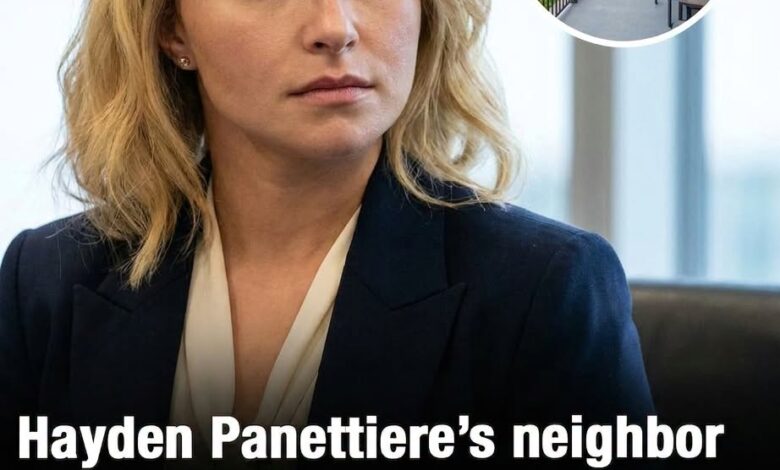
By morning, Judson Mill Lofts looked almost ordinary again.
That may have been the strangest part.
Cars moved through the parking lot. Doors opened and closed. Residents walked dogs, carried coffee, checked their phones, and headed toward another ordinary day in Greenville.
But everyone who had been there the afternoon before knew something had changed.
For hours, police vehicles had occupied the complex.
Officers came and went.
Paramedics moved quickly toward one apartment.
Neighbors watched from windows and balconies, trying to understand an emergency unfolding only a few doors away.
Nobody seemed to know exactly what had happened.
Then came the kind of silence that usually means the worst has already occurred.
Inside the apartment, first responders had been trying to save a 36-year-old woman.
For them, her identity would have mattered far less than her condition.
Celebrity disappears quickly in an emergency.
There is no television star lying on the floor.
No famous face.
No childhood icon.
There is a patient.
Someone whose heart needs to beat.
Someone who needs to breathe.
Someone whose life has suddenly narrowed to seconds.
They worked.
The minutes passed.
Outside, residents continued watching emergency workers move through a building they normally associated with deliveries, neighbors, barking dogs and the familiar rhythms of home.
Eventually, the attempts to save the woman ended.
Two men were later seen sitting near officers.
They weren’t speaking for cameras.
They weren’t giving interviews.
They simply appeared devastated.
That image stayed with people.
Because grief often looks nothing like it does in movies.
There isn’t always screaming.
Sometimes there are just two people sitting down because standing has become too difficult.
Sometimes there is a phone clutched in one hand.
A stare fixed on nothing.
A sentence started and abandoned.
A person waiting for reality to become less impossible.
The police presence continued into the evening.
Residents returned home and walked past it.
Some asked questions.
Others knew enough not to.
Then information began moving through the complex.
A woman had died.
She was young.
Investigators were involved because the death was sudden.
There was no immediate indication of foul play.
The cause had not yet been established.
Those were the facts people had.
They weren’t enough to satisfy curiosity.
They were enough to create dread.
Then came the name.
Hayden Panettiere.
For a generation of viewers, the name immediately carried images with it.
The little girl from Remember the Titans.
Claire Bennet in Heroes.
Juliette Barnes in Nashville.
Kirby Reed in the Scream franchise.
For residents of Judson Mill Lofts, however, something strange happened to those memories.
The celebrity suddenly became local.
Not metaphorically close.
Physically close.
She had been inside their building.
Behind one of those doors.
Only feet from hallways they walked every day.
Some neighbors hadn’t even realized she was there.
That can happen in apartment communities.
People occupy the same structure without truly knowing one another.
You recognize someone’s dog before you know their name.
You know which car belongs to which unit.
You exchange nods near the elevator.
You hear footsteps overhead.
Lives exist beside one another separated by walls thin enough to hear movement but thick enough to preserve mystery.
Then something happens.
An ambulance arrives.
Police block part of the property.
A neighbor doesn’t come back outside.
Suddenly everyone becomes painfully aware of how much life had been unfolding just beyond their own front door.
For people who had never met Hayden, the news created an uncomfortable kind of intimacy.
They hadn’t known her.
Yet now they knew where her life had ended.
That knowledge changes a place.
A hallway becomes the hallway paramedics rushed through.
A parking space becomes where police vehicles stood.
An apartment door becomes difficult not to notice.
People begin reconstructing the previous day.
Did I hear something?
Did I see her?
Was that person walking across the parking lot connected to what happened?
Could anyone have known?
These questions are natural.
They’re also dangerous when allowed to outrun evidence.
Sudden deaths create information vacuums.
Famous sudden deaths create enormous ones.
Within hours, social media can begin producing explanations long before investigators or medical professionals have completed their work.
An old photograph becomes evidence.
A previous interview becomes a clue.
Past struggles become a ready-made explanation.
Every gap attracts a theory.
But a person’s history is not automatically the cause of whatever happened to them later.
And until reliable findings establish what happened, uncertainty should remain uncertainty.
If investigators say there is no immediate sign of foul play, that is meaningful.
It is not the same thing as knowing the cause of death.
Those are different questions.
Patience rarely survives well online.
Grief requires it anyway.
Behind the public curiosity was a family receiving calls nobody ever wants.
A father learning his daughter was gone.
A child confronting the loss of her mother.
Friends realizing conversations they expected to continue never would.
People who had known Hayden without makeup, scripts or publicity schedules suddenly watching strangers discuss her final hours.
That is the part celebrity coverage can easily forget.
The public loses a performer.
Families lose a person.
Those losses overlap, but they are not equal.
Hayden had spent almost her entire life being observed.
She entered entertainment as a child.
By adulthood, millions of people had watched her face change over the years.
They had seen her play vulnerable characters, powerful characters, damaged characters and survivors.
The irony was that the woman behind them was navigating struggles audiences couldn’t fully see.
In later years, she became increasingly open about difficult parts of her life.
Addiction.
Postpartum depression.
Treatment.
Trauma.
Motherhood.
Grief.
She resisted the polished fantasy that professional success automatically produces personal peace.
That honesty made some people feel closer to her.
It also made her vulnerable to something uglier.
Once a public figure discusses personal struggles, people sometimes begin treating those disclosures as permanent explanations for everything that happens afterward.
That is unfair.
A human being is not a collection of old headlines waiting to become evidence.
Hayden’s past deserves context.
Her final hours deserve facts.
The two should not be carelessly fused.
At Judson Mill Lofts, the emotional reality was simpler.
A woman had been alive inside one of those apartments.
Then an emergency occurred.
People tried to save her.
They couldn’t.
Everything after that became aftermath.
Police procedure.
Phone calls.
Statements.
Questions.
Grief.
Residents went to sleep knowing someone had died nearby.
They woke knowing her name.
That transformation—from anonymous tragedy to famous tragedy—changed how outsiders viewed the scene.
Television crews and online audiences might see a celebrity death location.
Neighbors still saw home.
That’s another strange burden placed on places where famous people die.
An ordinary location becomes symbolic overnight.
But for the people who live there, the laundry still needs doing.
Packages still arrive.
Someone still forgets to take the trash out.
Children still run through hallways.
Life continues around the exact location where another life stopped.
There is something unsettling about that.
We expect tragedy to permanently alter the physical world.
Usually it doesn’t.
The sun rises.
Traffic continues.
Lights turn on in neighboring apartments.
That’s what makes death feel so surreal.
The world refuses to visually acknowledge what has happened.
By the following morning, the emergency vehicles were no longer the center of the property.
But residents carried the previous day’s images with them.
The officers.
The paramedics.
The waiting.
The two men sitting outside.
The realization that whatever they had witnessed could not be reversed.
Some residents may have known Hayden only through television.
Others perhaps didn’t recognize the name immediately.
But fame wasn’t necessary to understand the central fact.
Thirty-six is young.
Young enough that tomorrow usually feels guaranteed.
Young enough that people speak naturally about next year.
The next project.
The next birthday.
The next trip.
The next phone call.
Sudden death destroys that assumption.
It takes a future everyone casually expected and removes it without negotiation.
That is why people search so urgently for explanations.
If we can understand exactly why something happened, perhaps we can restore a sense that life follows rules.
Sometimes investigation provides that clarity.
Sometimes medicine does.
But even an eventual explanation cannot answer the emotional question hiding underneath:
How can someone simply be here, and then not?
There is no forensic answer for that.
There is only grief.
For fans, grief took the form of old clips and messages.
They returned to Claire Bennet.
The indestructible cheerleader.
A character whose body repeatedly repaired itself after impossible injuries.
They returned to Juliette Barnes, complicated and wounded, demanding to be loved while often fighting herself.
They returned to Kirby.
They returned to childhood performances.
Press play, and suddenly Hayden was alive again.
That’s one of film and television’s strange gifts.
Recorded performances preserve movement.
A smile remains exactly where it was.
A voice says the same sentence.
A character walks into the same room.
The actor never ages inside that scene.
For a few minutes, loss becomes temporarily negotiable.
Then the episode ends.
The screen goes dark.
Reality returns.
Perhaps that is why the residents’ experience feels so different.
Fans have screens between themselves and Hayden.
The people at Judson Mill Lofts have walls.
They know that the tragedy happened on the other side of something physically ordinary.
A door.
A hallway.
A ceiling.
A shared building.
It can make mortality feel frighteningly close.
But there is another lesson in that proximity.
We rarely know what is happening behind the doors around us.
The neighbor we pass may be celebrating.
Grieving.
Recovering.
Terrified.
Lonely.
Calling someone they love.
Waiting for medical results.
Having the best day of their life.
Having the worst.
Most of it remains invisible.
That doesn’t mean we should become suspicious of every closed door.
Perhaps the opposite.
It should make us gentler about what we assume.
Because proximity is not knowledge.
Seeing police outside an apartment doesn’t tell you the whole story.
Knowing someone’s past doesn’t explain their final hours.
Recognizing a famous name doesn’t mean you knew the person.
And uncertainty isn’t an invitation to invent whatever explanation feels most dramatic.
Eventually, investigators may provide clearer answers about what happened inside that Greenville apartment.
Those findings should be allowed to arrive through evidence rather than speculation.
Until then, the most responsible response is also the most human one.
Acknowledge what is known.
Respect what isn’t.
And remember the life before becoming consumed by its final minutes.
Because Hayden Panettiere was not merely the woman behind one apartment door.
She was decades of experiences before that afternoon.
A child who grew up on sets.
An actress who became recognizable around the world.
A daughter.
A sister who endured devastating loss.
A mother.
A performer who gave audiences characters they carried for years.
A woman who publicly acknowledged struggles many people endure privately.
A person still becoming whoever she hoped to become next.
No investigation can summarize that.
No cause-of-death report can.
Those documents answer specific questions.
They do not measure a life.
By the next evening, Judson Mill Lofts would continue returning to normal.
That’s what places do.
New residents will eventually arrive.
Furniture will move.
Cars will change.
Seasons will pass over Greenville.
The hallways will fill with different conversations.
But for those who were there that day, certain sounds may remain.
Sirens approaching.
Footsteps moving quickly.
Doors opening.
Then the quiet after everyone realized there was nothing more to be done.
Perhaps that is the image worth holding carefully.
Not as something macabre.
As something human.
Behind every celebrity headline, there eventually comes a moment when fame becomes irrelevant.
A room.
A handful of people.
Someone trying to help.
Someone waiting outside.
Someone receiving an unbearable phone call.
And afterward, silence.
For one afternoon in Greenville, a woman known by millions became simply someone’s daughter, someone’s mother, someone’s friend, and someone’s patient.
The world would soon turn her death into news.
Inside that building, it had already become something much simpler.
A loss.