Five Teenagers Died After Driving the Wrong Way on a Motorway—The Family They Hit Is Still Fighting to Recover

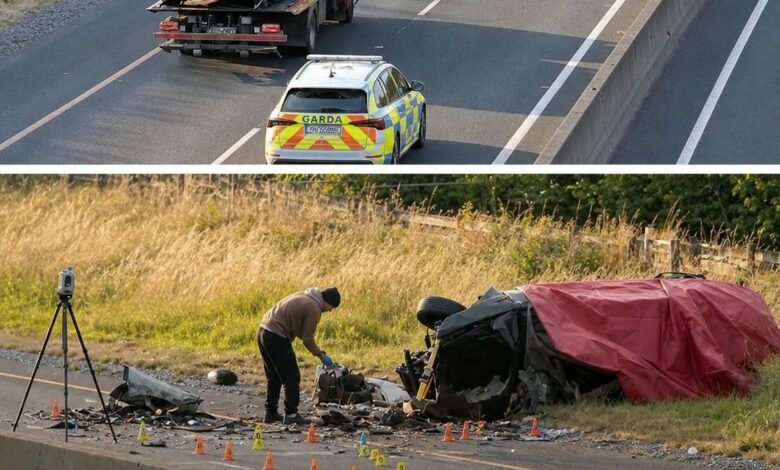
The road looked ordinary again by morning.
Traffic moved past.
Headlights swept across the tarmac.
People drove to work, carried children to school, stopped for coffee, complained about delays.
But for several families, that stretch of road would never be ordinary again.
Because only hours earlier, a few minutes of wrong-way driving had transformed strangers into permanent parts of one another’s lives.
Some would never come home.
Others would wake beneath hospital lights wondering whether their bodies—or their families—would ever feel the same.
That is the part dramatic footage rarely captures.
A crash happens in seconds.
Its consequences can last for generations.
Online, incidents like this often become compressed into a handful of images.
A damaged vehicle.
Flashing blue lights.
A road closed behind police tape.
Perhaps a video recorded shortly before impact.
Then come the reactions.
Anger.
Disbelief.
Speculation.
People replaying the footage and asking the same question:
What were they thinking?
Sometimes there is no satisfying answer.
Recklessness can look almost incomprehensible afterward because consequences make everything suddenly obvious.
From the safety of hindsight, every warning sign screams.
Slow down.
Turn around.
Stop.
Think.
But the people inside the moment do not yet know what the next minute contains.
That doesn’t excuse dangerous choices.
It explains why consequences can arrive before wisdom does.
A driver makes one decision.
Then another.
The road keeps coming.
Adrenaline rises.
Someone laughs.
Someone encourages them.
Perhaps somebody records it.
What initially feels daring begins feeding itself.
Turning back starts to feel embarrassing.
Stopping means admitting the whole thing was foolish.
So the vehicle continues.
And somewhere ahead is another family.
They know nothing about the decisions approaching them.
They haven’t agreed to participate.
They aren’t part of the joke.
They aren’t chasing attention.
They are simply traveling.
Maybe someone is looking out the window.
Maybe a parent is thinking about what needs to be done tomorrow.
Maybe a child is asleep.
Maybe the conversation inside the car is so ordinary that nobody will remember what was being discussed until, afterward, they would give anything to return to it.
Then headlights appear where headlights should never be.
Confusion comes first.
The brain needs a fraction of a second to understand something impossible.
That car is facing us.
Then instinct.
Brake.
Turn.
Brace.
Protect the child.
And suddenly there is no ordinary journey anymore.
There is impact.
Metal folds with horrifying efficiency.
Glass breaks.
Airbags explode.
Objects become projectiles.
Bodies are thrown against restraints designed to save them.
Then silence.
Or screaming.
Or both.
The people who arrive next are trained for catastrophe.
Gardaí.
Paramedics.
Firefighters and other emergency personnel.
They do not get the luxury of reacting like everyone watching later.
They have jobs to perform.
Secure the road.
Assess hazards.
Reach the injured.
Determine who needs help first.
Call for additional resources.
Control traffic.
Preserve evidence.
Contact hospitals.
Begin the terrible administrative process that follows when somebody cannot be saved.
Professionalism can make these scenes look mechanical from the outside.
They aren’t.
Emergency workers are human beings operating inside circumstances most people spend their lives avoiding.
They notice details.
A shoe in the road.
A phone still illuminated.
A child’s belongings inside a damaged vehicle.
A relative asking the same question repeatedly because shock has made every answer impossible to absorb.
Those images don’t necessarily disappear when the shift ends.
Some travel home.
Meanwhile, ambulances begin moving.
Inside them, the crash becomes medicine.
Blood pressure.
Oxygen.
Pain.
Breathing.
Bleeding.
Consciousness.
Every injury becomes a problem requiring immediate decisions.
At the hospital, another team is waiting.
Emergency physicians.
Nurses.
Surgeons.
Radiographers.
Anesthetists.
Specialists.
People whose names the injured family may never remember clearly, even though those strangers are about to fight for their future.
Clothing is cut away.
Scans are ordered.
Blood is drawn.
Relatives wait beside phones.
Someone is taken into surgery.
Someone else is moved to intensive care.
The language becomes clinical because it has to.
Fracture.
Internal injury.
Trauma.
Operation.
Stabilization.
Observation.
But behind every clinical word is a human consequence.
A fractured leg isn’t merely a line on an X-ray.
For a child, it can mean fear, surgery, casts, physiotherapy, missed school, sleepless parents, and the frightening discovery that walking—something once automatic—may have to be learned with confidence all over again.
Recovery doesn’t understand headlines.
It happens slowly.
One painful movement at a time.
The first attempt to sit up.
The first time standing.
The first step with assistance.
Another scan.
Another appointment.
Another night when pain interrupts sleep.
Another parent saying, “You’re doing great,” while privately wondering how much longer their child will hurt.
Some injuries heal visibly.
Bruises fade.
Stitches come out.
Bones knit.
Scars soften.
But families can carry another kind of injury.
A fear of headlights.
A sudden panic when another vehicle drifts too close.
Silence when passing the location of the crash.
A child asking whether every car journey is dangerous now.
A parent gripping the steering wheel harder without realizing it.
Trauma does not always announce itself dramatically.
Sometimes it becomes a new habit.
A new route home.
A reluctance to drive at night.
A flinch.
A nightmare.
A sentence that begins:
“Ever since the crash…”
For the families of those who died, there is another reality entirely.
There is no rehabilitation schedule.
No hopeful scan.
No milestone where doctors announce that healing is progressing well.
There is absence.
Someone has to make the phone calls.
Someone has to tell grandparents.
Friends discover messages that will never receive replies.
A bedroom remains exactly as it was left.
Shoes stay by a door.
A charger remains plugged into a wall.
There may be unfinished plans written in a calendar.
Clothes waiting in a washing basket.
Food someone bought expecting to eat later.
Death is enormous in theory.
In a home, it often reveals itself through tiny abandoned objects.
That is where public discussion can become painfully inadequate.
Online, people may reduce the dead to the choice that preceded the crash.
They were reckless.
They were foolish.
They should have known better.
Perhaps those judgments contain truth.
Choices have consequences.
Dangerous driving can devastate innocent people, and acknowledging that is not cruelty.
But accountability does not require stripping the dead of humanity.
A terrible decision can coexist with a lifetime of other things.
They were someone’s child before they became a headline.
Someone knew their laugh.
Someone remembers their first day of school.
Someone had argued with them over something trivial and expected another chance to make peace.
Someone still has their number saved.
Grief does not become smaller because the person who died contributed to the circumstances of their death.
Sometimes it becomes more complicated.
Anger joins sorrow.
Parents may love someone desperately while hating the decision that killed them.
Friends may replay earlier conversations searching for the moment when they could have intervened.
Why didn’t I stop them?
Why didn’t I call?
Why didn’t they listen?
Those questions can torture people precisely because the past cannot answer.
Then there are the innocent injured.
Their families may carry anger of a completely different kind.
They didn’t make the dangerous choice.
Yet their bodies paid part of its price.
That unfairness can be difficult to absorb.
One stranger’s decision can create another stranger’s medical history.
That may be the most sobering truth about reckless driving.
Risk is rarely contained to the person taking it.
A driver may believe:
It’s my life.
But roads are shared spaces.
Your decision enters other people’s vehicles.
Their children.
Their bodies.
Their futures.
That is why driving carries responsibilities far beyond personal bravery.
A car can feel private from inside.
Music playing.
Doors closed.
Friends talking.
But the moment it enters a public road, every decision interacts with strangers.
Speed becomes shared risk.
Distraction becomes shared risk.
Impairment becomes shared risk.
Wrong-way driving becomes shared risk.
The person making the choice does not get to choose who receives the consequences.
That randomness is what makes these tragedies so frightening.
An innocent family does everything normally.
Seat belts fastened.
Ordinary route.
Ordinary evening.
Then someone else’s decision arrives through the windshield.
Afterward, people naturally search for meaning.
Perhaps there was an online trend.
Perhaps there was peer pressure.
Perhaps there was an attempt to impress someone.
Perhaps there was simply catastrophic judgment.
Investigators have to separate evidence from assumption.
That distinction matters.
Viral narratives grow quickly after tragedy.
Facts grow slowly.
Gardaí must reconstruct what actually occurred.
Vehicle movements.
Road conditions.
Witness accounts.
Phone evidence where relevant.
Camera footage.
Timelines.
Physical evidence from the scene.
The purpose is not to create the most dramatic explanation.
It is to establish the most accurate one.
Families deserve that accuracy.
So do the injured.
So do the dead.
Because speculation has its own consequences.
A rumor posted casually can become part of a family’s grief before investigators have even finished their work.
The internet wants conclusions immediately.
Investigations cannot responsibly operate that way.
Eventually, however, the cameras leave.
The road reopens.
The footage stops circulating.
Another story replaces it.
This is the strange rhythm of public tragedy.
For everyone else, the event becomes something that happened.
For the families involved, it becomes the calendar around which life is reorganized.
Before the crash.
After the crash.
Before the phone rang.
After the phone rang.
Before the hospital.
After the hospital.
The internet may forget within days.
A child’s body remembers during months of rehabilitation.
A parent remembers every time the family gets into a car.
Emergency workers may remember years later when another scene looks unexpectedly similar.
And somewhere another family sets one fewer place at the table.
This is why the most important lesson cannot simply be:
Don’t do something stupid for attention.
That is true, but too small.
The deeper lesson is about the distance between an action and its consequences.
Young people especially can experience danger as temporary.
A few seconds of excitement.
A story to tell tomorrow.
A clip people will share.
But consequences do not respect the intended duration of the stunt.
You can make a ten-second decision that creates a fifty-year grief.
You can chase a minute of attention and give a stranger years of rehabilitation.
You can turn the wheel once and divide multiple families into permanent versions of before and after.
There is nothing glamorous about that.
No amount of views can make it worthwhile.
No applause survives the hospital corridor.
No trend sits beside a parent waiting for a surgeon.
No viral clip attends the funeral.
The people do.
That is what remains after spectacle collapses.
People.
The mother beside the hospital bed.
The father answering phone calls he never expected to receive.
The sibling staring at an empty room.
The nurse encouraging another painful step.
The Garda who has to knock on a door.
The paramedic who remembers the scene afterward.
The child learning that recovery is measured in centimeters before it is measured in kilometers.
And perhaps, eventually, healing.
Not forgetting.
Not pretending the event somehow happened for a reason.
Simply learning how to carry what cannot be changed.
For the injured, that may mean returning to school.
Walking independently.
Getting back into a car without panic.
Discovering that the body can become trustworthy again.
For grieving families, healing may mean something quieter.
Laughing without immediately feeling guilty.
Speaking the person’s name without collapsing.
Accepting that love for someone can survive anger at what they did.
Understanding that grief is not a problem to solve but a relationship with absence that changes over time.
There may never be a neat ending.
Real tragedies rarely provide one.
There is only the road afterward.
A road traveled by people who never asked to become symbols.
That is why their humanity matters more than the spectacle surrounding the crash.
The story should not become entertainment.
It should become memory.
A warning carried forward.
When someone suggests the reckless shortcut.
When a driver is tempted to impress passengers.
When a phone comes out and suddenly ordinary stupidity begins feeling like a performance.
When turning back feels embarrassing.
Remember the hospital.
Remember the operating theatre.
Remember the families.
Remember that embarrassment lasts minutes.
Consequences can last forever.
And remember the innocent vehicle coming the other way.
You cannot see the people inside yet.
You don’t know their names.
You don’t know where they’re going.
But their lives are every bit as important as yours.
That should be enough reason to stop.
Long after the footage disappears, the road will still be there.
Cars will pass over the same tarmac.
Rain will wash away the physical evidence.
Traffic will resume its ordinary rhythm.
Most drivers will never know exactly where everything happened.
But somewhere, a person may still touch a scar on their leg.
Somewhere, a parent may still stare at an old photograph.
Somewhere, an emergency worker may still remember that night with uncomfortable clarity.
The moment ended in minutes.
Its consequences did not.
That is the true cost of reckless driving.
Not the wrecked vehicles.
Not the police tape.
Not the viral outrage.
It is the ordinary life that was supposed to happen afterward—and never got the chance.