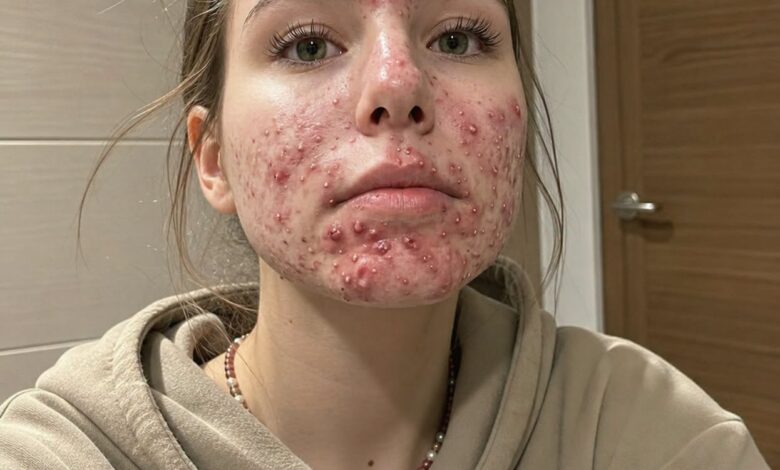
You wake up, walk to the mirror, and there it is.
Again.
Another painful bump along your chin.
Maybe it’s deep beneath the skin.
Maybe several smaller pimples have appeared around your mouth and jawline.
Maybe you’ve been treating the same area for weeks, only to watch one blemish disappear as another forms beside it.
And perhaps the most frustrating part is your age.
You thought acne was supposed to end years ago.
It doesn’t always.
Adult acne is common, and breakouts concentrated around the chin and jawline can have several possible contributors. Hormonal changes are one of them, but the location of a pimple alone cannot tell you exactly what is happening inside your body.
That’s an important distinction.
Your skin can provide clues.
It cannot perform blood tests.
Still, recurring chin acne is worth paying attention to, especially when it appears alongside other changes.
Hormones Can Play a Major Role
Hormones influence the sebaceous glands that produce oil.
Androgens in particular can increase sebum production and contribute to clogged pores and inflammation.
That is one reason some adults notice acne changing with their menstrual cycle.
A familiar pattern may emerge.
Skin looks relatively calm.
Then, in the days surrounding a period, tender bumps begin developing along the lower face.
The cycle repeats the following month.
Hormonal fluctuations can also occur during other stages of life.
Starting or stopping certain forms of hormonal contraception can change acne patterns.
Pregnancy can alter the skin.
Perimenopause and menopause bring substantial hormonal changes as well, although everyone’s skin responds differently.
And sometimes persistent acne appears alongside symptoms that deserve medical evaluation.
Polycystic ovary syndrome, or PCOS, is one example.
Acne alone does not mean someone has PCOS.
But if persistent acne occurs with symptoms such as irregular periods or increased facial or body hair, discussing the overall pattern with a healthcare professional may be worthwhile.
The key is not to diagnose yourself from your chin.
Look at the whole picture.
Stress Can Show Up on Your Skin
Then there is stress.
Most people recognize the experience.
Everything becomes overwhelming.
Sleep deteriorates.
Meals become irregular.
Then your skin seems to join the rebellion.
Stress involves hormonal and inflammatory responses that may worsen acne in some people.
But stress also changes behavior.
You’re tired, so you fall asleep wearing makeup.
You touch your face while working.
You eat differently.
You abandon the skincare routine that had been working.
You sleep poorly.
One stressful week can therefore affect your skin through several pathways at once.
Then the breakout creates more stress.
You examine it.
Touch it.
Cover it.
Search for treatments.
Check it again.
Now acne itself has entered the stress cycle.
Breaking that cycle sometimes begins with something remarkably unexciting:
Leave it alone.
Especially don’t squeeze deep, painful pimples.
Picking may increase inflammation and raise the risk of discoloration or scarring.
Your fingers are rarely the treatment your acne needs.
Don’t Try to Scrub Acne Away
A breakout can create a powerful urge to clean harder.
Surely, you think, if the pores are clogged, the solution is to scrub everything until it feels perfectly clean.
So you wash again.
Use hotter water.
Add an exfoliating scrub.
Then toner.
Then acids.
Then another treatment.
Your face starts burning.
You interpret the burning as evidence that the products are working.
It may actually mean your skin is irritated.
Acne isn’t simply dirt trapped in the skin.
Aggressive scrubbing cannot bully your pores into behaving.
Instead, excessive cleansing and irritating products may damage the skin barrier and make an already inflamed face feel worse.
Gentle consistency usually beats punishment.
A mild cleanser is enough for many people.
Wash according to your skin’s needs, particularly after sweating, without repeatedly scrubbing throughout the day.
Use lukewarm rather than painfully hot water.
Pat rather than attack your face with a towel.
Your skincare routine should not feel like disciplinary action.
Look at What Touches Your Chin
Sometimes the most useful clues are sitting directly in front of you.
Literally.
Your phone.
Think about how often it travels between your hands, desks, bags, counters, and face.
Cleaning it regularly is reasonable hygiene, particularly if it frequently touches your skin.
Then look at your hands.
Do you rest your chin in your palm while working?
Do you repeatedly touch the same area when concentrating?
Do you pick at tiny bumps without realizing it?
Friction, pressure, and repeated touching may aggravate susceptible skin.
The same principle applies to things such as helmets, straps, masks, or other equipment that repeatedly rubs against the lower face.
The solution isn’t to become terrified of everything touching your skin.
It’s simply to notice patterns.
If breakouts consistently appear exactly where something rubs, that information is useful.
Your Hair Products May Be Visiting Your Face
Hair products don’t always remain politely on your hair.
Conditioners.
Styling creams.
Oils.
Pomades.
Leave-in treatments.
They can migrate onto surrounding skin, especially around the hairline, neck, or face.
If you’re prone to breakouts, look for products labeled non-comedogenic or otherwise formulated with acne-prone skin in mind when appropriate.
The same applies to makeup and skincare.
“Heavy” doesn’t automatically mean bad, and “natural” doesn’t automatically mean safe for acne.
Marketing language can be misleading.
What matters is whether a product works for your skin without contributing to clogged pores or irritation.
And don’t forget makeup removal.
Sleeping in cosmetics once isn’t going to destroy your face forever.
Making it a regular habit, however, may not help acne-prone skin.
Give your skin a clean surface before bed.
What About Pillowcases?
Pillowcases receive a lot of blame online.
Sometimes too much.
Changing bedding regularly is sensible hygiene, particularly if you sweat heavily or use hair and skincare products that transfer onto fabric.
But don’t convince yourself that one imperfectly washed pillowcase is secretly responsible for months of persistent hormonal acne.
Acne is multifactorial.
There is rarely one villain hiding in your bedroom.
The same skepticism should be applied to towels.
Clean ones are sensible.
Constantly disinfecting everything around you as though acne were evidence of contamination is unnecessary.
Acne does not mean you are dirty.
That idea has caused enough shame already.
Food Is More Complicated Than “Chocolate Causes Pimples”
Diet and acne generate enormous amounts of confident advice.
The reality is more nuanced.
Research suggests that high-glycemic dietary patterns may worsen acne for some people, and dairy—particularly certain types—has also been investigated for possible associations.
That does not mean everyone with chin acne should immediately eliminate dairy, sugar, carbohydrates, gluten, coffee, chocolate, and everything else they enjoy.
Association is not the same as universal cause.
Food affects people differently.
If you suspect a particular dietary pattern is consistently associated with your breakouts, keep a simple record and discuss significant dietary changes with an appropriate healthcare professional or dietitian when needed.
Don’t turn your face into a reason to fear food.
A sustainable eating pattern that supports overall health is more useful than an extreme “acne detox.”
Your liver and kidneys already handle detoxification.
Your chin does not require a juice cleanse.
Build a Routine Your Skin Can Actually Tolerate
When acne appears, people often buy several treatments at once.
This creates a problem.
If the skin improves, you don’t know what worked.
If the skin becomes irritated, you don’t know what caused it.
A simpler routine makes troubleshooting easier.
Start with the foundation:
A gentle cleanser.
A moisturizer appropriate for your skin.
A non-comedogenic sunscreen during the day.
Then, if appropriate for you, consider an evidence-based acne treatment.
Common acne ingredients include benzoyl peroxide and salicylic acid.
Topical retinoids such as adapalene are another important option for many acne patients.
But more is not necessarily better.
Using multiple irritating treatments simultaneously can turn mild acne into angry skin plus acne.
Introduce treatments thoughtfully.
Follow product directions.
Give them time.
And remember that some acne medications and ingredients require special consideration during pregnancy or when trying to become pregnant, so discuss treatment choices with a healthcare professional if that applies to you.
Acne Treatments Need Time
This may be the least satisfying skincare advice in existence:
Wait.
People understandably want a product that makes a deep chin breakout disappear overnight.
Acne biology doesn’t always cooperate.
Treatments often require consistent use over weeks before meaningful improvement becomes obvious.
That creates a dangerous window.
You use something for four days.
Nothing dramatic happens.
You abandon it.
Buy another product.
Use that for a week.
Switch again.
Soon your bathroom contains twelve half-empty bottles and your skin has experienced six different routines in a month.
Consistency gives a reasonable treatment the opportunity to work.
Take occasional photographs under similar lighting if you want to track progress.
Daily mirror inspection can make gradual improvement difficult to notice.
Sleep Matters, but Don’t Turn It Into Another Source of Stress
Sleep affects overall health and interacts with stress, behavior, and inflammatory processes.
Getting adequate, consistent sleep is therefore a reasonable part of caring for yourself.
But avoid turning sleep into another perfection contest.
You don’t need a flawless nighttime routine to earn clear skin.
Aim for sustainable habits.
A reasonably consistent bedtime.
Less doom-scrolling when possible.
Enough time for rest.
A bedroom environment that helps you sleep.
If your life is stressful, skincare cannot compensate for every source of strain.
Sometimes the most useful thing you can do for your face is something that doesn’t come in a bottle.
Go outside.
Move your body.
Eat.
Sleep.
Talk to somebody.
Give your nervous system periods when it doesn’t have to remain on alert.
None of these habits guarantees acne-free skin.
They simply support the person whose skin you’re trying to treat.
Know When Home Treatment Isn’t Enough
There is no prize for suffering through acne alone.
Consider seeing a dermatologist or another qualified healthcare professional when acne is persistent, severe, painful, causing scars or significant dark marks, worsening despite appropriate over-the-counter treatment, or affecting your quality of life.
Professional treatment can include stronger topical medications, oral medicines, hormonal approaches for appropriate patients, and other options tailored to the type and severity of acne.
A clinician can also help determine whether something that resembles acne is actually another skin condition.
That matters because not every cluster of bumps around the mouth or chin is ordinary acne.
Treating the wrong condition aggressively can make matters worse.
Similarly, if acne arrives alongside significant menstrual changes, unusual hair growth, or other symptoms suggesting a hormonal issue, mention all of them.
Don’t divide your body into unrelated departments.
The dermatologist needs to know about your cycle.
The gynecologist may need to know about your skin.
The complete pattern can matter.
And Please Stop Blaming Your Face
Adult acne can feel uniquely unfair.
At sixteen, you’re told you’ll grow out of it.
Then you’re thirty, forty, or beyond, standing beneath unforgiving bathroom lighting with a painful pimple on your chin and wondering whether your skin missed the announcement.
There is nothing immature about adult acne.
There is nothing unhygienic about it.
And there is nothing morally superior about having clear skin.
Skin is an organ.
It responds to hormones, genetics, inflammation, medications, environment, products, behavior, and countless other variables.
Sometimes it behaves beautifully.
Sometimes it doesn’t.
Neither outcome says anything profound about your worth.
Treating acne should therefore come from care rather than disgust.
You aren’t trying to punish your skin into becoming acceptable.
You’re trying to understand what it needs.
Maybe that means changing a product.
Maybe it means introducing an evidence-based treatment.
Maybe it means leaving your chin alone instead of touching it all afternoon.
Maybe it means speaking with a dermatologist.
Maybe it means investigating a hormonal pattern.
Often it means several small changes maintained consistently rather than one dramatic cure.
And sometimes the first useful change is simply looking into the mirror differently.
Not:
“What’s wrong with my face?”
But:
“What pattern am I seeing, and what can I do about it?”
That question creates room for observation instead of shame.
Your chin isn’t betraying you.
It also isn’t sending a mystical coded message that can be decoded from a social-media face map.
It’s skin.
Complicated, responsive, occasionally frustrating skin.
Listen to the patterns.
Treat it gently.
Use treatments supported by evidence.
Ask for professional help when you need it.
Then give your skin something people rarely give themselves when a problem is visible:
time.
Clearer skin may come gradually.
Confidence can begin sooner.
Because feeling at home in your face shouldn’t have to wait until the last pimple disappears.