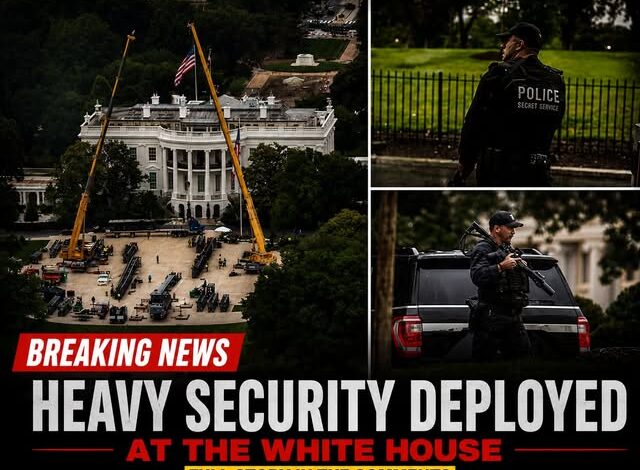
For a few chaotic minutes, the illusion of absolute security around the White House fractured in full public view.
The White House is designed to project permanence and control — layers of fencing, surveillance, armed agents, restricted airspace, rehearsed emergency protocols. To most Americans, it exists psychologically as one of the safest places on earth, protected not only by physical barriers but by the symbolic weight of the presidency itself.
That is precisely why moments of violence near its perimeter feel so destabilizing.
When witnesses described a gunman pacing near 17th Street before pulling a pistol and firing toward Lafayette Square, the scene transformed instantly from ordinary Washington routine into something far more primal:
fear,
confusion,
survival instinct.
People often imagine attacks against highly secured government locations unfolding like carefully choreographed action films. In reality, eyewitness accounts from these moments usually sound fragmented and chaotic:
shouts overlapping,
sirens arriving before understanding,
people ducking instinctively without knowing where danger actually is.
Tourists who moments earlier were taking photographs suddenly scattered in panic. Journalists dropped behind camera risers and barricades. Secret Service radios erupted with overlapping commands while agents reacted within seconds to neutralize the threat near Gate 17.
That speed matters because White House security operates under a philosophy shaped by worst-case scenarios. Agents cannot assume hesitation is safe. Every armed individual approaching the perimeter potentially represents catastrophic national danger:
an assassination attempt,
mass casualty attack,
coordinated assault,
or diversion for something larger.
So response protocols become immediate and overwhelming.
To bystanders, that intensity can feel surreal.
One moment:
tour buses,
reporters preparing live shots,
pedestrians crossing streets normally.
The next:
rifles drawn,
streets sealed,
agents screaming instructions,
people ordered to shelter in place.
Inside the press corps, the reaction reportedly reflected that abrupt psychological shift perfectly. Correspondents accustomed to covering politics as structured routine suddenly became part of the emergency itself. Phones kept recording while reporters were rushed toward secure briefing areas under lockdown conditions.
That detail is emotionally significant because journalism around the White House often creates an atmosphere of controlled familiarity. Reporters spend years moving through the same gates, briefing rooms, and security checkpoints daily. Over time, even highly fortified spaces begin feeling routine.
Violence shatters that familiarity instantly.
Suddenly everyone remembers that the White House is not only a workplace or tourist landmark.
It is a potential target.
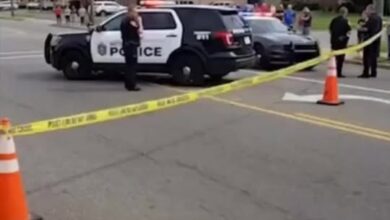
Outside the immediate perimeter, Washington transformed rapidly into a heavily militarized scene:
flashing lights reflecting across government buildings,
armored vehicles moving into position,
federal agents canvassing nearby blocks,
streets filling with officers carrying long guns.
The FBI’s rapid involvement underscored the seriousness with which incidents near the presidency are treated. Even when attackers appear to act alone initially, federal agencies immediately investigate broader possibilities:
political motivation,
mental health crisis,
organized extremism,
foreign influence,
copycat behavior,
or coordinated threats not yet visible publicly.
In moments like these, investigators are racing against uncertainty itself.
Who was the shooter?
Why there?
Why now?
Was anyone else involved?
Was the White House truly the intended target, or simply symbolic backdrop for a larger personal breakdown?
Those questions matter because attacks near seats of power carry meaning beyond physical harm alone. They are often designed—whether consciously political or psychologically chaotic—to puncture perceptions of stability and security.
And perhaps the most unsettling part of the story lies in the contrast between ordinary governance and sudden violence unfolding simultaneously.
According to reports, the president stated he was inside the White House at the time, working on diplomatic efforts tied to a fragile peace process.
That juxtaposition feels almost painfully symbolic:
inside,
officials discussing international stability and conflict resolution;
outside,
gunfire echoing through the streets surrounding the presidency itself.
Modern political life increasingly operates under this atmosphere of layered tension:
global diplomacy alongside domestic instability,
public ceremony alongside security threats,
normal governance interrupted constantly by crises erupting without warning.
The emotional impact on witnesses also lingers long after physical danger ends.
People caught unexpectedly near shootings often describe sensory memories remaining unusually vivid afterward:
the sound of shots echoing differently than expected,
the confusion of not immediately understanding what was happening,
the sight of armed officers suddenly moving at full speed.
For tourists especially, such incidents can become psychologically disorienting because they violate assumptions attached to iconic national spaces. Visiting the White House is supposed to feel symbolic, historical, civic. Violence intruding into that environment alters how people remember the experience permanently.
Importantly, events like this also reignite broader conversations about security and public life in America.
The United States occupies a unique cultural relationship with political violence:
assassinations,
attempted assassinations,
mass shootings,
threats against officials,
and increasingly polarized public rhetoric all shape national anxiety.
Security around government institutions has expanded enormously over decades precisely because the line between symbolic anger and physical violence can become frighteningly thin under certain conditions.
Yet even the most fortified systems cannot eliminate unpredictability entirely.
That reality unsettles people because it reveals something uncomfortable:
absolute security does not truly exist, even at the center of power.
For a few minutes, one armed individual managed to force lockdowns, trigger federal emergency response, terrify civilians, and interrupt the ordinary rhythm surrounding the presidency itself.
And afterward, as investigators piece together motive and timeline, the country is left confronting the same haunting tension that follows many acts of public violence:
how fragile the boundary can be between ordinary routine and sudden chaos.
One second, reporters prepare evening broadcasts.
Tourists pose for photographs.
Officials negotiate policy inside illuminated rooms.
The next, radios crackle,
sirens scream,
and people run for cover outside one of the most recognizable buildings in the world.
Then eventually the streets reopen.
Barricades move.
News cycles shift forward.
But for those who heard the shots echo near the White House gates that night, the memory remains:
the brief terrifying realization that even places built to symbolize stability can suddenly feel exposed,
human,
and frighteningly vulnerable.