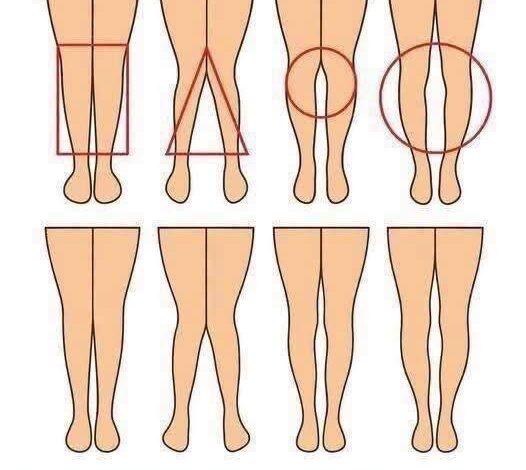
The shape of our legs tells a story that began long before we ever took our first steps. Long before exercise routines, fashion trends, or social media comparisons entered the picture, our bodies were already following a blueprint written by genetics, growth, and the natural architecture of our skeleton. Whether your thighs touch when you stand, your knees angle slightly inward, or your calves curve in a particular way, these features are usually the result of how your body developed—not something you chose or something that defines your worth.
Much of what we notice in the mirror is determined by factors beyond our control.
Bone structure influences the width of the hips, the alignment of the knees, and the spacing between the legs. Joint positioning, muscle attachment points, and inherited body proportions all contribute to the unique shape each person carries throughout life. These natural differences are not flaws waiting to be corrected. They are simply part of the remarkable variety found in the human body.
Exercise certainly plays an important role, but its influence has limits.
Strength training, walking, cycling, dancing, and other forms of physical activity can build muscle, improve balance, increase flexibility, and enhance overall mobility. These changes may refine the appearance of the legs and improve how they function, but they cannot alter the underlying framework created by your bones and joints. Understanding that distinction can help replace unrealistic expectations with healthier, more achievable goals.
Rather than trying to force every body into the same ideal, it is far more meaningful to appreciate what your legs allow you to do.
They carry you through busy mornings, long workdays, family adventures, quiet evening walks, and countless ordinary moments that often go unnoticed. They support you when you stand, help you explore new places, and make movement possible in ways that are easy to take for granted until something limits that ability.
The choices we make every day also become part of that story.
The clothes we wear express our personality. The posture we practice can influence comfort and confidence. The activities we enjoy—whether it’s running through a park, practicing yoga, dancing to favorite music, hiking mountain trails, or simply taking peaceful walks through the neighborhood—shape not only our physical strength but also our relationship with our own bodies.
Over time, those experiences leave their own signature.
Strong muscles reflect hours of activity.
Flexible joints speak to consistent movement.
Steady balance grows from practice.
Each person’s body becomes a record of how they have lived, learned, adapted, and cared for themselves.
Perhaps the most important change, however, happens in the way we think.
When we stop viewing our legs as problems to solve or imperfections to hide, something quietly shifts. Comparison begins to lose its power. The pursuit of impossible standards gives way to a deeper appreciation for health, resilience, and function.
Instead of asking whether our legs resemble someone else’s, we begin asking far more meaningful questions.
Are they strong enough to support the life I want to live?
Do they allow me to move with comfort and confidence?
Am I caring for them through regular movement, balanced nutrition, and rest?
Those questions focus on well-being rather than appearance, encouraging habits that benefit both body and mind.
Beauty standards continue to change across generations, but the value of a healthy, capable body remains constant. Every person’s legs are shaped by a unique combination of genetics, life experiences, and daily choices, making them as individual as fingerprints.
In the end, our legs are far more than physical features reflected in a mirror.
They are the foundation beneath every journey, every accomplishment, and every ordinary day. They carry our history, support our present, and move us toward whatever comes next.
When we learn to appreciate them not for how closely they match an ideal, but for the strength, balance, and freedom they provide, self-criticism gradually gives way to gratitude.
And in that quiet change of perspective, our legs no longer feel like something that needs to be judged or corrected.
They simply do what they have always done.
They carry us forward, one step at a time.