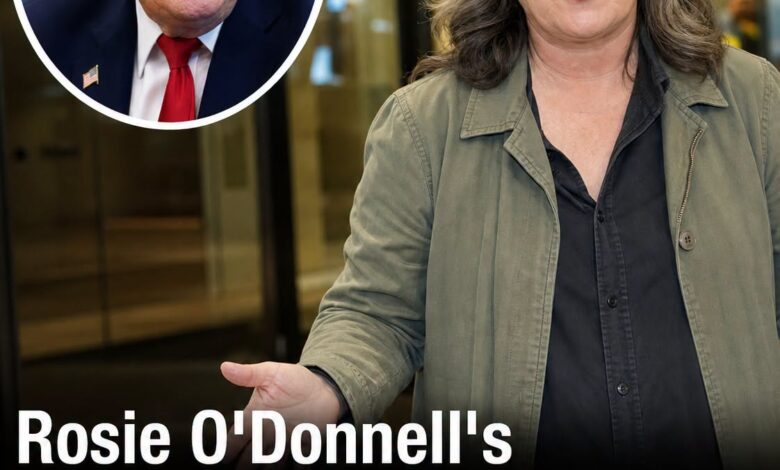
Rosie O’Donnell did not respond as though Donald Trump had merely insulted her.
She responded as though he had confirmed everything she had been warning about for years.
There was no carefully lawyered statement.
No attempt to lower the temperature.
No polite appeal for everyone to respect their differences.
Instead, O’Donnell reached for the weapon that has defined her long-running feud with Trump almost as much as his own attacks have:
Ridicule.
She posted a photograph showing Trump with Jeffrey Epstein and described the president as “rattled.” Then she turned the exchange into something larger than the latest chapter of a celebrity grudge.
She described herself in deliberately provocative terms—a loud, queer mother unwilling to remain silent—and contrasted that identity with her own accusations about Trump’s character.
The message was unmistakable.
If Trump wanted another fight, she was not going to hide.
But underneath the insults was a much more serious argument.
Who gets to decide whether an American belongs?
That question had become particularly charged because O’Donnell was no longer living in the United States.
She had moved to Ireland and spoken about pursuing Irish citizenship through her grandparents.
To critics, the move offered an easy punch line.
If America was so terrible, she had left.
To O’Donnell, that interpretation completely missed the point.
She did not frame her departure as rejection of the country she had spent most of her life calling home.
She framed it as a response to what she believed the country was becoming.
In her telling, leaving was not surrender.
It was refusal.
She was unwilling, she said in effect, to stand quietly while the America she recognized was transformed around her.
Whether one finds that explanation courageous, melodramatic, privileged, or some combination of all three depends heavily on how one already views Trump.
And that is exactly why their feud has survived for so long.
Trump and O’Donnell are almost perfectly designed to antagonize each other.
Both are famous.
Both understand television.
Both know how to generate a headline.
Neither has historically shown much interest in responding to a personal attack with restrained silence.
And both understand the power of a nickname.
Trump built an enormous part of his political communication style around reducing opponents to memorable labels.
O’Donnell learned to answer in the same language.
“Mango Mussolini.”
It is not an argument about executive authority.
It is not constitutional analysis.
It is mockery designed to stick.
And on Jimmy Kimmel Live!, O’Donnell leaned into that role completely.
She appeared in a bright pink floral suit, visually refusing the image of someone frightened into silence.
She joked.
She attacked.
She discussed her decision to leave the United States.
She referenced Project 2025 as part of the political environment that alarmed her.
Then she did something perfectly suited to a feud born in television and sustained by attention.
She looked directly into the camera.
“Hi! I know you’re watching.”
The audience laughed.
But the line carried another message.
You don’t scare me.
That is the emotional center of O’Donnell’s performance.
Not policy.
Defiance.
Trump’s threat had raised a profound legal and constitutional issue because presidential anger does not itself create the power to erase an American’s citizenship.
Citizenship is not a television contract that a president can cancel because someone becomes irritating.
That distinction matters enormously.
But O’Donnell was not interested in turning her response into a seminar on constitutional law.
She wanted to attack the premise emotionally.
The idea that someone in power could question her Americanness because she criticized him struck directly at her understanding of patriotism.
Her answer was essentially:
My opposition to you does not make this country yours.
That is where a feud that once looked like celebrity entertainment became something much more representative of American politics.
The Trump-O’Donnell conflict did not begin as a grand ideological battle.
Long before presidential politics transformed Trump into the dominant figure of the Republican Party, the two had already been trading attacks.
The hostility was personal.
Televised.
Often ugly.
But political power changes the meaning of old grudges.
An insult from a celebrity businessman is one thing.
A statement from the president of the United States carries different weight.
Even when made rhetorically, presidential threats exist beside actual governmental authority.
That is why critics reacted so strongly to the suggestion that O’Donnell’s citizenship could somehow be targeted.
The issue wasn’t whether people liked Rosie O’Donnell.
Plenty don’t.
The issue was whether citizenship could be rhetorically treated as conditional on political loyalty.
That question reaches far beyond her.
The United States was designed around political disagreement.
Its constitutional tradition assumes that citizens will criticize leaders.
Sometimes viciously.
Presidents are mocked.
Protested.
Parodied.
Condemned.
Voted against.
That is not a malfunction of American democracy.
It is part of the system.
The First Amendment would mean very little if criticism were protected only when presidents found it respectful.
O’Donnell’s language, of course, is hardly respectful.
Calling a president “Mango Mussolini” is intentionally inflammatory.
Posting photographs involving one of the most notorious figures in modern American scandal is designed to provoke.
Accusing a political opponent of dishonesty and fearmongering is not an attempt at reconciliation.
She is fighting.
And that creates an important distinction.
Defending O’Donnell’s right to criticize Trump does not require endorsing every word she uses.
Free expression protects speech precisely because people disagree about whether the speech is wise, decent, accurate, or productive.
Someone can believe O’Donnell’s rhetoric is excessive while also believing that presidential retaliation against a citizen for political criticism would be unacceptable.
Those positions are perfectly compatible.
Likewise, Trump supporters can reasonably object to the way O’Donnell portrays them or the president without accepting the idea that critics somehow possess less legitimate citizenship.
Political disagreement does not require exile.
That should be one of the least controversial principles in American civic life.
Yet “leave the country” rhetoric has become remarkably common across political factions.
People hear an opinion they despise and respond:
If you hate America so much, leave.
But criticism and hatred are not synonyms.
People often criticize countries precisely because they are emotionally invested in what those countries become.
That does not make every criticism correct.
It makes criticism part of citizenship.
O’Donnell’s move to Ireland complicates the symbolism.
She actually did leave.
At least geographically.
That gives opponents ammunition.
How can someone claim to be fighting for America from another country?
O’Donnell’s answer is that geography does not erase attachment.
She still considers American politics consequential.
She still has family, history, identity, and emotional investment tied to the United States.
And she has portrayed Ireland as a place where she could create distance from a political environment she found increasingly intolerable.
There is undeniable privilege in having that option.
Most Americans who fear the political direction of their country cannot simply relocate internationally.
They have jobs.
Mortgages.
Custody arrangements.
Aging parents.
Limited savings.
No ancestral route to another citizenship.
O’Donnell’s ability to move therefore cannot be presented as a universally available model of political resistance.
It is a choice made possible partly by circumstances many people do not possess.
That does not automatically make her fear insincere.
Privilege and genuine fear can exist simultaneously.
Her comments about Project 2025 illustrate that fear.
For many Trump critics, the project became shorthand for concerns about a second Trump administration and the potential expansion of conservative executive power.
For supporters, discussion of Project 2025 was often exaggerated by opponents or inaccurately treated as though every proposal represented Trump’s personal agenda.
Those competing interpretations became another battlefield.
O’Donnell clearly belonged to the alarmed camp.
She read what she saw happening around Trump not as ordinary partisan change but as evidence of a deeper transformation.
That perception helps explain the intensity of her language.
If you believe your political opponent is simply wrong, you debate them.
If you believe your political opponent represents an existential danger, restraint starts feeling irresponsible.
This is one of the central problems in modern American politics.
Both sides increasingly describe the other not as mistaken, but as dangerous.
Trump tells supporters that entrenched elites, radical Democrats, hostile media organizations, prosecutors, bureaucrats, and other opponents are threatening the country.
Many of his critics say Trump himself threatens democratic institutions, minority rights, constitutional norms, and the rule of law.
Each side believes urgency is justified.
Each side interprets the other’s urgency as evidence of extremism.
Then the cycle intensifies.
Rosie O’Donnell is particularly suited to this environment because subtlety has never been the defining feature of her feud with Trump.
She does not sound detached.
She sounds furious.
That makes her compelling to people who share her anger.
It also makes her easy to dismiss for people who don’t.
A careful constitutional scholar may persuade readers who want analysis.
A celebrity saying “Mango Mussolini” does something else.
She converts political anxiety into theater.
That has advantages.
The message travels.
People pay attention.
Clips circulate.
But theater also carries costs.
Mockery can obscure substance.
If the serious issue is presidential power and citizenship, a nickname can consume more attention than the constitutional question underneath it.
That is one of the great paradoxes of political entertainment.
The joke gets people into the room.
Then sometimes nobody discusses anything except the joke.
Trump understands this better than almost anyone in modern American politics.
His communication style repeatedly transforms complicated disputes into characters and slogans.
Opponents become nicknames.
Institutions become enemies.
Policy becomes narrative.
Politics becomes episodic.
O’Donnell’s response effectively enters that arena rather than rejecting it.
She answers spectacle with spectacle.
Nickname with nickname.
Provocation with provocation.
That may be emotionally satisfying.
Whether it changes anyone’s mind is another matter.
Very few undecided voters are likely to hear O’Donnell insult Trump and suddenly reconsider their political worldview.
Likewise, very few committed Trump critics will hear him attack O’Donnell and decide they had misunderstood him.
The feud functions less as persuasion than reinforcement.
Each side watches its champion attack someone it already dislikes.
The crowd cheers.
The clip spreads.
Everyone goes home more convinced.
That is why the exchange is culturally revealing even if it changes almost nothing electorally.
It shows how political identity now operates.
People are not merely debating policies.
They are defending competing stories about the country.
O’Donnell’s story says America is being damaged by Trump and that refusing to normalize him is an act of patriotism.
Trump’s political story says America was damaged by establishment figures and institutions, and that aggressive disruption is necessary to restore it.
Both invoke loss.
Both invoke recovery.
Both imply that something recognizable as “America” has been stolen.
The disagreement is over the thief.
This is why the phrase “our country” becomes so powerful and so dangerous.
Who is “our”?
Trump supporters?
Trump opponents?
People who stayed?
People who left?
Conservatives?
Liberals?
Immigrants?
People whose families have been there for centuries?
The constitutional answer has to be broader than any political faction.
America cannot belong exclusively to the people who currently control the White House.
Nor can it belong exclusively to celebrities, activists, media institutions, or whichever political movement considers itself morally enlightened.
A democratic country belongs to citizens who disagree about it.
Sometimes bitterly.
That means Rosie O’Donnell gets to criticize Donald Trump.
It also means millions of Americans get to think her criticism is ridiculous.
It means Trump can answer his critics.
It does not mean political disagreement should determine whether someone is treated as belonging to the nation.
That boundary matters.
Because once citizenship becomes psychologically conditional on loyalty, democracy begins changing into something else.
The most disturbing sentence in politics is not necessarily an insult.
It is:
People like you don’t belong here.
That idea can come from the right or the left.
Its target changes.
Its danger doesn’t.
O’Donnell’s response, stripped of the jokes and theatrical insults, is fundamentally a refusal of that premise.
She is saying:
You do not get to define my Americanness.
Moving to Ireland did not, in her mind, surrender that claim.
Criticizing a president did not surrender it.
Being queer did not surrender it.
Being loud did not surrender it.
Being Rosie O’Donnell, with all the baggage and controversy attached to that name, did not surrender it.
Whether people admire her or find her exhausting is beside the point.
Rights are not personality contests.
That is the part of the feud worth preserving after the jokes fade.
Years from now, “Mango Mussolini” may sound like just another artifact from an era when American politics increasingly resembled entertainment.
The pink suit will become an old clip.
The late-night audience’s laughter will belong to another news cycle.
But the underlying question will remain.
What does a country do with dissent?
Does it tolerate criticism only when the criticism is polite?
Does patriotism require admiration for whoever holds office?
Can someone leave the country physically while remaining emotionally and politically connected to it?
And most importantly:
Who possesses the authority to decide which citizens are American enough?
Those questions are far larger than Rosie O’Donnell.
They are larger than Donald Trump.
They reach into the central tension of democracy itself.
A free society has to tolerate people who say things that infuriate those in power.
Sometimes those critics will be thoughtful.
Sometimes crude.
Sometimes unfair.
Sometimes funny.
Sometimes unbearable.
Freedom doesn’t become meaningful only when exercised elegantly.
O’Donnell’s response was anything but restrained.
It was angry.
Personal.
Theatrical.
Deliberately provocative.
It was Rosie O’Donnell doing what Rosie O’Donnell has done for years when Donald Trump’s name enters the conversation.
But beneath all the fire was one argument surprisingly simple in its construction:
You cannot make me stop belonging merely because I refuse to admire you.
That is where the celebrity feud stops being merely celebrity gossip.
Trump and O’Donnell can insult each other indefinitely.
Neither needs sympathy.
Neither is likely to retreat.
But the presidency is an institution, not one participant in a television argument.
And citizenship is a legal and civic status, not a prize awarded for political obedience.
That distinction is what matters when the laughter ends.
O’Donnell looked directly into the camera and addressed Trump as though the entire country had temporarily disappeared and only the two of them remained.
“Hi! I know you’re watching.”
It was a perfect television moment.
Defiant.
Funny to supporters.
Infuriating to critics.
Designed to travel online.
But the more meaningful audience was everyone else.
Because beneath the performance sat a question Americans keep being forced to answer:
Can we still share a country with people whose politics we cannot stand?
If the answer becomes no, no insult will be the real problem.
The problem will be that Americans have started treating political disagreement as grounds for expulsion from the national family.
Rosie O’Donnell may live across an ocean.
Donald Trump may sit at the center of American political power.
The distance between them could hardly be greater.
Yet both continue fighting over the same piece of territory.
Not Washington.
Not Ireland.
Not a television studio.
The definition of America itself.
And that definition will ultimately be determined not by whichever one delivers the sharper insult, but by whether the country remains large enough to contain citizens who despise each other’s politics without denying each other’s right to belong.