I thought I knew exactly what my seventeen-year-old son did every afternoon.
School ended at 3:10. Noah came home around 3:30, threw his backpack beside the stairs despite being told approximately a thousand times not to, ate whatever he could find, finished his homework, and was home before curfew.
That was the structure I’d built around him.
Nothing extraordinary.
Nothing dangerous.
Just the small routines parents use to convince themselves their children are safe.
Then an attorney handed me an envelope with Noah’s name on it and told me our elderly neighbor had left my son $85,000.
“What?”
The attorney adjusted his glasses.
“Mr. Vance named Noah as the beneficiary of a life-insurance policy.”
I actually laughed.
Not because it was funny.
Because it made absolutely no sense.
Mr. Vance lived across the street in a faded yellow house with an enormous oak tree and a green wooden chair on the porch.
He had died three weeks earlier.
I knew Noah occasionally helped him.
What I didn’t know was how often.
“What kind of relationship did my son have with this man?”
The attorney slid the envelope toward me.
“I think Mr. Vance wanted Noah to explain that himself.”
I drove home with it unopened.
Noah was at the kitchen table eating cereal.
I put the envelope in front of him.
His spoon stopped halfway to his mouth.
“Where did you get that?”
“Mr. Vance’s attorney.”
Noah lowered the spoon.
“You knew about this?”
“No.”
“But you recognize the envelope.”
He stared at it.
“Yes.”
I sat opposite him.
“Noah, Mr. Vance left you eighty-five thousand dollars.”
His face didn’t change the way I expected.
No excitement.
No disbelief.
He simply looked down.
Then he whispered, “He actually did it.”
“Did what?”
Noah rubbed both hands over his face.
“He told me he was going to make sure I had choices.”
That sentence frightened me more than the money.
“What happened between you two?”
So Noah finally told me.
It had started two years earlier.
One afternoon he’d noticed Mr. Vance struggling to drag his garbage cans back from the curb.
Noah crossed the street and helped.
The next week, he did it again.
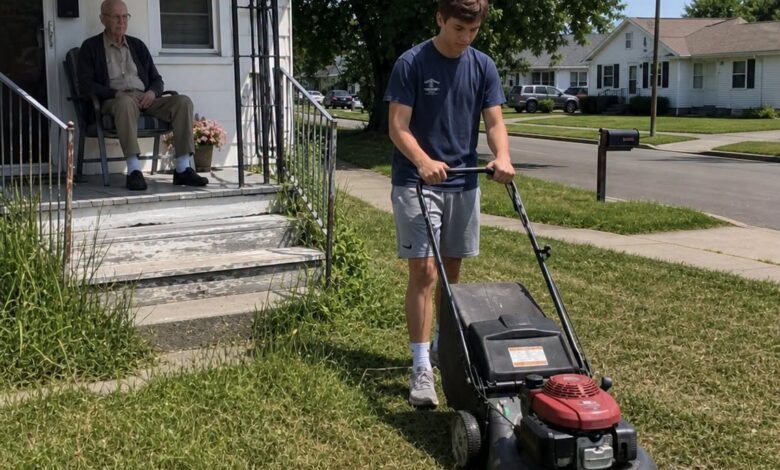
Eventually he started mowing the front lawn whenever he mowed ours.
Then came groceries.
Changing lightbulbs.
Moving boxes.
Sitting on the porch.
Mostly, apparently, sitting.
“You spent that much time over there?”
Noah shrugged.
“He was lonely.”
“Why didn’t you tell me?”
“I didn’t think it was important.”
That hurt in a strange way.
I’d spent years teaching my son kindness as though it were a lesson I could schedule.
Say thank you.
Hold doors.
Help people.
Be respectful.
Meanwhile, Noah had quietly discovered the difficult version of kindness—the kind nobody applauds because nobody knows you’re doing it.
Mr. Vance’s letter explained the rest.
Noah opened it with shaking hands.
The first page began simply:
“Kid, if you’re reading this, I finally ran out of tomorrows.”
Noah laughed through his tears.
“That sounds like him.”
Then he continued.
Mr. Vance hadn’t left Noah the money because Noah had performed some heroic act.
There had been no fire.
No dramatic rescue.
No debt.
He’d left it because Noah kept coming back.
Mr. Vance had spent most of his life doing the opposite.
His letter was brutally honest.
He’d been a successful salesman, then a business owner.
He’d made good money.
He’d also been a terrible husband.
Work always came first.
Then pride.
Then alcohol.
His marriage collapsed.
His daughter stopped speaking to him.
His son gave him opportunities to repair their relationship until eventually there were no more opportunities left.
Mr. Vance had grandchildren he’d barely known.
There were birthdays he’d missed because he was angry.
Christmases he’d skipped because apologizing felt humiliating.
Phone calls he’d refused to make because he kept believing there would be another year.
Then his wife died.
His children built lives elsewhere.
The big yellow house became very quiet.
“Why would he tell you all this?” I asked.
Noah looked at me.
“Because I asked why nobody visited.”
Of course he had.
Mr. Vance could have lied.
Instead, he’d apparently looked at a fifteen-year-old boy and said, “Mostly because I taught them how to live without me.”
That sentence stayed with Noah.
So did another.
According to the letter, Mr. Vance had spent his final years learning that regret accumulates interest.
Every apology postponed becomes harder.
Every missed birthday joins the previous one.
Every year of silence makes the first phone call heavier.
By the time pride finally loosens its grip, sometimes the people you love have stopped waiting.
Then Noah reached the part about the money.
I watched his eyes move across the page.
He stopped.
“What?”
He handed it to me.
Mr. Vance had written:
“I’m not paying you for sitting with an old man. If kindness can be purchased, it isn’t kindness anymore. This money is for the future you haven’t chosen yet. Education, a business, a home, travel—use it to buy yourself options. Just don’t use it to become the kind of man who thinks money can substitute for showing up.”
I had to stop reading.
For years, I’d believed I was the one preparing Noah for adulthood.
I’d worried about his grades, friends, curfew and college applications.
Across the street, an old man had been teaching him something I hadn’t known he needed.
How easily a life can be wasted by assuming there will always be time to repair it.
There were legal safeguards around the money because Noah was still a minor. We met with professionals and made sure nothing happened impulsively.
But Noah barely talked about the money.
He talked about the chair.
After Mr. Vance’s house was sold, Noah asked the family whether he could keep the green porch chair.
They agreed.
He sanded it.
Repaired one leg.
Painted it almost exactly the same shade.
Years passed.
Noah used part of the money for college.
He studied occupational therapy.
That surprised me.
I’d expected engineering.
He’d once expected it too.
“What changed?” I asked.
He smiled.
“I like helping people stay in their own homes.”
I understood immediately.
His first job involved older adults recovering from injuries and illnesses.
Then I began noticing something.
Noah kept finding porches.
There was Mrs. Alvarez, whose husband had died and whose children lived several states away.
There was Mr. Kim, who insisted he didn’t need help but somehow always had coffee ready when Noah visited.
There was a retired teacher named Evelyn who sat outside every afternoon and complained that everyone walked too quickly.
Noah visited even when he wasn’t being paid.
He brought groceries.
Fixed loose railings.
Listened to stories he’d already heard.
One Thanksgiving, I asked whether he ever worried people might take advantage of him.
He considered the question.
“Sometimes.”
“Then why keep doing it?”
He looked toward the green chair, which now sat on his own porch.
“Because being careful isn’t the same as being unavailable.”
That stopped me.
Mr. Vance had died full of regret.
But somehow he had managed to keep regret from becoming his final gift.
He gave Noah money, yes.
Eighty-five thousand dollars was life-changing for a teenager.
But money gets spent.
Tuition gets paid.
Cars wear out.
Accounts rise and fall.
The thing that endured was harder to measure.
Mr. Vance had given my son an uncensored account of where pride, absence and postponed love can lead.
Noah didn’t judge him for it.
He learned from him.
Years later, after Noah married, I visited his house and found another green chair beside the original one.
His wife was inside.
Noah was on the porch talking with an elderly neighbor I’d never met.
They weren’t discussing anything important.
Baseball.
Weather.
A tree that needed trimming.
Ordinary things.
I stood there watching my grown son give away twenty minutes of his Saturday as though twenty minutes were nothing.
Then I remembered Mr. Vance.
Maybe that had been his final lesson.
A life isn’t usually ruined in one enormous decision.
It’s built—or neglected—in ordinary minutes.
The phone call you make.
The apology you stop postponing.
The chair you sit in.
The person you notice.
I had tried to raise Noah safely through rules and routines.
Mr. Vance gave him something I couldn’t.
He showed him the end of a road and said, in effect:
Don’t come this way.
Take the money.
Take the warning.
Then go build something better.
And Noah did.
The eighty-five thousand dollars helped him begin his adult life.
But that was never the inheritance that mattered most.
The real inheritance was permission to reach the end of his own life with fewer apologies left unsaid, fewer doors unopened, and fewer empty chairs waiting for someone who always thought he’d come tomorrow.