The Abandoned Bride: My Fiancé Vanished with 10 Kids, But 30 Years Later, His Lawyer Delivered a Secret That Destroyed My World

For thirty years, I called my husband a coward.
Never in front of the children at first.
When they were small, I gave them softer versions of the truth I believed.
“Your father had to go away.”
“He wasn’t ready to be a family man.”
“Sometimes adults make selfish choices.”
But after they were asleep, when the dishes were done and the house became painfully quiet, I used the words I really meant.
Coward.
Liar.
Traitor.
Robert had walked out on me and our two children without even having the courage to say goodbye properly.
Or so I believed.
Then, on a rainy Tuesday morning thirty years later, a stranger knocked on my door carrying a worn manila folder.
He introduced himself as Daniel Mercer.
“I used to be a social worker,” he said.
Used to be.
Something about those words bothered me.
Then he looked at the folder.
“I retired last month. There’s something I’ve carried for a very long time that I think belongs to you.”
He placed it on my kitchen table.
Written across the front were two names.
Mine.
And Robert’s.
I stared at them.
“Where did you get this?”
Daniel didn’t answer immediately.
Instead, he reached into his coat pocket.
When he opened his hand, my knees nearly gave out.
Robert’s wedding ring.
I knew every scratch on it.
There was a small dent along one edge from the summer he’d tried repairing our washing machine and smashed his hand against the frame.
I hadn’t seen that ring since the night he disappeared.
“Where did you get that?”
Daniel pulled out a chair.
“You should sit down.”
“I don’t want to sit down.”
“Please.”
Thirty years of anger rose into my throat.
“If you know where Robert went, you’re about three decades late.”
Daniel looked at me with an expression I couldn’t read.
“Robert didn’t leave you for another woman.”
“I never said he did.”
“He didn’t leave because he wanted another life either.”
My hands tightened around the back of the chair.
“What are you talking about?”
Daniel pushed the folder toward me.
“Your husband had a brain tumor.”
The kitchen disappeared.
I heard the refrigerator humming.
Rain tapping against the window.
My own breathing.
Nothing else.
“No.”
“He was diagnosed shortly before he disappeared.”
“No.”
Daniel opened the folder.
There were medical records.
Dates.
Hospital admissions.
Neurological assessments.
Signatures.
Robert’s name appeared again and again.
I recognized his handwriting on several pages.
The diagnosis was there in language I didn’t understand, followed by words I understood perfectly.
Aggressive.
Progressive.
Poor prognosis.
I sat down.
“He would’ve told me.”
Daniel looked away.
“He wanted to.”
“Then why didn’t he?”
Because, Daniel explained, Robert had become terrified of what his illness would do to us.
Not simply emotionally.
Financially.
Robert knew me.
He knew that if he’d come home and told me he was dying, I would’ve emptied the bank account, borrowed money, quit work if necessary and spent every remaining day trying to save him.
He was right.
I would’ve done all of it.
“He kept saying you had two children to raise,” Daniel told me. “He believed you’d destroy your future trying to buy him more time.”
“So he abandoned us instead?”
My voice cracked.
Daniel shook his head.
“It’s more complicated than that.”
The tumor had begun affecting Robert’s judgment.
There were periods of confusion, paranoia and memory loss. He was heavily medicated. During those final months, other people became involved in decisions that should have belonged to us.
Medical consents.
Temporary guardianship arrangements.
Financial paperwork.
Separation documents.
Some Robert apparently understood.
Others, according to the records, were signed during periods when his capacity was increasingly questionable.
I felt sick.
For thirty years, I’d imagined Robert packing a suitcase with a clear mind.
I’d pictured him closing our front door and feeling relieved.
I’d imagined him waking somewhere else the next morning, free of crying children, bills and responsibility.
That imaginary man had become the villain of my entire adult life.
But the man inside Daniel’s folder wasn’t free.
He was sick.
Frightened.
And disappearing inside his own mind.
“What happened to him?”
Daniel’s eyes filled before he answered.
“He died.”
I stared at him.
“When?”
“Six months after you last saw him.”
I stood so quickly the chair fell backward.
“No.”
“I’m sorry.”
“Thirty years?”
My voice became a scream.
“Thirty years and nobody told me he was DEAD?”
Daniel didn’t defend himself.
That somehow made me angrier.
I hit the table with both hands.
“My children thought their father didn’t want them!”
“I know.”
“I thought he was alive somewhere!”
“I know.”
“You knew?”
Daniel’s silence answered.
I wanted to throw him out.
I wanted names.
I wanted someone to punish.
But thirty years had passed, and the folder contained a messy history of medical decisions, confidentiality, questionable judgment and people convincing themselves they were protecting everyone involved.
Nothing about it felt clean enough to satisfy my rage.
Then Daniel reached into the folder again.
“There is something else.”
He handed me an envelope.
My name was written across it.
Not typed.
Written.
In Robert’s handwriting.
I hadn’t seen that handwriting in three decades, yet I recognized it instantly.
My fingers shook opening the envelope.
The letter began simply.
My love.
That was enough.
I cried before I reached the second line.
Robert wrote that he was sorry.
Not the polished apology of someone expecting forgiveness.
The frightened, uneven confession of a dying man who understood too late that trying to spare his family pain had created a different kind of pain.
He wrote about our son learning to ride his bicycle.
Our daughter refusing to sleep without the stuffed rabbit he’d bought her.
He wondered whether she still had it.
She did.
It was currently sitting in a box in her attic.
He asked whether the children remembered his pancakes.
Whether our son still drew dinosaurs.
Whether I’d repaired the loose cabinet door he’d promised to fix.
Ordinary questions.
That’s what destroyed me.
Because selfish men escaping their families weren’t supposed to care about cabinet doors.
Dying fathers did.
Near the end, the handwriting became harder to read.
One sentence stopped me completely.
Please don’t let them believe I stopped loving them.
I lowered the letter.
For thirty years, that was exactly what they’d believed.
Because it was what I’d believed.
I remembered every birthday when one of the children looked toward the driveway.
Every Father’s Day school project.
Every Christmas when I’d silently hated Robert for not appearing.
Every teenage argument when our son shouted that he didn’t care about the father who didn’t care about him.
Robert had been dead through all of them.
Not partying somewhere.
Not building another family.
Not enjoying freedom.
Gone.
I looked at Daniel.
“Did he ask for us?”
“Constantly.”
“Then why didn’t someone bring us to him?”
Daniel swallowed.
“People thought they were following his wishes. Later, when his condition worsened, it became unclear what he actually wanted. By the time some of us understood how badly things had been handled, he was gone.”
That answer wasn’t enough.
It never will be.
There are mistakes so large that explanations cannot shrink them.
That evening, I called my children.
They were adults now.
Parents themselves.
I asked them to come over without explaining why.
My son arrived first.
My daughter came twenty minutes later.
I placed Robert’s ring between them.
Neither spoke.
Then I said:
“Your father didn’t abandon us.”
I told them everything.
My daughter cried immediately.
My son didn’t.
He read every page Daniel had left.
Then he picked up the letter.
When he reached the line about the dinosaurs, he covered his mouth.
“I thought he hated us.”
Those five words broke whatever remained of me.
“No,” I whispered. “He didn’t.”
My daughter picked up the ring.
“All this time?”
“All this time.”
We sat around that table until after midnight.
There was anger.
A lot of it.
Not only toward the people who had kept the truth from us.
Toward Robert too.
Because understanding someone’s decision doesn’t automatically make it right.
He should have trusted me.
He should have allowed me to choose whether caring for him was too great a sacrifice.
Love doesn’t give someone the right to decide what another person can survive.
His illness complicated that truth.
It didn’t erase it.
That was perhaps the hardest thing to accept.
Robert wasn’t the monster I’d created.
But he wasn’t suddenly a saint either.
He was my husband.
A frightened, seriously ill man who made desperate decisions while his own mind was betraying him.
And those decisions hurt us for decades.
The following Sunday, the three of us visited his grave.
I had never known it existed.
Daniel had given me the cemetery information.
The stone was small.
ROBERT HALE.
Beloved Husband and Father.
I almost laughed when I saw those words.
Beloved husband.
I’d hated him longer than I’d loved him.
Or perhaps that wasn’t true.
Maybe hatred had simply been what love became when it had nowhere else to go.
My children stood behind me.
I knelt and placed his ring against the stone.
Then I changed my mind.
I picked it back up.
“No,” I whispered.
My daughter touched my shoulder.
“You okay?”
I looked at the ring.
“I think this belongs with us.”
At home that night, I opened a box I’d avoided for years.
Photographs.
Robert holding our newborn daughter.
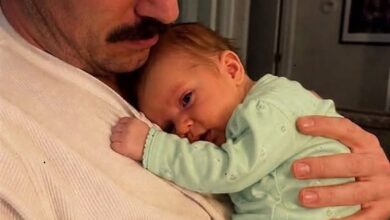
Robert asleep on the couch with our son sprawled across his chest.
Robert standing behind me at a picnic, laughing at something outside the frame.
I’d spent decades treating those photographs like evidence from a fraudulent marriage.
Now they became memories again.
That didn’t erase what happened.
Nothing could return those six months.
Nothing could give my children the chance to say goodbye.
Nothing could restore thirty years spent believing rejection where there had actually been illness.
But the truth gave us something time couldn’t.
A different memory of him.
My children could finally understand that their father had loved them.
And I could finally stop imagining him walking away without looking back.
I still get angry.
Sometimes I’m furious with Robert for deciding that protecting me meant excluding me.
Sometimes I’m furious with people whose names appear throughout that folder.
Sometimes I’m angry at myself for never questioning the story more deeply.
But anger no longer consumes every memory.
Now I can remember his laugh.
His terrible pancakes.
The dent in his wedding ring.
The way he carried our daughter through the house when she couldn’t sleep.
For thirty years, I asked one question:
Why wasn’t I enough to make him stay?
It was the wrong question.
I had always been enough.
So had our children.
Robert hadn’t chosen another life over us.
He’d been facing the end of his own.
And in his fear, illness and misguided love, he convinced himself that disappearing would save us.
It didn’t.
It wounded us differently.
But now, at least, we know.
I keep Robert’s ring beside his final letter.
Sometimes I unfold the pages and read that one sentence again.
Please don’t let them believe I stopped loving them.
They don’t anymore.
Neither do I.
Thirty years after losing my husband without knowing I’d lost him, I finally stopped hating the man who never came home.
Not because the truth repaired the past.
Some things cannot be repaired.
But because the truth finally gave Robert back to us as he really was—not a coward, not a villain, not a perfect martyr.
Just a frightened man who loved his family, became terribly ill, and made a choice whose consequences lasted far longer than he did.
For thirty years, I thought his absence was proof that love had ended.
Now I understand the crueler truth.
The love had still been there.
We simply weren’t given the chance to say goodbye.