I was halfway to the trash can with an empty plastic bottle when an older craftsman stopped me with four words:
“Don’t throw that away.”
I looked at the bottle in my hand. It was empty, slightly crushed, and completely ordinary. To me, it had already finished its job. Whatever usefulness it once possessed had disappeared with the last drop inside.
He apparently saw something entirely different.
“You’re holding material,” he said. “Not garbage.”
That simple comment changed the way I looked at something most of us discard without a second thought.
Plastic bottles are everywhere. They carry water, juice, cleaning products, and countless other everyday necessities. Once empty, they’re usually dropped into a recycling container—or, unfortunately, thrown into ordinary trash.
But before disposing of one, there’s another possibility worth considering.
With some creativity and basic crafting techniques, certain empty plastic containers can become surprisingly useful objects around the home.
The Bottle Isn’t Necessarily Finished
The craftsman explained that he’d spent years working with wood, metal, plastic, and other materials. One thing experience had taught him was that beginners often identify objects by their original purpose.
A bottle is a bottle.
A jar is a jar.
A wooden pallet is a pallet.
A professional maker, however, often sees the underlying material first.
That bottle wasn’t merely packaging to him. It was a lightweight, water-resistant piece of plastic that could potentially be cut, shaped, decorated, or incorporated into something else.
Once I understood that distinction, the possibilities became much easier to see.
A large bottle could become a planter.
The bottom section of another could become a small organizer.
Several matching containers could be turned into storage for lightweight craft supplies.
With careful cutting and finishing, bottles can also become funnels, scoops, seed starters, decorative pieces, or components for children’s craft projects.
Suddenly, that empty bottle didn’t look quite so useless.
Start With the Simplest Transformation
You don’t need professional equipment or years of crafting experience to experiment with reuse.
One of the easiest projects is a small planter.
Start with an appropriately sized, thoroughly cleaned bottle. Remove the label and adhesive as completely as possible. Depending on the design, you can carefully cut away the upper portion, leaving the lower section as a container.
Any cut plastic edge can be surprisingly sharp, so this stage deserves patience. Children should not handle cutting tools or freshly cut edges without appropriate adult supervision.
Once the container is safely prepared, add drainage holes if the plant requires them, followed by soil and a small plant.
The bottle that would otherwise have been discarded is suddenly sitting on a windowsill growing herbs or flowers.
It isn’t complicated.
That’s precisely the point.
Turn Bottles Into Organizers
Look around a desk, workshop, craft room, bathroom, or garage and you’ll probably find dozens of small objects that never seem to have a permanent home.
Pens.
Brushes.
Screws.
Craft supplies.
Clips.
Small tools.
Clean plastic containers can sometimes provide simple storage without requiring another trip to the store.
Cut a suitable bottle to the desired height, make the edges safe, and decorate the exterior if you want something more attractive.
A piece of material that cost nothing has now replaced a container you might otherwise have purchased.
Make several matching ones, and suddenly you’ve created an entire organization system.
There’s More Potential in Larger Containers
Larger bottles and jugs offer even more possibilities because there’s simply more material available.
Depending on their original contents and whether they can be thoroughly cleaned, they may be repurposed into gardening accessories, watering aids, storage containers, or scoops for non-food household materials.
The key is matching the reuse to the original container.
A bottle that previously contained hazardous chemicals shouldn’t automatically be repurposed for food, drinking water, children’s projects, or anything else that could create inappropriate exposure.
Reuse should be practical, but it should also make sense.
Sometimes recycling or proper disposal really is the best destination.
What About Heating Plastic?
This is where the craftsman’s advice came with an important warning.
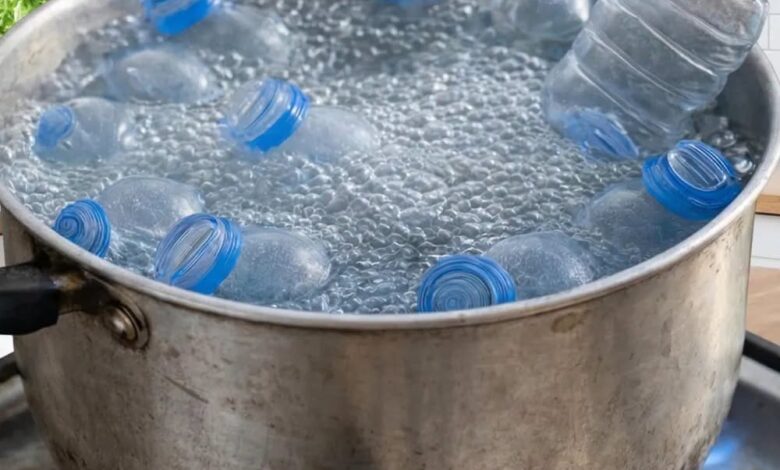
Some plastics soften when heated, which means experienced makers may sometimes manipulate them into different shapes.
But that doesn’t mean casually holding a bottle over a flame, heating it in the kitchen oven, or experimenting with melting plastic indoors is a good DIY technique.
Different plastics respond differently to heat, and overheating plastic can produce unpleasant or potentially harmful fumes while also creating serious burn and fire hazards.
For ordinary household projects, cold-working methods—cutting, folding where appropriate, joining, painting, or decorating—are generally much simpler.
If a project genuinely requires heat-forming plastic, it should only be attempted with appropriate knowledge, ventilation, temperature control, protective equipment, and an understanding of the specific material being used.
Creativity isn’t improved by unnecessary risk.
Make Something You Actually Need
There’s another side to upcycling that’s easy to overlook.
Turning every empty bottle into a decoration doesn’t automatically make your home more sustainable if you’re simply creating another object you’ll eventually throw away.
The most effective reuse projects solve a genuine problem.
Need seed-starting containers?
Use bottles.
Need temporary organizers for a workshop?
Try suitable containers before buying new ones.
Need a simple watering solution for the garden?
An empty bottle might provide the starting material.
The goal isn’t to accumulate homemade objects merely because you can.
It’s to extend the useful life of material you already have.
A Great Way to Exercise Creativity
There is something satisfying about looking at an ordinary object and asking:
What else could this become?
That question encourages a different kind of creativity from buying ready-made products.
You’re working within limitations.
The bottle already has a shape. The plastic has particular properties. You have to decide which parts are useful, what can be removed, and how the remaining material could serve another purpose.
Children can participate in age-appropriate versions of these projects too, particularly decorating prepared containers or turning them into imaginative craft pieces after an adult handles any cutting.
The lesson extends beyond crafting.
Objects don’t necessarily lose all value simply because their first purpose has ended.
Reuse Isn’t the Entire Solution
It’s also worth keeping the bigger picture in perspective.
Upcycling a few bottles won’t solve the enormous environmental challenges associated with disposable plastics.
Reducing unnecessary consumption remains important, as does recycling appropriately where effective recycling systems exist.
Reusable containers can often prevent waste more effectively than repeatedly finding new purposes for disposable ones.
But reuse still has value.
Every object that serves a useful second purpose delays the need to discard it and may reduce the need to purchase another item.
More importantly, it encourages us to think differently about consumption.
Look Once Before You Throw
I eventually understood what the craftsman had meant when he stopped me beside that trash can.
He wasn’t really trying to save one bottle.
He was teaching me to look twice.
We live surrounded by objects designed for convenience. We buy them, use them, empty them, and discard them so quickly that their disappearance becomes almost automatic.
Interrupting that routine for a few seconds can reveal possibilities.
Maybe the bottle should be recycled.
Maybe it genuinely belongs in the trash.
Or perhaps, after being cleaned and safely modified, it could become the planter, organizer, scoop, or craft container you were about to buy tomorrow.
The most valuable part of that lesson wasn’t learning a clever plastic-bottle trick.
It was learning to ask one question before throwing something away:
“Is this really finished—or have I simply finished using it the first way?”
Sometimes sustainability begins with enormous changes.
And sometimes it begins with an empty bottle, a little imagination, and someone stopping your hand before it reaches the trash.