The first sound that frightened everyone wasn’t thunder.
It was the trees breaking.
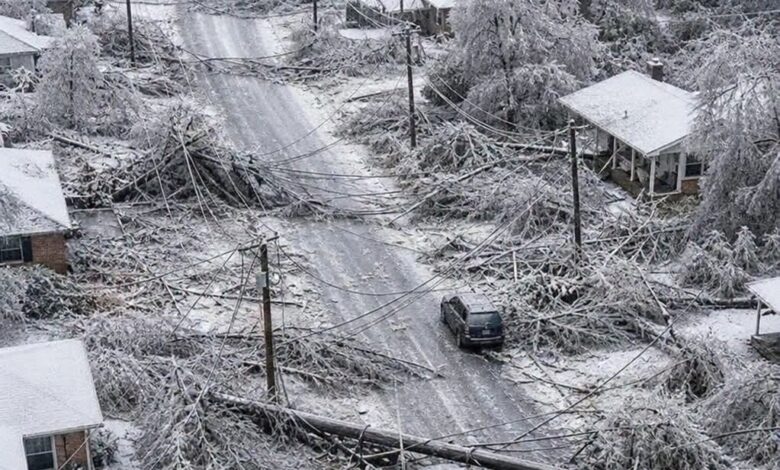
Across neighborhoods already swallowed by darkness, residents described hearing sharp cracks outside their homes, followed seconds later by the heavy crash of branches surrendering beneath layers of ice. Each sound carried another possibility: a blocked road, a crushed vehicle, a severed power line, or a tree coming down on someone’s roof.
Inside, families waited without knowing which would happen next.
More than a quarter million homes and businesses were reported without electricity as the severe winter storm tightened its grip across the region, leaving communities around Nashville facing a dangerous combination of freezing temperatures, treacherous roads, fallen trees, and damaged electrical infrastructure.
What had begun as a winter weather event was becoming something far more isolating.
In powerless neighborhoods, familiar streets looked almost unrecognizable.
Porches disappeared into darkness.
Streetlights went black.
Traffic signals stopped working.
Trees bent beneath the weight of accumulated ice, their branches hanging dangerously low over roads, driveways, homes, and utility lines.
The world seemed strangely beautiful from behind a window.
That beauty vanished the moment another branch snapped.
For families without generators or fireplaces, the most immediate problem was inside the house.
The heat was gone.
At first, many residents treated the outage like any temporary inconvenience. They pulled out flashlights, lit candles, found extra blankets, and told children the electricity would probably return soon.
Then an hour became several.
Rooms began cooling.
Sweaters went over pajamas.
Coats came out of closets.
Families gathered in one room and shut doors to unused parts of the house, trying to preserve whatever warmth remained.
Phone screens became some of the only sources of light.
But those created another countdown.
Eighty percent battery.
Fifty.
Twenty.
Every weather update, message to a relative, and call to an emergency line consumed a little more of the connection people depended on.
Some residents sat inside cars long enough to recharge devices, provided they could do so safely outdoors and away from enclosed spaces where deadly carbon monoxide could accumulate.
Others simply switched their phones off.
They were saving the remaining battery for an emergency.
Outside, the storm kept changing the landscape.
Ice is particularly destructive because it doesn’t need dramatic wind or enormous snowfall to create serious damage.
It accumulates quietly.
A thin coating becomes thicker.
Branches become heavier.
Power lines sag.
Then gravity finishes what the storm started.
Large trees that had survived decades of thunderstorms and high winds could suddenly fail under the added weight.
Some landed across streets.
Others collapsed onto parked vehicles.
Several blocked driveways, effectively trapping residents even if they had been willing to risk the roads.
For utility crews, every fallen tree could mean another obstacle between workers and damaged equipment.
Restoring electricity under those conditions is not as simple as flipping a switch.
Crews first have to reach the affected location safely.
Hazards must be identified.
Downed lines may need to be isolated.
Trees and branches sometimes must be removed before electrical repairs can begin.
Then damaged poles, transformers, wires, and other equipment may require repair or replacement.
And while one section is being restored, continuing ice accumulation can create a new failure somewhere else.
That is why some residents who briefly saw their lights return feared losing them again.
The roads presented another problem.
A street that merely looked wet could be covered in nearly transparent ice.
Bridges, ramps, hills, and untreated secondary roads were especially dangerous.
Emergency vehicles couldn’t simply move at ordinary speed because they were responding to an emergency.
An ambulance sliding into a ditch helps no one.
Neither does a fire engine unable to reach the next call.
So responders faced a brutal calculation: move urgently, but not so quickly that they became casualties themselves.
Stranded motorists added to the burden.
Some had attempted short trips believing major roads would remain manageable.
Others had been caught as conditions deteriorated.
A vehicle that becomes disabled during normal weather is inconvenient.
During an ice storm, it can become a cold metal shelter with limited fuel and falling temperatures.
That makes unnecessary travel dangerous not only for the driver but for rescuers who may eventually have to reach them.
The greatest concern, however, remained people who could not easily protect themselves.
Older adults living alone.
People dependent on electrically powered medical equipment.
Families with infants.
Residents with mobility limitations.
Anyone without reliable transportation.
Anyone whose home loses heat faster than expected.
For those households, a prolonged outage can shift from uncomfortable to dangerous.
Neighbors became an essential part of the response.
In some communities, people walked carefully from house to house checking whether older residents had blankets, food, medication, working phones, or somewhere warmer to go.
Others shared generators, portable chargers, firewood, hot meals, and information.
A house with electricity became a charging station.
A neighbor with four-wheel drive became an emergency ride.
A family with a safe source of heat suddenly had room for several more people.
These were small acts compared with the scale of the storm.
Inside a freezing house, they could mean everything.
Officials repeatedly warned residents to treat downed electrical lines as energized.
A wire lying silently across a yard or roadway may still carry electricity, and fallen trees or fences touching damaged lines can also create hazards.
Generators and fuel-burning heaters introduce another invisible threat.
Carbon monoxide has no color or smell, and improperly operated generators, grills, vehicles, or heating devices can fill enclosed or partially enclosed spaces with lethal gas.
The temptation to improvise becomes powerful when a home is getting colder.
That is precisely when caution matters most.
Candles carry their own risks, particularly when families are tired, children or pets are nearby, or flammable blankets and curtains surround temporary sleeping areas.
Flashlights and battery-powered lanterns are generally safer when available.
Residents also have to consider frozen pipes.
As indoor temperatures fall, plumbing in vulnerable parts of a house may freeze and potentially burst, adding water damage to an already dangerous situation.
Yet for many families, protecting the plumbing is secondary to protecting people.
By nightfall, entire neighborhoods seemed to be holding their breath.
The storm created a strange new geography.
People no longer measured distance by miles.
They measured it by obstacles.
Can an ambulance get down this road?
Is that bridge iced over?
Is the tree blocking the only exit?
Does the neighbor still have heat?
How much battery is left?
How cold will the bedroom become before morning?
And always, somewhere outside, came another crack.
Sometimes it was only a branch.
Sometimes the lights of a utility truck appeared afterward.
Sometimes nothing happened at all, and that silence could be worse because residents were left imagining what had fallen.
Morning did not instantly solve the crisis.
Daylight merely revealed what darkness had concealed.
Cars sat beneath broken limbs.
Trees lay across yards and streets.
Power lines drooped between damaged poles.
Ice coated railings, roofs, signs, and sidewalks.
The destruction wasn’t concentrated in one dramatic location.
It was scattered across hundreds of ordinary places, creating thousands of individual problems that crews would have to solve one by one.
That is what makes a severe ice storm so exhausting.
There is rarely one defining moment.
Instead, the emergency accumulates.
One branch.
One transformer.
One blocked street.
One powerless home.
One family watching the temperature fall.
Then another.
And another.
For people waiting in the dark, restoration estimates can feel painfully abstract.
They aren’t thinking about electrical grids or weather models.
They’re thinking about the elderly woman two houses away.
The medicine in the refrigerator.
The child sleeping beneath three blankets.
The remaining firewood.
The phone sitting at 9%.
The enormous tree bending toward the roof.
Eventually the ice will stop accumulating.
Road crews will regain ground.
Utility workers will move deeper into damaged neighborhoods.
The hum of furnaces will return house by house, and suddenly the refrigerator motor or a hallway lamp will sound like something worth celebrating.
But until then, the safest victory may be simply making it through the next cold hour without taking an unnecessary risk.
Stay warm safely.
Stay away from downed lines.
Avoid unnecessary travel.
Check on people who may not be able to check on themselves.
Preserve phone batteries where possible.
And never bring generators or other fuel-burning equipment into enclosed living spaces.
Because beneath the enormous outage numbers are individual households sitting quietly in the cold.
For them, this storm isn’t a map on television.
It’s the darkness beyond the window.
It’s the blankets piled across the couch.
It’s a dying phone battery beside a flashlight.
And it’s that terrible sound somewhere outside—
another tree beginning to crack.