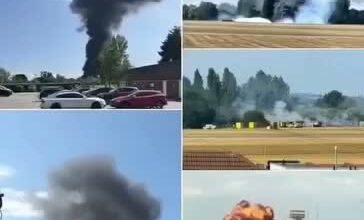
Twelve arrested over A66 wrong-way crash: Nine men and three women held after seven died including two police

Seven people left home expecting an ordinary journey.
Two were police officers carrying out their duties.
Others were members of a family heading toward an airport.
A seven-year-old boy was among those whose lives would be caught in what followed.
None of them could have known that their journeys were about to intersect with a Volkswagen Passat reportedly traveling in the wrong direction on the A66.
In moments, an ordinary road became the scene of unimaginable devastation.
Among those who died were police constables Matthew Blades and Tom Clough, both men in their 30s.
Their deaths struck particularly hard because there was nothing extraordinary about the duty that placed them there.
Police officers spend much of their careers dealing with situations most people drive past without a second thought.
A stopped vehicle.
A collision.
A stranded motorist.
A concern reported by another driver.
A stretch of road that needs securing.
Most such incidents never become national news.
Officers arrive, perform their duties, and go home.
That expectation—that routine work will remain routine—is part of what makes a tragedy like this so difficult to comprehend.
Blades and Clough were working on a road they knew.
Then, according to accounts surrounding the collision, a vehicle came toward them from the wrong direction.
There was almost no time for anything else.
Afterward came the familiar machinery of catastrophe.
Emergency calls.
Blue lights.
Road closures.
Ambulances.
Police tape.
Families waiting for information they desperately did not want to receive.
The A66, normally an artery carrying people toward work, holidays, appointments and home, became something entirely different.
For the families involved, it became a dividing line.
Life before the crash.
Life after it.
The tragedy extended far beyond the two officers.
Members of a family traveling toward the airport were also caught in the collision, with devastating consequences.
A mother, relatives and a seven-year-old child were among those affected.
What should have been the beginning of a journey became an emergency from which some would never return.
That detail is almost impossible not to dwell on.
Airport trips are usually filled with small concerns.
Have we packed everything?
Did somebody remember the passports?
Will traffic be bad?
What time do we need to arrive?
Children become impatient.
Adults check the clock.
Nobody expects the journey itself to become the event that changes the family forever.
Yet that is the cruelty of serious road collisions.
They don’t ask whether someone has plans.
They don’t care that dinner is waiting.
They don’t care about birthdays next month or holidays already booked.
They happen in seconds.
Their consequences can last generations.
As investigators began reconstructing events on the A66, attention inevitably turned toward the occupants of the Passat and the circumstances preceding the crash.
Reports that some of the young men connected with the vehicle had participated in or posted material involving dangerous driving added another disturbing dimension to the public conversation.
Social media has changed the way recklessness can be performed.
Once, dangerous driving might have been witnessed by a handful of passengers or people standing nearby.
Now a phone can turn a road into a stage.
Speed becomes footage.
A near miss becomes entertainment.
A police pursuit becomes something to upload.
Comments, shares and likes can transform behavior that endangers strangers into material rewarded with attention.
That doesn’t mean social media causes every act of reckless driving.
Nor does posting a video prove responsibility for an unrelated event.
Those distinctions matter, especially while investigations are ongoing.
But the broader phenomenon deserves serious examination.
When dangerous behavior becomes content, incentives can change.
The driver isn’t necessarily performing only for the passengers anymore.
An invisible audience is riding along.
Someone knows the video might be uploaded.
Someone wants the clip that friends will talk about.
Someone pushes a little further because ordinary driving doesn’t generate the same reaction.
The line between recording recklessness and encouraging it can become dangerously thin.
Platforms face a difficult challenge here.
Millions of videos are uploaded constantly.
Some depict legitimate motorsport.
Some document newsworthy events.
Some show driving on private tracks or controlled environments.
Others appear to glorify behavior that would be catastrophically dangerous on public roads.
Distinguishing between them at scale isn’t always straightforward.
But difficulty doesn’t eliminate responsibility.
If algorithms repeatedly recommend videos depicting dangerous illegal driving because those clips generate engagement, questions about platform design are legitimate.
Should videos celebrating extreme speeding on public roads be amplified?
Should monetization reward them?
Should accounts repeatedly promoting obviously dangerous driving face restrictions?
How quickly should material be removed when it appears to encourage behavior capable of killing innocent people?
Those questions become much harder to treat as abstract policy debates when families are planning funerals.
Calls for platforms to remove material glorifying so-called joyriding or dangerous driving therefore reflect a larger concern.
The internet doesn’t merely document culture anymore.
It shapes what receives attention inside it.
Attention is a currency.
And some people will do extraordinarily dangerous things to earn it.
But social-media outrage can create another danger too.
After a tragedy, fragments of information spread rapidly.
Names circulate.
Old videos resurface.
Rumors become assertions.
People combine unrelated events into narratives before investigators have finished establishing basic facts.
That can undermine rather than support accountability.
A serious investigation requires evidence.
Vehicle examination.
Road data.
CCTV.
Phone records where lawfully obtained.
Witness accounts.
Timelines.
Forensic analysis.
The difference between what appears obvious online and what can actually be proven matters enormously.
The arrests reported in connection with suspected organized-crime and firearms offences have understandably intensified public concern.
Twelve arrests connected with such serious suspicions suggest investigators were examining issues extending beyond the immediate mechanics of a road collision.
But arrests are not convictions.
Suspicion is not proof.
And responsible discussion must leave room for investigators and courts to determine individual culpability based on evidence.
That restraint doesn’t minimize the tragedy.
It protects the integrity of the process intended to establish what actually happened.
For Middlesbrough and surrounding communities, however, the legal distinctions don’t make the grief any lighter.
Police stations are workplaces, but they are also communities.
Officers share long shifts.
They attend difficult scenes together.
They depend on one another in circumstances where trust isn’t optional.
When colleagues die suddenly, uniforms don’t insulate anyone from grief.
An empty locker remains empty.
A familiar voice no longer answers the radio.
Someone else’s name appears on the duty roster.
People continue working because emergencies don’t stop while officers mourn.
The families of Blades and Clough face something even harder.
Public tributes may describe service, courage and professionalism.
Those things matter.
But families knew people rather than uniforms.
They knew jokes.
Habits.
Morning routines.
Favorite meals.
Unfinished conversations.
The things that make someone irreplaceable rarely fit neatly into an official statement.
The same is true for every civilian life lost.
Statistics are useful for understanding road safety.
Seven fatalities can be entered into a database.
Investigators can chart positions and calculate speeds.
Governments can discuss policy.
But families don’t experience loss statistically.
They experience it through absence.
A chair nobody occupies.
A telephone number nobody answers.
Clothes still hanging in a wardrobe.
A child’s belongings left exactly where they were.
A planned holiday that becomes unbearable to think about.
That is why the conversation surrounding dangerous driving must ultimately move beyond sensational footage.
A car can feel like entertainment from inside it.
Music is playing.
Friends are laughing.
The camera is recording.
The road appears open.
Speed feels exciting.
But public roads are shared spaces.
Around the next bend could be a parent driving home.
A road worker.
A police officer.
A motorcyclist.
A family going to the airport.
A seven-year-old child.
None of them agreed to participate in somebody else’s thrill.
That distinction is fundamental.
Risk undertaken on a controlled racetrack is one thing.
Risk imposed on strangers is another.
A driver’s moment of bravado can become somebody else’s lifetime of grief.
And once that line is crossed, there is no edit button.
No deleted post can restore a life.
No apology can reverse a collision.
No sentence imposed by a court can make a family whole again.
That doesn’t mean prevention is hopeless.
Road engineering can reduce risks.
Enforcement can deter dangerous behavior.
Education can change attitudes.
Vehicles themselves can incorporate technology that helps prevent certain collisions.
Police intelligence can target organized offending.
Platforms can reconsider whether algorithms should amplify content apparently celebrating dangerous behavior on public roads.
Parents, schools and communities can challenge the idea that recklessness is evidence of courage.
But prevention requires treating dangerous driving as more than mischievous entertainment.
The language matters.
Calling extreme road behavior a “stunt” can make it sound playful.
Calling it “content” can make the camera seem more important than the danger.
Behind every spectacular clip are people who didn’t consent to the risk.
The pedestrian outside the frame.
The driver approaching from the opposite direction.
The emergency worker standing beside the road.
The child strapped into the back seat of another car.
They are part of the video too, even if nobody points the camera at them.
In the aftermath of the A66 tragedy, there will be demands for answers.
What happened before the collision?
Why was a vehicle allegedly traveling the wrong way?
What role, if any, did broader criminal activity play?
Could authorities have intervened earlier?
Should online platforms have acted differently toward accounts promoting dangerous driving?
Could laws be strengthened?
Those are legitimate questions.
Some answers may come from investigators.
Others may require policy changes.
Some may remain disputed.
But beneath every investigation and political argument lies something much simpler.
Seven people are dead.
That fact should not become merely another piece of viral content.
Their deaths deserve more than outrage that burns brightly for several days and disappears when the algorithm finds another subject.
They deserve serious consideration of what allows dangerous road behavior to become normalized, celebrated or rewarded.
They deserve an investigation allowed to establish facts without rumor replacing evidence.
And their families deserve space to grieve human beings rather than symbols.
Eventually, the A66 will look ordinary again.
Traffic will move.
Drivers unfamiliar with the tragedy may pass the location without knowing what happened there.
Roads are like that.
They absorb history remarkably quickly.
But the people closest to those who died will not simply return to normal.
For them, there will always be a before and an after.
Before the telephone call.
Before the knock at the door.
Before an ordinary journey became the last one.
That is the reality hidden behind every reckless-driving clip that makes danger look exciting.
The camera captures seconds.
The consequences can last forever.
Likes disappear.
Trends move on.
Algorithms find something new.
Grief doesn’t.
And no matter what investigations ultimately establish about the events surrounding the A66 crash, that should remain at the center of the story.
Not the spectacle.
Not the bravado.
Not the social-media numbers.
The lives.
Seven of them.
And the people who would give anything to have them back.