The desert keeps its secrets differently.
There are no locked doors.
No curtains.
No basement walls concealing what happened.
Everything appears exposed beneath an enormous sky, surrounded by sand, rock, scrub, and towering saguaros.
Yet the Arizona desert can hide a person remarkably well.
That is what makes the discovery of human remains so unsettling.
Somewhere beyond the familiar roads and neighborhoods, investigators are now confronting a second mystery while another family continues waiting for answers about a missing woman.
At first glance, the two developments seem impossible not to connect.
A disappearance.
Human remains.
The same broad region.
Two investigations unfolding beneath the same brutal landscape.
But investigators have emphasized an essential distinction:
The discovery of unidentified remains and the search for Nancy Guthrie must be treated as separate matters unless evidence establishes otherwise.
That may sound frustrating to people following the case.
It is also exactly how a responsible investigation has to work.
Because before detectives can determine what happened to an unidentified person, they have to answer the most basic question of all.
Who is this?
That question can be extraordinarily difficult.
A body recovered quickly and under controlled circumstances may provide investigators with fingerprints, recognizable features, personal belongings, medical evidence, and relatively intact DNA.
Remains exposed outdoors for an extended period can present a very different challenge.
Heat accelerates decomposition.
Sunlight damages exposed material.
Animals can scatter bones.
Rain can move evidence.
Wind covers and uncovers objects.
Vegetation changes.
Human activity can disturb a scene without anyone realizing what was there.
In the desert, time doesn’t merely pass.
It works on the evidence.
That means forensic teams must resist the pressure to provide immediate answers.
Every fragment matters.
A small piece of bone may help determine biological characteristics.
Dental work can become critical.
A healed fracture may correspond with an old medical record.
Clothing or jewelry may provide leads, although such items alone cannot establish identity.
DNA may eventually offer the strongest answer—but even DNA doesn’t always produce an instant name.
Investigators may need a suitable sample.
A laboratory must process it.
The resulting profile must then have something useful to compare against.
That could involve a known sample from a missing person, a relative’s DNA, or an appropriate database used under applicable laws and procedures.
Sometimes identification happens quickly.
Sometimes it takes months.
In difficult cases, it can take years.
For families of missing people, that waiting can be excruciating.
Every discovery creates two contradictory emotions.
Hope.
And terror.
Hope that uncertainty might finally end.
Terror about what that answer could be.
For the family of Nancy Guthrie, those emotions are particularly raw.
Her disappearance has remained in public view partly because her daughter, Savannah, has continued making sure people remember that behind every headline is a mother who has not come home.
That distinction matters.
Missing-person cases can gradually transform into abstractions for outsiders.
A photograph becomes familiar.
A name becomes searchable.
People debate theories.
Online communities study timelines.
Rumors circulate.
Eventually, the missing person can become almost like a character in a mystery.
Families don’t experience it that way.
To them, the missing person remains present through absence.
There is still a place where she should be.
A phone that should ring.
A chair she should occupy.
A routine that should continue.
That’s why Savannah’s public appeals carry such emotional force.
She isn’t discussing an intriguing case.
She’s asking for her mother.
And sometimes the smallest piece of information can matter.
A vehicle noticed at an unusual hour.
A person seen near a particular location.
A conversation someone dismissed at the time.
A photograph taken accidentally in the background.
A security camera recording that hasn’t been reviewed.
A detail somebody withheld because they assumed investigators already knew it.
Large investigations are often built from small observations.
The challenge is separating useful information from noise.
A highly publicized case can generate enormous numbers of tips.
Some are sincere but mistaken.
Some repeat information already known.
Some are speculation presented as fact.
Others may come from people attempting to insert themselves into the investigation.
Investigators must evaluate them all without allowing the volume of public attention to distort the evidence.
A large reward can increase that volume dramatically.
With reports of a reward reaching $1 million in connection with information capable of advancing the Guthrie investigation, the incentive for someone with genuine knowledge to come forward can be substantial.
But rewards have another side.
They can attract unreliable claims.
A person may suddenly become “certain” about something previously remembered only vaguely.
Someone may embellish an observation because they believe it could qualify.
Others may deliberately fabricate information.
That makes corroboration essential.
A tip is not evidence simply because it sounds convincing.
Investigators look for details that can be independently verified.
Does surveillance footage support the account?
Do phone records align?
Does the timeline work?
Can another witness confirm it?
Does physical evidence match?
That same discipline applies to the remains discovered in the desert.
Proximity creates a powerful psychological pull.
Humans naturally connect events.
When two disturbing things happen near one another, we want them to form a single story.
Sometimes they do.
Sometimes they don’t.
Arizona has many unresolved missing-person cases.
Human remains can belong to someone who disappeared recently or someone whose family has been waiting far longer.
They may be connected to an investigated crime.
They may involve an accident, exposure, illness, or circumstances not immediately apparent.
Until forensic identification and examination provide evidence, declaring a connection to a particular missing person can cause enormous harm.
Imagine having a missing relative and seeing strangers online confidently announce that newly discovered remains must belong to them.
Now imagine learning those strangers were wrong.
Or imagine being another family whose missing loved one receives little attention because everyone has already assigned the unidentified remains to a more famous case.
That is why official caution isn’t evasiveness.
It’s necessary.
The remains deserve an identity independent of whatever case currently dominates the headlines.
Someone belonged to those bones.
Someone had a name.
A childhood.
Relationships.
Habits.
Perhaps someone is still waiting for them.
Forensic specialists now carry the responsibility of returning that identity.
Their work can involve anthropology, pathology, genetics, dentistry, and conventional investigative methods.
The condition of the remains will determine which techniques are useful.
Forensic anthropologists can examine skeletal material for information that may help narrow identification.
Pathologists may search for evidence related to injury or cause of death when the condition of the remains allows it.
Dental comparisons can be particularly valuable because dental work and tooth patterns may survive conditions that destroy softer tissues.
DNA can provide another route.
In some unidentified-remains cases, forensic genetic genealogy has become an important investigative technique, though its use depends on jurisdiction, available samples, legal rules, resources, and the circumstances of the case.
None of these methods resemble the instant certainty portrayed on television.
Real forensic work can be slow.
A sample gets collected.
Documented.
Transported.
Tested.
Sometimes retested.
Specialists compare findings.
Detectives request records.
Possible matches are eliminated.
Then another possibility emerges.
The slowness can look unbearable from outside.
But mistakes made quickly can be worse than answers delivered carefully.
Meanwhile, Arizona’s environment continues presenting its own challenges.
Extreme heat isn’t merely uncomfortable for search teams.
It can determine when and how long people can safely work.
Terrain can restrict vehicles.
Remote areas may require specialized searches.
Scavenging animals can move evidence away from an original location.
A discovery site can expand from several square meters into a much larger search area if investigators suspect material has been scattered.
That means the place where remains are first noticed may not be the place where the person died.
It may not even be where the remains originally came to rest.
Investigators have to consider all of those possibilities before building a narrative.
And while they do, the public waits.
That waiting has become part of the Guthrie story.
Savannah’s continued appeals serve a practical purpose beyond maintaining attention.
Public memory fades quickly.
People who initially saw a missing-person alert may stop thinking about it after several days.
News coverage moves on.
Posters become background scenery.
Keeping a face visible can reach the one person who suddenly realizes:
I saw something.
Maybe that person thought it was irrelevant.
Maybe they were afraid.
Maybe they didn’t understand what they witnessed until later information gave it context.
That possibility is why investigators so often continue asking people to report information even after a case has received extensive publicity.
The useful tip isn’t necessarily dramatic.
It simply needs to be true.
But the same public attention that can solve cases can also damage them.
Social media has transformed missing-person investigations into collaborative puzzles for enormous online audiences.
At its best, that attention spreads photographs, keeps cases visible, and encourages witnesses to contact authorities.
At its worst, it produces unsupported accusations.
Private citizens are identified as suspects without evidence.
Families are scrutinized for displaying the “wrong” emotion.
Ordinary inconsistencies become conspiracy theories.
Every unrelated discovery gets forced into the same narrative.
The desert remains are exactly the kind of development capable of triggering that cycle.
The temptation is obvious.
People want to know whether this is the breakthrough.
Whether two timelines have finally intersected.
Whether the search has reached its terrible conclusion.
At present, speculation cannot provide those answers.
The laboratory might.
Investigators might.
Evidence might.
Until then, restraint is not indifference.
It is respect.
Respect for Nancy Guthrie.
Respect for her family.
And respect for the unidentified person whose remains have now become the center of another investigation.
Somewhere, forensic specialists may be working through that process now.
Measurements.
Samples.
Records.
Comparisons.
Each result eliminating one possibility or strengthening another.
Eventually, there may be a name.
If that name is unrelated to the Guthrie investigation, the discovery will still matter enormously.
Another mystery may begin moving toward resolution.
Another family may finally learn what happened to someone they lost.
If credible evidence does establish a connection, investigators will have to follow that evidence wherever it leads.
Either outcome deserves accuracy more than speed.
For Savannah and those searching for Nancy, meanwhile, the work continues.
Her photograph remains visible.
Appeals remain active.
Tips continue to matter.
The reward keeps attention focused on the possibility that someone knows more than they have said.
And somewhere across Arizona, investigators continue working against the same forces that complicate so many desert cases:
Distance.
Heat.
Time.
Silence.
The desert itself offers no explanation.
It simply preserves some clues and destroys others.
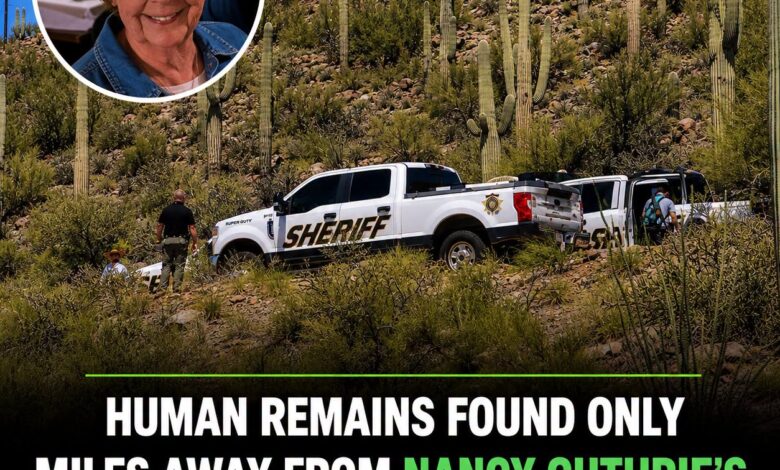
That is what makes the image of forensic teams working beneath the saguaros so haunting.
Every object has to be considered.
Every fragment documented.
Every assumption challenged.
Because something that looks insignificant could be the detail that restores a person’s name.
For everyone watching the Guthrie investigation, the discovery of remains inevitably creates another wave of questions.
But the most responsible thing anyone can do is allow those questions to remain questions until evidence answers them.
A missing woman deserves facts.
An unidentified person deserves a name.
Two grieving families—whether they know yet that they are grieving or not—deserve better than speculation.
For now, Arizona is left with two timelines.
One belongs to Nancy Guthrie, whose family continues asking the public not to forget her.
The other belongs to a person found in the desert whose story investigators are only beginning to reconstruct.
Perhaps those timelines will eventually meet.
Perhaps they never will.
The answer is not hiding in rumor, proximity, or coincidence.
It is hiding in evidence.
A DNA profile.
A dental record.
A recovered object.
A verified tip.
One small fact capable of turning uncertainty into knowledge.
Until that fact arrives, the desert keeps both stories suspended beneath the same enormous sky.
And somewhere, families wait for the phone to ring.