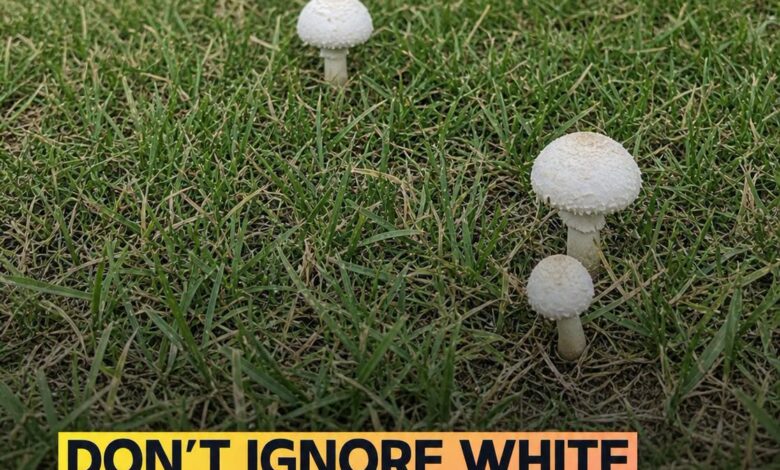
You walk outside one morning and suddenly they’re everywhere.
Small white mushrooms scattered across the lawn.
Yesterday, there was nothing but grass. Today, pale caps have pushed through the soil as if an underground army arrived overnight.
For many homeowners, the reaction is immediate:
What is wrong with my yard?
Should you pull them?
Spray them?
Is the grass dying?
Are they poisonous?
Are they evidence of some terrible fungus spreading beneath your home?
Usually, the truth is far less frightening—and considerably more interesting.
Those mushrooms aren’t necessarily invading your lawn.
In many cases, they’ve been there all along.
What you’re seeing is only the temporary reproductive structure of a much larger fungal organism living beneath the surface.
Think of a mushroom somewhat like an apple growing on a tree.
The apple isn’t the entire organism.
It’s simply the visible product.
Much of a fungus exists underground as an intricate network of microscopic threads called mycelium.
Those threads can spread through soil, decomposing leaves, mulch, old roots, buried lumber, and other organic material.
Then conditions become favorable.
Moisture rises.
Temperatures cooperate.
Humidity increases.
And suddenly the hidden organism produces mushrooms.
They can appear with astonishing speed.
That’s why a lawn that looked perfectly ordinary on Tuesday can resemble a mushroom garden by Wednesday morning.
And contrary to popular assumption, their presence can sometimes be a sign that something beneath your grass is working exactly as nature intended.
Soil isn’t just dirt.
Healthy soil is alive.
It contains bacteria, fungi, insects, worms, roots, microscopic organisms, decaying plant material, and countless chemical interactions happening beyond your sight.
Fungi play an enormous role in that underground economy.
Consider a tree root left behind after an old tree was removed.
The stump may be gone.
The visible tree may have disappeared years ago.
But enormous woody roots can remain underground.
Something has to break them down.
Fungi are among nature’s great recyclers.
They digest complex organic material and help return nutrients to the surrounding ecosystem.
The mushrooms appearing above that buried root system may therefore be evidence of decomposition rather than disease.
The same thing can happen where old lumber, wood chips, mulch, leaves, or other organic matter has become buried.
Homeowners occasionally discover mushrooms appearing in strangely straight lines or concentrated patches.
Dig beneath them and the explanation may be an old root, forgotten landscaping material, or construction debris slowly decomposing below the lawn.
Your grass remembers what your eyes can no longer see.
Mushrooms can reveal that history.
Some fungi also form extraordinarily important relationships with living plants.
These are called mycorrhizal associations.
In simplified terms, fungal networks connect with plant roots and can help plants access water and nutrients, while receiving sugars produced by the plants in return.
This relationship is sometimes described popularly as the “wood wide web.”
The phrase is catchy, although the actual biology is more complicated than the idea of trees simply chatting through an underground internet.
Still, the central lesson is remarkable:
Fungi aren’t automatically enemies of plants.
Many are partners.
Without fungi, forests, gardens, and soils would function very differently.
So when mushrooms appear in a healthy lawn after several rainy days, there may be no crisis whatsoever.
They may simply be the visible evidence of an active decomposer community beneath your feet.
But that’s only half the story.
Because mushrooms can also tell you that conditions in your yard deserve attention.
One of the first things to examine is water.
Fungi generally thrive where moisture is available.
If mushrooms repeatedly erupt across your lawn despite relatively dry weather, ask yourself whether you’re watering more than necessary.
Automatic irrigation systems make overwatering remarkably easy.
A sprinkler schedule gets programmed in spring.
Then nobody thinks about it again.
Rain arrives.
Temperatures change.
Shade patterns shift.
But the irrigation system keeps running exactly as programmed.
The soil never gets much opportunity to dry.
That persistent moisture can encourage fungal activity and create other lawn problems.
The mushrooms themselves aren’t necessarily damaging the grass.
They’re clues.
Your lawn may be telling you:
I’m staying wet for too long.
Check irrigation timing.
Look for broken sprinkler heads.
Watch for low areas where water collects.
Consider whether dense shade is slowing evaporation.
Water deeply when appropriate rather than automatically keeping the surface continuously damp, and adjust frequency to the needs of your grass, soil, season, and climate.
Another potential issue is compacted soil.
Think about the parts of your yard receiving the most traffic.
Children running through the same route.
Dogs patrolling the fence.
People walking from the driveway to the patio.
Heavy lawn equipment repeatedly crossing the same area.
Over time, soil particles can become compressed.
Air movement decreases.
Drainage can suffer.
Roots may struggle.
Moisture can linger near the surface.
If mushrooms consistently appear in those same wet, compacted areas, improving soil structure may help.
Core aeration can be useful for appropriate lawns because it removes small plugs of soil, allowing better movement of air, water, and nutrients.
But again, don’t aerate merely because you saw three mushrooms.
Look for the pattern.
Is the ground hard?
Does water puddle?
Is grass thinning?
Does the area receive heavy foot traffic?
The lawn’s symptoms should guide the response.
Thatch can create another moisture-holding environment.
A small amount of thatch isn’t automatically harmful.
But an excessive layer of dead and living organic material between the grass blades and soil can interfere with water movement and create conditions favorable to certain problems.
If your lawn has a substantial thatch layer, appropriate dethatching may be worth considering.
Then there are the mysterious circles.
You may have seen them:
Mushrooms forming a ring or partial arc across the lawn.
For centuries, these formations inspired folklore.
People called them fairy rings and imagined supernatural gatherings taking place during the night.
The scientific explanation is less magical but still fascinating.
A fungal colony can expand outward through the soil from an original point.
As it spreads, mushrooms may emerge around the advancing edge, producing a circle that becomes larger over time.
Some fairy rings primarily produce mushrooms.
Others can change the appearance of the grass.
You may notice unusually dark green growth where nutrients released by fungal decomposition stimulate the turf.
In other situations, grass can become stressed or die, particularly when fungal activity contributes to water-repellent conditions in the soil.
That means the phrase “fairy ring” describes something more complex than a decorative circle of mushrooms.
If the grass remains healthy, the mushrooms themselves may be little more than a temporary nuisance.
If the ring is associated with declining turf, however, management can become more complicated and professional guidance may be useful.
Pet waste can produce another revealing pattern.
Dogs repeatedly using the same section of lawn can create localized nutrient concentrations, particularly nitrogen and salts.
Depending on the amount and conditions, you may see dark green patches, burned grass, or changes in microbial activity.
If mushrooms seem strangely concentrated around areas receiving animal waste, cleanup and irrigation practices may deserve attention.
But one mushroom pattern should make you look upward rather than downward.
Mushrooms appearing around the base of a tree or tracing its root zone.
Again, this doesn’t automatically mean the tree is dying.
Some fungi coexist harmlessly with trees.
Some are beneficial.
Others feed on dead material already present.
But certain fungal fruiting bodies around trunks, root flares, or major roots can be associated with wood decay.
And that matters because a tree can look surprisingly healthy above ground while structural roots or internal wood are deteriorating.
Leaves tell you only part of a tree’s story.
A large tree with significant root or trunk decay can eventually become a safety hazard.
If unfamiliar mushrooms repeatedly emerge directly from the trunk, root flare, exposed roots, or around a tree that is also showing decline—such as canopy thinning, branch dieback, cracks, cavities, or instability—don’t diagnose it from an internet photograph.
Call a qualified arborist.
The mushroom may be insignificant.
Or it may be the visible clue to a structural problem that deserves professional assessment.
Identification matters for another reason:
Some mushrooms are toxic.
You cannot reliably determine whether an unknown mushroom is safe to eat simply because it is white, small, common-looking, growing in your yard, or ignored by wildlife.
Never treat a lawn mushroom as food unless it has been positively identified as edible by someone genuinely qualified to make that determination.
This is especially important when children or pets use the yard.
If you’re concerned about accidental ingestion, physically removing visible mushrooms can reduce immediate exposure.
Wear gloves if appropriate, collect them, and dispose of them where children and animals cannot reach them.
But understand what removal accomplishes.
Picking a mushroom is like picking an apple.
You’ve removed the visible structure.
You haven’t necessarily removed the organism producing it.
The underground fungal network may remain.
That’s why mushrooms can return after mowing or picking.
And that’s also why indiscriminately flooding the lawn with fungicide isn’t usually the smartest first response to ordinary mushrooms.
Start with the environment.
Is the lawn too wet?
Is drainage poor?
Is organic debris accumulating?
Is irrigation running unnecessarily?
Is the soil compacted?
Is there buried wood?
Are tree roots decomposing?
Are mushrooms appearing alongside damaged turf?
The answers tell you far more than the mushroom alone.
If you’re dealing with an actual turf disease rather than harmless fruiting bodies, accurate diagnosis becomes even more important.
Different fungal diseases require different management strategies.
Some are influenced by excessive nitrogen.
Others by prolonged leaf wetness.
Temperature, humidity, mowing practices, snow cover, drainage, and grass species can all affect disease development.
Throwing a generic fungicide at every unusual patch isn’t diagnosis.
It’s guessing.
Your local agricultural extension service, horticultural adviser, turf professional, or plant diagnostic laboratory may be able to identify the problem and recommend management appropriate for your region.
Often the solution is surprisingly ordinary.
Change watering practices.
Improve drainage.
Aerate compacted soil.
Remove excessive thatch.
Clean up pet waste.
Rake heavy layers of leaves.
Remove buried decaying material when practical.
Improve sunlight or airflow where possible.
And sometimes the correct solution is simply:
Do nothing.
That’s the part many homeowners find hardest.
We have been trained to view a perfect lawn as an inert green carpet.
Anything else—a mushroom, clover flower, insect mound, patch of moss—feels like evidence that nature has breached the perimeter.
But a lawn is an ecosystem whether we acknowledge it or not.
There are entire communities living beneath those blades of grass.
Most remain invisible.
Mushrooms briefly bring part of that hidden world above ground.
They can tell you that a root is decomposing.
That moisture is lingering.
That organic matter is being recycled.
That your soil is biologically active.
That a tree deserves inspection.
Or simply that it rained yesterday.
The trick is learning not to confuse a messenger with the message.
So the next time a cluster of pale mushrooms appears overnight, don’t immediately reach for chemicals.
Look around.
Touch the soil.
Check the irrigation.
Notice whether the grass is healthy.
Look for patterns.
Examine nearby trees.
Think about what may be buried underneath.
Ask what changed in the weather during the previous few days.
Those strange little caps may disappear almost as quickly as they arrived.
But while they’re there, they’re giving you a rare glimpse into a world that normally operates completely out of sight.
Your lawn isn’t just grass.
Beneath it is a living system constantly decomposing, exchanging, recycling, feeding, competing, and rebuilding.
And sometimes, after the right combination of moisture and temperature, that underground system sends up a small white flag.
Not necessarily to warn you.
Not necessarily to threaten you.
Sometimes simply to announce:
There’s a lot more happening down here than you realize.