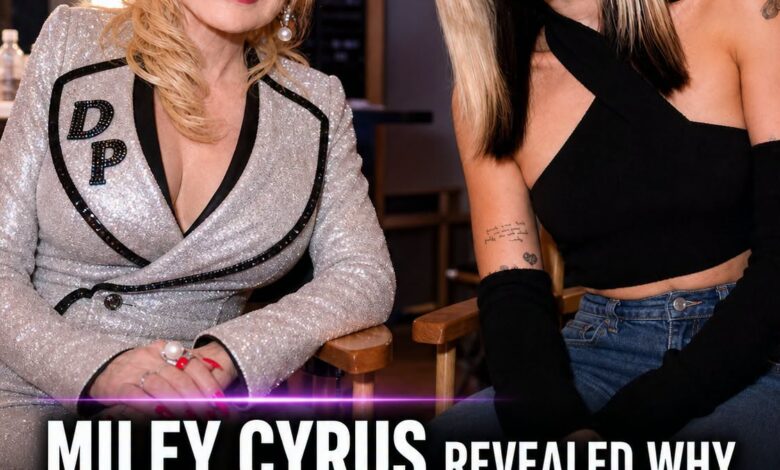
Long before grief claimed it, August 25 already belonged to Miley Cyrus.
It was one of those strange dates that seemed to keep returning at major turning points in her life, collecting memories until it became almost impossible to separate the calendar from the person she had become.
There was “Wrecking Ball.”
There were the VMAs.
There was heartbreak.
There was family.
And eventually, there was “Used To Be Young,” perhaps one of the most vulnerable reflections Miley had ever offered on the complicated journey from child star to adult woman.
Then August 25 acquired another meaning.
Dolly Parton.
For Miley, Dolly had never simply been the country legend everyone else knew.
She was family.
Her godmother.
A mentor.
A collaborator.
A woman who had known Miley before the controversies, reinventions, broken relationships, awards, viral performances, and years of public scrutiny.
Dolly had watched the girl become the woman.
That made the loss something no chart position or public tribute could adequately describe.
And suddenly, a date Miley had deliberately chosen to represent her past became inseparable from another goodbye.
Years earlier, August 25 had helped announce one of Miley’s most dramatic transformations.
In 2013, she stepped onto the MTV Video Music Awards stage and delivered the performance that seemed to detonate the last remaining pieces of her Disney identity.
The reaction was immediate.
People argued about it for weeks.
Parents complained.
Commentators dissected her every movement.
Photographs flooded the internet.
Miley Cyrus, once associated almost inseparably with Hannah Montana, was announcing with spectacular force that she would no longer behave according to the expectations attached to the girl America thought it owned.
The performance became one of the defining pop-culture moments of that period.
Then came “Wrecking Ball.”
The song presented another side of the transformation.
Behind the provocation was heartbreak.
Behind the headlines was somebody hurting.
The video became impossible to ignore, but beneath its imagery was a remarkably exposed song about loving somebody even while a relationship collapsed.
That era also coincided with the disintegration of Miley’s relationship with Liam Hemsworth.
Their story would eventually become far more complicated than one breakup.
They separated.
Reconciled.
Married.
Divorced.
And became part of each other’s histories in ways neither could simply erase.
For Miley, growing up wasn’t happening privately.
Millions of people were watching.
Every haircut became symbolism.
Every relationship became public property.
Every performance became evidence for whichever version of Miley somebody wanted to believe existed.
Rebellious Miley.
Heartbroken Miley.
Wild Miley.
Married Miley.
Divorced Miley.
Country Miley.
Rock Miley.
Pop Miley.
The problem with those labels was that she contained all of them.
Years later, she finally wrote a song that seemed to understand that.
“Used To Be Young.”
Its title sounded almost painfully simple.
The woman singing it wasn’t denying the chaos of her past.
She wasn’t begging to be forgiven for it either.
She was looking backward with something closer to compassion.
Yes, she had been reckless.
Yes, she had changed.
Yes, she had done things differently from the person she was now.
But that was because she had been young.
The song refused the cruel expectation that adulthood requires us to despise our younger selves.
Instead, Miley seemed to be saying: I remember her.
I understand her.
I don’t have to become her again to love what she gave me.
Then came the choice of release date.
August 25, 2023.
Miley explained that the date carried deep personal significance.
It connected different moments from her history—career upheaval, relationships, family, transformation.
Even her father Billy Ray Cyrus’ birthday falls on August 25.
So releasing “Used To Be Young” on that date felt deliberate.
Almost ceremonial.
She took a day already crowded with memories and placed a song about memory directly inside it.
At the time, it seemed beautifully appropriate.
She couldn’t know what else the date would eventually carry.
Dolly had been present across Miley’s life in a way few mentors ever are.
Their connection existed before Miley needed career advice.
Dolly had known Billy Ray and became Miley’s godmother, creating a bond that eventually became both personal and professional.
As Miley’s fame exploded, Dolly occupied a rare position.
She understood.
Not approximately.
Not theoretically.
She actually understood what it meant to become a character in the public imagination.
Dolly herself had spent decades navigating the distance between a human being and an image.
She knew what happened when strangers believed familiarity entitled them to ownership.
She knew what it meant to have clothes, hair, relationships, sexuality, intelligence, ambition, and private decisions turned into public conversation.
And she knew something Miley desperately needed during her most controversial years:
A woman does not have to shrink because people misunderstand her.
Dolly didn’t need Miley to become Dolly.
That was part of the beauty of their relationship.
Their aesthetics were different.
Their generations were different.
Their musical instincts sometimes traveled in different directions.
But beneath those differences was a striking similarity.
Both women understood reinvention.
Both knew how dangerous it could be for a female entertainer to allow other people to define her permanently.
And both understood that spectacle could coexist with substance.
Dolly could wear enormous wigs and rhinestones while quietly being one of the smartest businesspeople in entertainment.
Miley could provoke an entire cultural argument and still possess a voice capable of silencing a room.
Neither woman fit comfortably inside the caricature strangers built around her.
Their affection became especially visible whenever they performed together.
There was teasing.
Admiration.
Comfort.
Dolly’s warmth toward Miley never felt manufactured for television.
She spoke about her with the protectiveness of someone who understood that beneath all the fame was still a person she had watched grow up.
Dolly once described loving Miley like one of her own.
That kind of sentence changes meaning after somebody is gone.
So does old footage.
After a loss, recordings become strange objects.
A laugh you barely noticed becomes precious.
A hug lasts differently.
An ordinary exchange suddenly feels unbearable because the people inside the video don’t yet know what you know.
They don’t know the clock is running.
They don’t know which Christmas will be the last.
Which performance will become archival footage.
Which photograph will someday be captioned “remembering.”
That is what fans experienced while revisiting Miley and Dolly together.
The footage hadn’t changed.
The audience had.
And then there was the date.
August 25.
The day Miley had already turned into a marker of her personal history now carried Dolly too.
That coincidence gives “Used To Be Young” an emotional weight it could never have possessed when Miley released it.
The song is fundamentally about looking backward.
About recognizing previous versions of yourself without becoming trapped inside them.
About accepting that the person you used to be mattered because she created the person standing here now.
Dolly had witnessed many of those versions.
She knew Miley before the world had fully decided what to make of her.
She saw Hannah Montana.
The teenage star.
The rebel.
The tabloid obsession.
The woman trying to separate herself from childhood expectations.
The musician who gradually stopped needing shock to prove she had changed.
The artist who could stand almost motionless with a microphone and command attention simply because of what her voice had become.
Dolly watched the evolution.
And unlike an audience, she wasn’t merely watching a celebrity transformation.
She was watching someone she loved grow up.
That is why grief has a peculiar relationship with dates.
The calendar is indifferent.
It simply repeats.
August 25 arrives every year whether someone is ready for it or not.
But people attach meaning to dates until a square on a calendar becomes almost physical.
A birthday.
An anniversary.
A release.
A breakup.
A death.
Eventually, one date can contain several lives at once.
For Miley, August 25 already did.
Now it holds even more.
It contains Billy Ray.
It contains a young performer stepping onto a VMA stage while the world prepared to judge her.
It contains the emotional wreckage of relationships that shaped her.
It contains “Wrecking Ball.”
It contains the older Miley looking back and singing, in effect, that she no longer hates the girl responsible for those memories.
And now it contains Dolly.
The godmother who stood close enough to understand the difference between Miley Cyrus the headline and Miley the person.
That does not mean every future August 25 must become a day of sadness.
Grief rarely works that cleanly.
Eventually, memories begin mixing.
You cry at something that once made you laugh.
Then years later, you laugh at something that once made you cry.
Loss doesn’t erase the memories that came before it.
It joins them.
Perhaps that is what makes the connection to “Used To Be Young” so powerful.
The song was already about learning to carry the past rather than escaping it.
Now Miley has another piece to carry.
Dolly.
Not only Dolly’s death, but everything before it.
The advice.
The jokes.
The performances.
The Christmas specials.
The embraces.
The harmonies.
The private conversations fans never heard.
The reassurance that may have mattered most during the years when Miley seemed to be fighting everyone else’s idea of who she should become.
Those things don’t disappear because somebody dies.
In some ways, they become louder.
And perhaps Miley understands that better than most.
She has spent her entire adult life turning endings into music.
Relationships ended.
Identities ended.
Eras ended.
The blonde Disney wig came off.
The marriage ended.
Versions of herself disappeared.
But something always remained.
A voice.
That voice changed with her.
It became rougher.
Deeper.
More weathered.
Less interested in proving anything.
By the time she recorded “Used To Be Young,” Miley sounded like somebody who had finally stopped running from her own history.
That song now sits beside a loss she could never have anticipated when she chose its release date.
There is something almost unbearably poetic about it.
A song about remembering who you were.
Released on a date already filled with memories.
A date that would later become associated with saying goodbye to someone who had watched so much of that becoming.
But Dolly’s place in Miley’s story cannot be reduced to the day she died.
That would be exactly the wrong way to remember her.
Dolly was laughter.
Music.
Advice.
Ridiculous glamour.
Tenderness.
Work ethic.
Faith.
Rebellion disguised as sweetness.
She was the woman who proved you could be underestimated without becoming small.
That inheritance is far more useful than grief.
Miley will continue changing.
That is one of the few guarantees her career has ever offered.
There will be more songs.
More performances.
More versions of the woman she becomes.
Dolly won’t be physically present to watch them.
But influence has a way of surviving the person who gave it.
A phrase stays in your head.
A piece of advice appears when you’re about to make a decision.
You hear yourself laughing like someone you miss.
You choose courage because somebody once showed you what it looked like.
That is how people remain.
So August 25 will come again.
The internet will repost the old VMAs footage.
Fans will play “Wrecking Ball.”
Someone will mention Billy Ray’s birthday.
“Used To Be Young” will appear in playlists and anniversary posts.
And inevitably, Dolly will be remembered too.
All those memories will occupy the same twenty-four hours.
The scandal.
The heartbreak.
The family.
The music.
The growing up.
The goodbye.
Perhaps that is fitting.
Because “Used To Be Young” was never really about mourning youth.
It was about making peace with time.
And time does this to all of us.
It keeps adding meaning to ordinary dates until they become containers for entire lives.
For Miley Cyrus, August 25 was already one of those dates.
Now it carries the girl she used to be, the woman she fought to become, and the godmother who loved them both.
The date didn’t change.
Miley did.
And now, whenever it returns, it will bring Dolly with it.