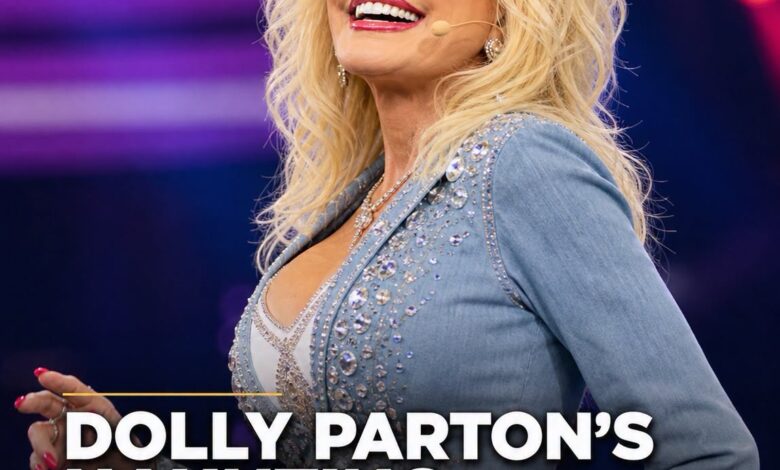
Dolly Parton never sounded like a woman preparing to disappear.
That may be the most heartbreaking part.
Even as her health became more difficult, even as public appearances grew less frequent and plans began shifting, Dolly continued talking about tomorrow.
There were projects she wanted to finish.
Songs she still wanted to write.
Stories she hadn’t told.
Places she wanted to build.
Ideas that existed only as sketches, conversations and dreams waiting for someone to turn them into something real.
When Dolly spoke about the future, she didn’t sound like someone closing a door.
She sounded like someone running late.
There was always another thing to do.
Another person to help.
Another melody waiting to arrive.
Another reason to believe she’d be back soon.
And when she reassured the people who loved her, that optimism carried the authority of a woman who had spent her entire life surviving things that should have diminished her.
Poverty hadn’t stopped her.
Rejection hadn’t stopped her.
Heartbreak hadn’t stopped her.
Age hadn’t stopped her.
Criticism certainly hadn’t stopped her.
Why should anything else?
For decades, Dolly had trained the world to expect another act.
So when she stepped away temporarily, people believed her.
They expected the curtain to rise again.
Only afterward did some of those hopeful words begin to sound different.
What once sounded like reassurance became unbearably tender.
What sounded like a pause began resembling a farewell nobody recognized while it was happening.
And the simplest promises hurt most.
See you soon.
Few phrases contain more ordinary hope.
We say it without thinking.
At doorways.
At airports.
At the end of telephone calls.
After dinner.
Before somebody drives away.
It assumes there will be another meeting.
Another conversation.
Another ordinary day.
Dolly seemed to live inside that assumption.
She continued imagining.
That was one of her defining characteristics.
Long after she had achieved more than the girl growing up in the Smoky Mountains could reasonably have imagined, Dolly kept dreaming as if she still had something to prove.
But the dreams had changed.
Early on, they were about escape.
She wanted to write songs.
She wanted Nashville.
She wanted people to hear her voice.
She wanted a life larger than the circumstances into which she had been born.
And she got it.
Then she did something more interesting.
She stopped dreaming only for herself.
Success became infrastructure.
Dollywood wasn’t merely a monument to celebrity. It brought employment and tourism to the region that shaped her.
The Imagination Library wasn’t simply philanthropy with a famous name attached. It grew from something deeply personal: Dolly’s awareness of what illiteracy had meant in her own family and her determination to put books into children’s hands before circumstance could limit their possibilities.
Her businesses became opportunities.
Her songs became doors.
Her fame became leverage.
That is why Dolly’s unfinished plans matter.
They reveal that she never believed legacy was something you began constructing after retirement.
Legacy was work.
There was always more of it.
She could have stopped decades earlier.
She had the money.
The awards.
The recognition.
The catalog.
She had nothing left to prove commercially.
But Dolly’s imagination apparently never received that message.
She continued discussing hotels, museums, entertainment projects and new creative ventures.
She talked about songs still waiting to be written.
She remained fascinated by what might come next.
Even as her body forced limitations upon her, her mind kept moving forward.
That contrast now feels almost cruel.
The body saying slow down.
The imagination saying keep going.
It is tempting, after someone dies, to search their final words for evidence that they somehow knew.
We replay interviews.
We reread captions.
We examine smiles.
We turn ordinary sentences into prophecies because grief wants the ending to have been understood by someone.
But perhaps Dolly’s final optimism matters precisely because it wasn’t a carefully scripted goodbye.
Maybe she really expected another chapter.
Maybe she believed there would be more time.
Most of us do.
That isn’t failure.
It’s life.
Dolly had always responded to uncertainty by creating something.
When she was poor, she wrote.
When her heart broke, she wrote.
When people underestimated her, she worked.
When doors closed, she found another entrance.
When she became successful, she created opportunities for others.
So when illness narrowed her world, it makes sense that she would continue reaching toward projects that required a future.
Creation was how Dolly argued with darkness.
A new song assumes someone will eventually hear it.
A new hotel assumes guests will arrive.
A museum assumes people will walk through its doors.
A book program assumes children will grow up.
Every act of creation contains faith in tomorrow.
Dolly spent her life practicing that faith.
And perhaps that is why her absence feels so strange.
She built so much movement around herself that stillness seems incompatible with her.
Dolly was always becoming something.
Singer.
Songwriter.
Actress.
Businesswoman.
Philanthropist.
Theme-park visionary.
Author.
Producer.
Cultural institution.
She somehow became larger without becoming distant.
People who never met her spoke about her with the warmth normally reserved for relatives.
Part of that came from the way Dolly told her story.
She never seemed embarrassed by where she came from.
The poverty wasn’t polished away once she became wealthy.
She carried the mountains with her.
She talked about the crowded cabin.
The homemade clothes.
Her parents.
Her siblings.
Her father’s work.
Her mother’s stories.
She transformed the details of hardship into proof that circumstances do not get the final vote on a person’s possibilities.
That message mattered because Dolly embodied it.
When she told a child to dream, she had once been that child.
When she encouraged someone to believe in an improbable future, she had lived one.
When she told women to own their ambition, she had spent decades surviving an industry perfectly willing to profit from talented women while allowing men to control the business.
Dolly learned to control her own.
She understood publishing.
Ownership.
Branding.
Negotiation.
She could laugh at herself while knowing precisely what her work was worth.
That combination became part of the inheritance she left women who followed.
You could be warm without being weak.
Feminine without surrendering authority.
Funny without becoming a joke.
Generous without becoming naive.
Ambitious without apologizing for wanting more.
And perhaps most importantly, you could refuse the version of yourself other people found easiest to understand.
Dolly did that repeatedly.
The image was exaggerated, but the woman controlling it was remarkably precise.
The hair grew higher.
The rhinestones became brighter.
The jokes became sharper.
Meanwhile, behind the spectacle, she wrote checks, negotiated contracts, protected copyrights, employed thousands and quietly expanded a literacy program across enormous distances.
People saw glitter.
Dolly understood structure.
That structure is part of why her work continues without her.
A child does not need Dolly physically standing nearby for a book to arrive.
A young songwriter doesn’t need to have met her to learn from the decisions she made.
A woman negotiating ownership of her work can still study Dolly’s example.
A family visiting the Smoky Mountains can still encounter the world she helped build.
And somewhere tonight, somebody who has never been to Tennessee will press play.
Maybe it will be “Jolene.”
Maybe “Coat of Many Colors.”
Maybe “9 to 5.”
Maybe “I Will Always Love You.”
The recording will begin.
And for several minutes, Dolly will exist exactly where she always did.
Inside a story.
That is the strange bargain artists make with mortality.
The person ends.
The performance doesn’t.
A singer can die while the voice remains young forever.
The first note waits patiently for someone to press play.
The song doesn’t know how much time has passed.
It simply begins again.
Dolly understood that power better than most because songwriting had always been central to how she understood herself.
Before the wigs became iconic and before Dollywood became a destination, she was a writer.
She took things human beings struggled to say and made them singable.
Jealousy.
Poverty.
Goodbye.
Work.
Desire.
Sacrifice.
Love strong enough to release someone.
Her greatest songs rarely needed complicated language.
They needed emotional precision.
She knew where the bruise was.
Then she touched it.
That gift will outlive every headline about her final months.
So will the books.
Perhaps nothing captures Dolly’s philosophy better than the Imagination Library because it operates on a beautiful assumption.
Give a child something now, and you may change a future you will never personally witness.
Dolly could never meet every child receiving those books.
She would never know every name.
She would never see every bedroom where a parent opened one before bedtime.
She would never witness every child discovering that printed words could contain entire worlds.
She gave anyway.
That is legacy in its purest form.
Doing something whose reward belongs to a future from which you may be absent.
In that sense, Dolly had been preparing for life after Dolly for years.
Not necessarily death.
Continuation.
She built mechanisms that did not require her constant physical presence.
She created things other people could carry.
That distinction changes the meaning of her unfinished dreams.
Yes, there were plans she could not personally complete.
That hurts.
There were songs that may never receive the final touch she intended.
Rooms she may have imagined but never walked through.
Projects whose opening days she expected to witness.
Promises of return that life did not allow her to keep literally.
But an unfinished dream is not always a dead dream.
Sometimes it becomes an assignment.
Someone else finishes the building.
Someone protects the foundation.
Someone sings the song.
Someone sends the book.
Someone takes the opportunity created by a person they never met and carries it farther.
That is how a life exceeds its biological boundaries.
Not through immortality.
Through transmission.
Dolly gave people things they could transmit.
Songs.
Stories.
Jobs.
Books.
Confidence.
Humor.
A model for surviving hardship without allowing hardship to become your entire personality.
And kindness that somehow remained visible despite decades inside an industry famous for consuming it.
Perhaps that is where her final “see you soon” belongs.
Not as a promise that she would physically return.
Not as some coded farewell.
Something gentler.
An invitation.
See me soon.
In the girl writing a song everyone tells her is too risky.
In the woman refusing to surrender ownership of something she created.
In the child opening a book that arrived with no expectation of repayment.
In the family visiting Tennessee and realizing somebody who escaped poverty chose to invest back into the place where it began.
In the person who discovers that humor can coexist with pain.
In the artist who learns that being underestimated can become an advantage.
In the stranger who decides generosity doesn’t require an audience.
That is where Dolly went.
Into other people’s choices.
Death creates a terrible illusion that everything has stopped.
For the people closest to someone, something has.
There is an empty chair.
A number you can no longer call.
A voice that exists only in recordings.
Plans that suddenly have no owner.
Grief is real precisely because presence cannot be replaced.
No legacy makes that painless.
But influence behaves differently.
Influence keeps moving.
Dolly Parton’s life had extraordinary momentum.
It would be almost impossible for that momentum to stop at the instant her heart did.
Too many people had already been touched by it.
Too many systems had been built.
Too many songs had escaped into the world.
Too many children had opened books.
Too many women had watched Dolly smile while quietly taking control of her own career and thought:
Maybe I can do that too.
That is continuation.
Not the sentimental kind that pretends death isn’t final.
The practical kind.
One person changes another.
That person changes somebody else.
The original source eventually disappears from sight, but the movement continues.
Dolly spent her final months still looking forward.
That may be what hurts most.
But perhaps it should also be what survives.
She didn’t spend her life teaching people how to stop.
She taught them how to make something out of whatever they were handed.
Poverty became songs.
Heartbreak became standards.
Fame became philanthropy.
Money became books.
A childhood dream became jobs for an entire region.
Even the exaggerated image people initially laughed at became one of the most recognizable personal brands on Earth.
Again and again, Dolly took what existed and asked what else it could become.
Now the question belongs to everyone left behind.
What can grief become?
Maybe another song.
Another book.
Another act of generosity nobody photographs.
Another impossible ambition somebody pursues because a girl from a one-room Tennessee cabin once demonstrated that improbable things occasionally happen to people stubborn enough to keep walking toward them.
Dolly couldn’t finish everything.
Nobody can.
A meaningful life almost guarantees unfinished work because meaningful people keep imagining things faster than time permits them to complete.
The tragedy isn’t that Dolly still had dreams.
The tragedy would have been reaching the end without any.
She never did.
Right to the edge, there was apparently another idea waiting.
Another story.
Another possibility.
Another tomorrow she was already filling.
So perhaps those final hopeful words don’t need to be heard as promises she failed to keep.
Maybe they were perfectly consistent with everything she had always believed.
There would be more.
She simply wouldn’t be the only one making it.
The music remains.
The businesses remain.
The books keep arriving.
The dreams have changed hands.
And somewhere, someone who never met Dolly Parton is about to do something courageous because of something she left behind.
That is not resurrection.
It is legacy.
And maybe that is what “see you soon” means now.
Not that Dolly will walk back onto the stage.
But that if we know where to look, she never entirely left it.