Billy Ray Cyrus Breaks His Silence on Dolly Parton — The Private Message She Sent Him Before Her Death Hits Hard

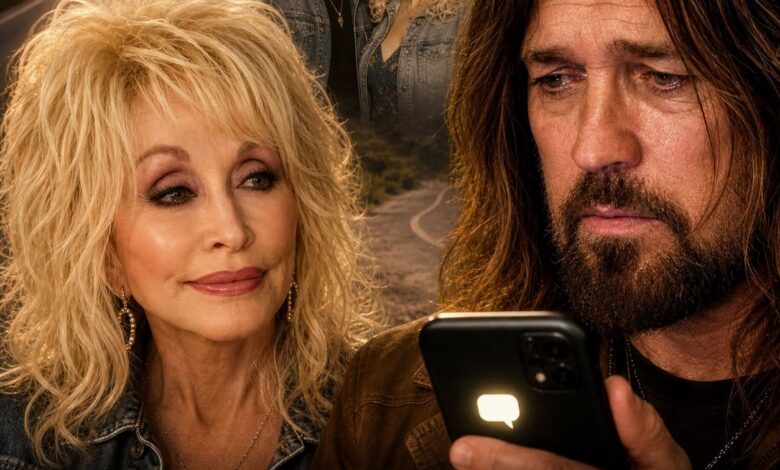
The last message Billy Ray Cyrus received from Dolly Parton wasn’t about music.
It wasn’t about awards, Nashville, old rumors, or the extraordinary careers that had connected their lives for more than three decades.
It was about love.
She told him she loved him with her whole heart.
After Dolly’s death at 80, those simple words became something Billy Ray could never read the same way again.
They were no longer merely another affectionate message from an old friend. They were among the final pieces of a relationship that had survived fame, gossip, family upheaval, career changes and the peculiar pressure of being watched by millions of strangers.
For Billy Ray, losing Dolly meant losing far more than a country music legend.
He had lost someone woven into the history of his family.
Their friendship stretched back to the early 1990s, when Billy Ray was exploding onto the country scene and suddenly discovering what it meant to become famous almost overnight.
“Achy Breaky Heart” transformed him from an aspiring musician into an international phenomenon. His face appeared everywhere. His mullet became almost as recognizable as his voice. Crowds screamed. Records sold.
And with that attention came gossip.
Dolly knew that world intimately.
By then, she had already spent decades learning how celebrity worked. She understood that once the public became fascinated by someone, ordinary friendships could be transformed into scandals simply because scandal made a better headline.
Billy Ray and Dolly discovered that firsthand.
As they became close, rumors began circulating about the nature of their relationship.
To outsiders, the story practically wrote itself.
He was the handsome new country sensation.
She was Dolly Parton.
Put them together, add a photograph and a suggestive headline, and suddenly friendship wasn’t interesting enough.
There had to be something more.
Billy Ray could have panicked.
Dolly laughed.
That reaction became one of his enduring memories of her.
She had spent too many years inside the machinery of fame to be intimidated by gossip. She knew that denying every rumor only gave some stories more oxygen.
So Dolly did what Dolly often did best.
She turned discomfort into comedy.
A wink.
A joke.
A perfectly timed remark.
Instead of allowing strangers to define their friendship, she made the absurdity part of the entertainment.
Billy Ray learned something from watching her.
Fame could take your privacy.
It could distort your intentions.
It could turn a friendship into a headline.
But it didn’t have to take your sense of humor.
More importantly, it didn’t have to determine whom you loved.
Their friendship endured.
Then something happened that made the connection far deeper than a professional relationship.
Dolly became Miley Cyrus’ godmother.
It was a role that seemed almost inevitable.
Miley grew up surrounded by music, celebrity and the complicated inheritance of being Billy Ray Cyrus’ daughter. Long before she could understand what fame would eventually demand from her, Dolly was already there.
And Dolly understood something Billy Ray could never fully teach his daughter himself.
She knew what it was like to be a woman in entertainment whose image threatened to become larger than the person underneath it.
She knew how quickly people could mistake appearance for intelligence.
She knew how audiences could adore a performer while simultaneously demanding ownership over her choices.
She knew what happened when a woman changed and the world resented her for no longer being the version it remembered.
Those lessons would become extraordinarily relevant as Miley grew older.
The little girl became a Disney star.
The Disney star became one of the most recognizable teenagers in America.
Then she became an adult determined to dismantle the identity other people had constructed around her.
The transformation wasn’t graceful.
Growing up rarely is.
Miley simply had to do it in front of millions of people.
There were controversies.
Performances that dominated headlines.
Relationships that became public property.
Reinventions.
Criticism.
Family tension.
Periods when seemingly everyone had an opinion about what Miley Cyrus should be.
Dolly remained.
She didn’t require Miley to stay innocent enough for nostalgia.
She didn’t disappear when the headlines became uncomfortable.
She understood that loving someone through change means allowing them to change.
That mattered to Billy Ray.
Whatever complexities existed within the Cyrus family, Dolly occupied a unique place inside it.
She was famous enough to understand their world but emotionally close enough to see the people underneath the headlines.
She wasn’t simply Billy Ray’s friend anymore.
She had become part of the family story.
Years accumulated.
Careers changed.
Billy Ray experienced enormous professional highs and difficult personal chapters.
Miley became a global star in her own right.
Dolly moved through all of it with the strange permanence she seemed to possess.
She was there so long that imagining a world without her became almost impossible.
That is one of grief’s cruelest tricks.
The people who have been present for decades begin to feel structural.
Like walls.
Like mountains.
Like something you assume will remain because it always has.
Until suddenly it doesn’t.
After Dolly died, Billy Ray returned to the message she had sent him.
She loved him with her whole heart.
There was nothing particularly complicated about the sentence.
That was what made it devastating.
Dolly was one of the greatest songwriters of her generation. She could construct an entire emotional universe in a handful of lines. She knew how to find the exact phrase that made heartbreak almost physically painful.
But sometimes love doesn’t require songwriting.
Sometimes the plainest words are the ones that remain.
I love you.
With my whole heart.
Billy Ray answered that message after she was gone in the only way that seemed possible.
He would love her the same way.
With his whole heart.
For the rest of his life.
The promise contained an unbearable truth.
Their friendship had become one-sided in the physical world.
There would be no new reply.
No phone call.
No mischievous laugh.
No Dolly turning a painful moment into a joke before anyone else knew what to say.
Billy Ray could continue loving her.
He simply had to learn how to do it in her absence.
That is what mourning eventually asks of everyone.
Love doesn’t necessarily stop when a person dies.
It loses its destination.
You still have the instinct to call.
To send the photograph.
To tell them what happened.
To hear what they think.
Then reality arrives again.
The number may still exist.
The messages may still be there.
But the conversation has ended.
For Billy Ray, the archive is unusually large.
There are photographs.
Performances.
Interviews.
Shared memories.
Stories stretching across more than thirty years.
There is footage of Dolly with Miley.
There are jokes about the rumors that once followed Billy Ray and Dolly.
There are public moments and countless private ones nobody outside their families will ever know.
And now there is that final message.
It inevitably changes the memories that came before it.
The old gossip, for example, seems almost comically insignificant.
At the time, tabloids wanted to turn their friendship into something scandalous because ordinary affection apparently wasn’t dramatic enough.
Decades later, the endurance of that friendship became the real story.
Dolly’s laughter in the face of those rumors mattered because it revealed something fundamental about her.
She refused to let other people make tenderness embarrassing.
She could love Billy Ray openly as a friend.
She could embrace Miley as family.
She could say exactly what someone meant to her without allowing strangers to dictate the vocabulary.
That confidence was one of Dolly’s quiet strengths.
She was sentimental without seeming ashamed of sentiment.
She could talk about faith, family, loyalty and love in an era increasingly suspicious of sincerity.
And because she possessed such a sharp sense of humor, the tenderness rarely became saccharine.
She could make you cry and then puncture the emotion with a joke.
Billy Ray knew that Dolly.
Not simply the icon preserved in rhinestones.
The woman who laughed.
The friend who checked in.
The godmother who loved his daughter.
The person who stayed.
That distinction becomes especially important after someone famous dies.
Public mourning naturally turns people into monuments.
The career gets summarized.
The awards are counted.
The biggest songs return to the charts.
Photographs from different decades are assembled into tributes.
The human being can disappear beneath the legacy.
But friends grieve differently.
They remember details too small for documentaries.
The way somebody answered the phone.
A private joke.
A phrase they repeated.
The expression that appeared just before they laughed.
The message that didn’t seem historically important when it arrived.
Those are the things death transforms into treasures.
For Billy Ray, “with my whole heart” became one of them.
Perhaps Dolly knew how much the words would matter.
Perhaps she didn’t.
Not every final message is written as a final message.
That is part of what makes them so powerful.
Human beings rarely know which conversation will become the last one.
We assume there will be another.
Another holiday.
Another performance.
Another phone call.
Another opportunity to say what we forgot.
Dolly had already said it.
Whatever else remained unfinished, Billy Ray did not have to wonder whether his friend loved him.
She told him.
Clearly.
Completely.
That is an extraordinary gift.
And the history behind those words made them even heavier.
She had known him when his career suddenly exploded.
She had watched the world gossip about them.
She had laughed beside him.
She had become family.
She had watched Miley grow from Billy Ray’s little girl into a woman commanding stages of her own.
She had remained connected through seasons when the Cyrus family itself was changing.
Thirty-plus years compressed into one sentence.
I love you with my whole heart.
It wasn’t a professional compliment.
It wasn’t country music royalty congratulating another performer.
It was Dolly talking to Billy Ray.
Friend to friend.
Family to family.
And now he carries the sentence alone.
There is something beautifully appropriate about Billy Ray’s response.
He did not try to compete with Dolly’s words.
He didn’t need an elaborate farewell.
He simply returned them.
Whole heart for whole heart.
Love given.
Love answered.
Maybe that is the real story of their relationship.
Not the rumors that once made headlines.
Not whether tabloids could manufacture romance from photographs.
Not even the celebrity connection that made Dolly the famous godmother of a future superstar.
It was endurance.
The world changed around them.
Their families changed.
Country music changed.
Billy Ray changed.
Miley changed.
Dolly herself moved through different eras of her career.
But affection remained.
That kind of constancy becomes increasingly valuable as life grows more complicated.
Dolly understood that relationships didn’t need to fit neatly into categories for them to matter.
She could mentor someone and tease them.
Work with someone and love them.
Be godmother, friend, collaborator and honorary family all at once.
Perhaps that is why so many people describe her loss in intimate terms.
Dolly had an unusual ability to make affection feel personal.
Billy Ray happened to know that affection firsthand.
Now every old photograph contains an absence.
Every performance becomes history.
Every story about the rumors ends differently because there will be no new chapter in which Dolly laughs about them again.
But the last message remains.
Billy Ray can return to it whenever grief makes memory feel unreliable.
There it is.
Written down.
Proof.
She loved him.
Not cautiously.
Not conditionally.
Not because they were useful to each other’s careers.
With her whole heart.
Death took away Dolly’s ability to send another message.
It did not take away Billy Ray’s ability to answer.
And so he made his promise.
He would keep loving her.
Through the songs.
Through the memories.
Through Miley.
Through every ridiculous old headline that now seems trivial compared with what their friendship actually became.
Through every moment when he can almost hear her laughing at something only Dolly would find funny.
For the rest of his life.
With his whole heart.
The tabloids once tried to decide what kind of love existed between Dolly Parton and Billy Ray Cyrus.
Time gave the better answer.
It was the kind that stayed.