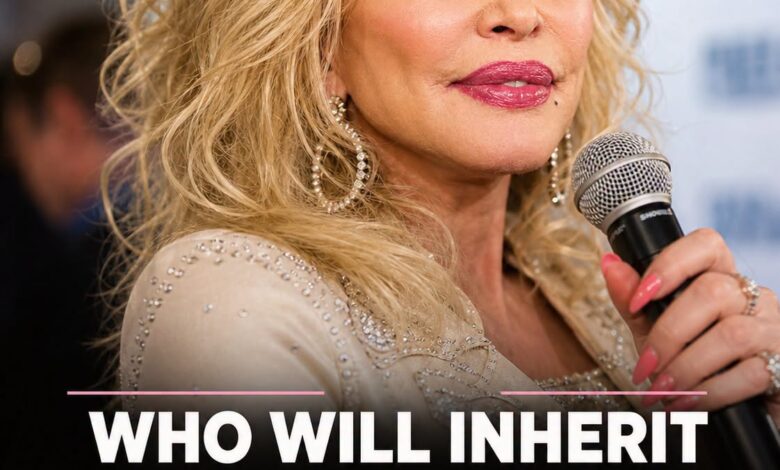
Dolly Parton spent a lifetime giving things away.
Songs. Books. Money. Opportunities. Hope.
But when it came to what would happen to everything she had built after her death, she appears to have approached the question with the same careful business instincts that helped turn a poor Tennessee girl into one of entertainment’s most enduring empires.
And that leaves one enormous question:
Who inherits Dolly Parton’s fortune?
Estimates placed her net worth at roughly $450 million, although celebrity wealth figures are notoriously difficult to verify. Her assets weren’t simply piles of cash sitting in bank accounts. They were connected to businesses, intellectual property, real estate, investments, charitable ventures, and, perhaps most importantly, music.
Her song catalog alone has been estimated to be worth around $120 million.
Then there is Dollywood, the Tennessee attraction that transformed Dolly’s connection to her birthplace into a major tourism enterprise and economic engine.
Add decades of royalties, licensing arrangements, publishing interests, branding, television and film work, and other ventures, and the estate becomes considerably more complicated than dividing money among relatives.
Dolly also left behind no children.
Her husband, Carl Dean, with whom she shared nearly 60 years of marriage, died in 2025.
That means the two people many would instinctively imagine at the center of an inheritance story—a spouse and children—weren’t there to provide an obvious answer.
But Dolly had something perhaps more important.
A plan.
Long before questions about her estate became urgent, she had spoken about the importance of arranging her affairs properly.
She had watched what happened when famous people died without sufficient planning.
Suddenly, private relationships became courtroom evidence.
Family disagreements became headlines.
Business arrangements were dissected publicly.
Songs became assets fought over by heirs, managers, companies, and attorneys.
Dolly had spent too many decades building her career to casually leave its future to chance.
Behind the deliberately exaggerated country-girl image was an exceptionally shrewd businesswoman.
People underestimated that at their peril.
Dolly understood ownership early.
One of the defining decisions of her career involved maintaining control over her songwriting.
That mattered enormously.
Songs aren’t merely recordings.
They can continue generating value through radio, streaming, films, television, advertising, cover versions, licensing, and countless uses that may not even exist when the songwriter first puts pen to paper.
Dolly understood that a song could outlive its creator.
Few examples demonstrate that better than “I Will Always Love You.”
She wrote the song herself, and when Elvis Presley’s team expressed interest in recording it, Dolly faced a decision that could have changed her financial future.
The proposed arrangement reportedly involved giving up a substantial portion of the publishing rights.
She refused.
It was painful.
Having Elvis record one of her songs could have been an extraordinary career moment.
But Dolly understood what ownership meant.
Years later, Whitney Houston recorded “I Will Always Love You,” turning it into one of the most famous recordings in pop history.
Dolly’s decision to retain control became legendary.
That story is important when considering her estate because it reveals how she thought.
She wasn’t careless with the things she created.
She understood their long-term value.
So it would be surprising if someone with that level of foresight simply left hundreds of millions of dollars in assets without detailed instructions.
Trusts are one possibility.
Unlike a traditional will that may eventually become accessible through probate proceedings, trusts can allow substantial portions of an estate to remain private.
They can also provide much greater control.
A person can establish rules governing when assets are distributed, who manages them, how intellectual property is handled, what happens to business interests, and how charitable commitments continue.
For someone like Dolly, that could be crucial.
Her estate isn’t merely about wealth.
It is about stewardship.
Who decides when one of her songs can be licensed?
Who protects her name and likeness?
Who oversees her publishing interests?
Who ensures that businesses connected to her image continue operating in ways consistent with what she wanted?
Who prevents an iconic catalog from being fragmented or sold simply because individual heirs want cash?
Those questions can matter more than the headline number attached to an estate.
Then there is Dolly’s enormous family.
She grew up as one of twelve children.
Throughout her life, she maintained strong connections to siblings, nieces, nephews, and extended relatives. Family wasn’t an abstract concept to Dolly. It was embedded in her identity, her music, her businesses, and her understanding of where she came from.
That naturally creates speculation that relatives could benefit from her estate.
But without public documentation confirming individual beneficiaries, assigning specific fortunes to particular family members would be guesswork.
And Dolly may have wanted it that way.
Privacy was one of the quiet themes running through her life.
People sometimes forget that because Dolly seemed so open.
She could tell hilarious stories about herself.
She joked about cosmetic surgery.
She discussed growing up poor.
She talked about faith, marriage, ambition, and mistakes.
But she was remarkably skilled at deciding exactly how much the public was allowed to know.
Carl Dean was perhaps the clearest example.
For nearly six decades, Dolly managed to maintain one of the most private marriages in entertainment while simultaneously being one of the world’s most recognizable celebrities.
Carl didn’t want fame.
Dolly respected that.
If she could protect a marriage from the machinery of celebrity for that long, she certainly understood the value of keeping estate arrangements away from public spectacle.
Her charitable legacy adds another layer.
Dolly didn’t wait until death to become philanthropic.
She gave while she was alive.
That distinction matters.
Her most famous charitable project, the Imagination Library, began in Tennessee in 1995 and expanded dramatically, sending free books to young children regardless of family income.
The inspiration was deeply personal.
Dolly’s father couldn’t read or write.
She spoke with enormous affection about him, and the literacy program became one way of honoring both him and the children whose circumstances might otherwise limit their opportunities.
Over the decades, the program distributed hundreds of millions of books.
That is legacy planning of a different kind.
Rather than simply writing a charitable organization into a will, Dolly built something during her lifetime that could develop its own structure, partnerships, funding relationships, and identity.
She could watch it work.
She could improve it.
And she could establish something capable of continuing without her.
The same is true of Dollywood.
To outsiders, it can look like another celebrity-branded attraction.
To Dolly, it represented something more.
She could have taken her wealth anywhere.
Instead, she repeatedly invested in East Tennessee, helping create jobs and tourism in the region that formed her.
The poor girl who left the Smoky Mountains seeking opportunity eventually returned with enough power to create opportunities for others.
That pattern appeared repeatedly in her life.
She turned personal experience into something useful.
Poverty became songs.
Her father’s illiteracy helped inspire a literacy program.
Her fame became leverage for philanthropy.
Her business success became employment.
Even her songwriting rights became an example of why creators should understand the value of what they own.
That is why reducing Dolly’s estate to “Who gets the $450 million?” misses much of the story.
The more interesting question is what happens to the machinery she built.
Money can be divided.
A legacy has to be managed.
Imagine the challenge facing whoever is entrusted with Dolly Parton’s intellectual property.
Her songs aren’t merely financial assets.
They are pieces of American cultural history.
“Jolene.”
“9 to 5.”
“Coat of Many Colors.”
“I Will Always Love You.”
Each can generate revenue for decades.
But each can also be associated with products, films, advertisements, political campaigns, performances, and technologies Dolly never personally encountered.
Future administrators may have to make decisions she cannot make herself.
Would Dolly have approved this commercial?
Would she have wanted her voice used this way?
Should this song appear in this project?
How aggressively should licensing opportunities be pursued?
At what point does maximizing revenue begin damaging the identity she spent a lifetime creating?
Those aren’t ordinary inheritance questions.
They are guardianship questions.
The same applies to her image.
Dolly Parton wasn’t simply a person who made music.
“Dolly” became a cultural brand with an instantly recognizable visual language: blond hair, rhinestones, humor, Tennessee roots, warmth, exaggeration, and an almost stubborn optimism.
That identity has enormous commercial value.
Handled carefully, it could support businesses and charities for generations.
Handled badly, it could become just another celebrity image printed onto anything someone is willing to buy.
Dolly understood branding better than many executives.
It is difficult to imagine that she didn’t think about that distinction.
There is also a misconception that having no children means having no heirs.
Dolly’s life demonstrated the opposite.
She had an enormous extended family.
She had godchildren.
She had colleagues who became family.
She had charitable institutions.
She had business organizations.
And she had causes she had supported for decades.
Inheritance doesn’t have to move in one direction.
An estate can support relatives while simultaneously funding charitable work, preserving businesses, managing intellectual property, and establishing long-term trusts.
Indeed, that kind of diversified plan might fit Dolly better than simply handing everything to one person.
She had spent her life distributing opportunity rather than concentrating it.
But until reliable estate documents or authorized representatives identify beneficiaries, the exact arrangement remains private.
That uncertainty will inevitably attract rumors.
Someone will claim a particular relative inherited everything.
Another story will insist the entire fortune went to charity.
Others will attach precise dollar amounts to people without evidence.
Celebrity estates generate those stories because enormous numbers attract attention.
Dolly’s actual planning may prove much less sensational.
It may involve lawyers, trustees, corporate entities, charitable foundations, licensing agreements, and carefully written instructions.
In other words, exactly the kind of boring preparation that prevents spectacular family disasters.
That may ultimately be one of Dolly’s final acts of generosity.
Poor estate planning can turn grief into litigation.
Relatives who should be mourning instead hire attorneys.
Old resentments surface.
Private conversations become depositions.
Money transforms relationships into competing claims.
Dolly had seen enough of show business to understand how ugly that could become.
Planning ahead could spare the people she loved from having to fight over what she left behind.
And perhaps that is the most fitting way to understand her fortune.
The $450 million estimate makes an irresistible headline.
The $120 million song catalog sounds astonishing.
But Dolly Parton’s real wealth was always more difficult to calculate.
How much is a song worth after it helps someone survive heartbreak?
What is the value of a book arriving at the home of a child who has never owned one?
What is a job worth to a family in the region where Dolly herself grew up poor?
How do you put a price on an artist retaining ownership of her work and inspiring generations of songwriters to think differently about theirs?
Those things don’t appear neatly on an estate inventory.
Yet they may endure longer than the money.
Eventually, more details about Dolly’s estate may emerge.
Perhaps relatives will be identified as beneficiaries.
Perhaps significant assets will support charitable causes.
Perhaps trusts will keep most of the arrangements private indefinitely.
Perhaps the answer will be some combination of all three.
But one thing seems consistent with the life Dolly spent building.
She never treated success as something that should stop with her.
She transformed it.
Reinvested it.
Shared it.
Turned it into books, jobs, music, opportunities, and institutions.
The girl who once had very little became a woman with more than she could possibly spend on herself.
And long before anyone began asking who would receive what remained, Dolly had already spent decades answering the larger question.
What should you do when life gives you more than you need?
Give some of it back.
Build something that lasts.
Protect the people you love.
And make sure the good continues after you’re gone.
Whatever names ultimately appear in Dolly Parton’s estate documents, they will inherit only part of what she left behind.
The money will change hands.
The businesses will continue.
The songs will generate royalties.
But millions of books will keep arriving in children’s homes bearing the legacy of a woman they never met.
And somewhere, decades from now, someone will hear “Jolene” or “I Will Always Love You” for the first time.
That may be the inheritance Dolly understood best.
Not simply wealth passed from one person to another.
Something valuable kept alive.