One Week Before Her Passing, Dolly Parton Made Her Final Appearance — Fans Say She Looked ‘Like an Angel’

Nobody knew they were watching Dolly Parton say goodbye.
That may have been exactly how she wanted it.
There was no grand farewell tour. No solemn television interview announcing that the end was near. No carefully marketed final concert where every lyric carried the unbearable knowledge that it would never be sung live again.
Instead, there were rhinestones.
Jokes.
Perfect wigs.
Video messages.
A giant pair of scissors.
And a woman who, even as her physical world appeared to grow smaller, remained fiercely determined to control what the public saw.
Looking back, Dolly’s final appearances can feel different.
Moments that seemed like temporary interruptions now resemble pieces of a farewell she never publicly acknowledged.
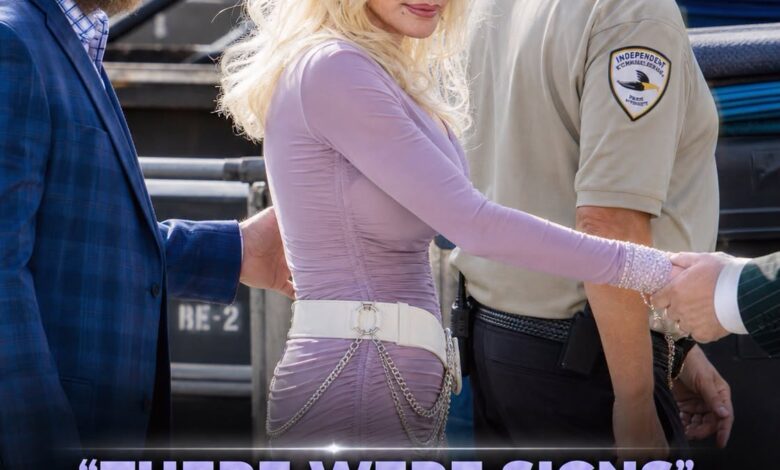
At the opening of Dolly’s Tennessean Travel Stop in Cornersville, Tennessee, she appeared exactly as people expected Dolly Parton to appear.
Blond curls perfectly arranged.
A glamorous outfit.
That unmistakable smile.
The humor still intact.
She stood with oversized ceremonial scissors and celebrated the opening with the enthusiasm expected of the woman whose name was attached to the building.
But behind the sparkle, something seemed different.
Dolly moved carefully.
People close to her stayed close.
At moments, two men appeared to provide physical support, helping steady the woman who had spent decades commanding enormous stages in towering heels.
It was an unsettling contrast.
Dolly had always seemed almost physically inseparable from motion.
She bounced into rooms.
She gestured when she talked.
She performed with an energy that made her elaborate costumes seem weightless.
Now every step appeared more deliberate.
Yet she still showed up.
That mattered to her.
The name tag pinned to her outfit almost seemed like a private Dolly joke.
As if one of the most recognizable women in American entertainment might need to introduce herself.
Dolly.
Of course.
She had spent decades making exaggeration look effortless, and even in a moment of visible fragility, the familiar machinery remained in place.
The hair.
The makeup.
The clothes.
The smile.
The joke.
The performance wasn’t necessarily deception.
It may have been protection.
Dolly understood audiences better than almost anyone.
She knew people didn’t simply listen to her music.
They carried an emotional idea of her.
Dolly was reassurance.
She was the woman who could sing about unbearable heartbreak and somehow make you feel stronger afterward.
She could discuss childhood poverty without surrendering joy.
She could turn humiliation into a punch line before anyone else got the chance.
For millions of people, Dolly represented resilience with eyelashes.
Perhaps she wasn’t ready to let illness replace that image.
So when appearing physically became harder, technology offered another way.
The stage became a screen.
For the ACM Poet’s Award, Dolly appeared remotely, dressed beautifully in white.
She looked serene.
Composed.
Almost luminous.
Viewers saw the version of Dolly they knew.
The image was controlled.
The lighting was flattering.
The message was warm.
There was no dramatic confession about mortality.
No request for sympathy.
Just Dolly, still participating in the world she had helped build.
That appearance now carries a different emotional weight because of what followed.
At the time, fans could reasonably interpret a virtual appearance as convenience.
Dolly was older.
She had worked relentlessly for decades.
Travel was exhausting.
Remote appearances had become normal for celebrities.
There was no reason to assume that a screen was functioning as a curtain.
Then came Dollywood.
Again, Dolly couldn’t be there in person.
Again, she found a way to appear.
And again, she transformed vulnerability into comedy.
She wore fairy wings.
Pink.
Sparkle.
Pure Dolly.
Then she joked that her doctor had “clipped” her wings.
It was exactly the kind of line she had been delivering for decades.
Take something frightening.
Dress it in rhinestones.
Make everybody laugh before they have time to worry.
She referred to health problems in reassuring language.
Dizziness.
Dehydration.
Things that sounded temporary.
Treatable.
Annoying rather than catastrophic.
The message underneath seemed clear:
Don’t worry about me.
I’m still here.
I’m working.
I’m getting better.
I’ll be back.
Fans wanted desperately to believe her.
Why wouldn’t they?
Dolly had been “coming back” for her entire life.
Every setback became another story.
Every disappointment became material.
Every changing musical era somehow made room for her again.
She possessed that rare quality that makes a person feel permanent.
Age seemed almost irrelevant to her public identity.
The face changed.
The voice matured.
The world around her transformed.
But Dolly remained Dolly.
So when she said she was dealing with health problems, people heard what they wanted to hear.
Temporary.
Recovering.
Soon.
They didn’t hear goodbye.
Behind the carefully presented appearances, however, her life seemed to be contracting.
Events were canceled.
Plans changed.
Public appearances became rarer.
The woman who had spent decades traveling between studios, stages, business meetings, charity events, film sets, and Dollywood increasingly remained close to home.
Her Tennessee estate became a refuge.
The contrast was extraordinary.
Dolly Parton had built a life almost impossibly large.
Her songs traveled everywhere.
Her image appeared around the world.
Her businesses drew millions of visitors.
Her Imagination Library placed books into the homes of children she would never meet.
Yet illness can reduce even enormous lives to small spaces.
A bedroom.
A chair.
A doctor’s appointment.
A screen.
A few trusted people allowed inside.
And still, when the camera came on, Dolly assembled herself.
That may be the most heartbreaking detail.
The public Dolly Parton had always been partly a construction.
She said so herself.
The wigs were deliberate.
The exaggerated makeup was deliberate.
The costumes were deliberate.
She had taken an idea of glamorous femininity, amplified it beyond reason, and turned it into one of entertainment’s most recognizable identities.
There was tremendous freedom in that construction.
If Dolly could create the image, Dolly could control it.
Illness threatened that control.
A failing body doesn’t care about branding.
Fatigue doesn’t care about rhinestones.
Pain doesn’t wait until the camera switches off.
But Dolly still had one choice available.
She could decide how much strangers were permitted to witness.
Apparently, the answer was: not much.
She would show the smile.
Not necessarily what happened after the smile disappeared.
She would make the joke.
Not necessarily the frightening conversation that preceded it.
She would acknowledge health concerns.
But she would not allow them to consume the story.
There is something deeply consistent about that choice.
Dolly had always guarded important parts of herself despite appearing extraordinarily accessible.
Her husband, Carl Dean, remained almost entirely outside the celebrity machine throughout their marriage.
Her private home life stayed remarkably private.
She could tell intimate stories without giving strangers unrestricted access to the people she loved.
Privacy wasn’t secrecy for its own sake.
It was a boundary.
In her final chapter, that boundary may have become even more important.
The public didn’t need to see every difficult moment.
She had spent decades giving audiences pieces of herself.
The rest still belonged to Dolly.
That doesn’t mean the signs weren’t visible.
They were.
The careful walking.
The physical support.
The missed appearances.
The switch to prerecorded messages.
The references to doctors.
The canceled commitments.
The increasingly reassuring explanations.
Viewed separately, each detail could mean almost nothing.
Together, and only in hindsight, they form a more troubling picture.
But hindsight is cruel.
It creates patterns from moments that were ambiguous while we were living through them.
Once we know someone is gone, every previous sentence begins sounding prophetic.
Every photograph becomes potentially “the last.”
Every smile looks fragile.
Every joke seems to conceal something.
We begin searching backward for the exact moment goodbye started.
Usually there isn’t one.
Life doesn’t provide that kind of editing.
There are simply moments.
At Cornersville, Dolly smiled.
People helped steady her.
She opened the travel stop.
The crowd celebrated.
Later, she appeared through screens.
She accepted honors.
She joked.
She talked about work.
She reassured people.
Then, suddenly, those appearances stopped being updates.
They became archives.
That transformation is what makes final footage so painful.
When it was recorded, the person was alive.
Planning.
Speaking in the present tense.
Thinking about tomorrow.
Then death arrives and changes the grammar.
“I am” becomes “she was.”
“I’ll see you” becomes a sentence that can never be fulfilled.
“We’re working on” becomes unfinished business.
The video itself hasn’t changed.
We have.
Perhaps that is why Dolly’s humor in those final appearances feels especially poignant.
Humor had always been one of her methods of control.
People could stare at her body, speculate about cosmetic surgery, mock her clothes, underestimate her intelligence, or make assumptions about her background.
Dolly would usually arrive at the joke first.
She understood something powerful:
If you can laugh without surrendering your dignity, other people’s laughter loses some of its ability to wound you.
She apparently applied the same instinct to illness.
Doctor clipped my wings.
It’s funny.
It’s reassuring.
It turns medical vulnerability into a Dolly Parton punch line.
And for a moment, everybody can relax.
Maybe she needed that too.
There is a tendency after famous people die to interpret every late appearance as an intentional farewell.
Reality is usually more complicated.
Dolly may have expected to recover.
She may have genuinely believed there would be another event, another recording session, another opening, another joke.
Human beings can understand that they are seriously ill while still planning for tomorrow.
Hope and realism can occupy the same room.
What does seem clear from the image she presented is that she didn’t want to be reduced to illness.
She had spent too long becoming something larger.
Not larger than mortality.
Nobody achieves that.
Larger than the idea that a person’s weakest physical moment should define the life that came before it.
If Dolly’s body was failing, her imagination wasn’t required to fail with it.
She could still plan.
Still write.
Still joke.
Still put on the wig.
Still choose the earrings.
Still speak to fans.
Still be Dolly.
There is dignity in that.
There is also sadness.
Because the audience now knows something it didn’t know then.
There wouldn’t be unlimited next times.
The Cornersville appearance wouldn’t simply become another ribbon cutting in a long schedule of appearances.
The virtual messages wouldn’t be placeholders until she returned.
Eventually, the screen would go dark.
And the woman who had spent decades telling everyone else how to survive heartbreak would become the reason millions experienced it.
Perhaps the most haunting part isn’t that fans missed the clues.
It is that they trusted Dolly’s reassurance because she had trained them to.
She had spent a lifetime transforming pain before handing it over.
She rarely delivered suffering raw.
She wrote it into songs.
Wrapped it in melody.
Added humor.
Found a rhyme.
Put rhinestones around it.
Then offered it back as something people could survive.
Why would the end be completely different?
At Cornersville, she allowed herself to be held upright but still smiled for the crowd.
On screen, she allowed people to know there was a doctor but not necessarily everything the doctor knew.
In fairy wings, she transformed physical limitation into another joke.
Even as her world narrowed, the Dolly the audience received remained expansive.
Bright.
Funny.
Working.
Hopeful.
Maybe those appearances weren’t clues we failed to decipher.
Maybe they were gifts we were meant to receive exactly as she presented them.
Not as warnings.
Not as puzzles.
Not as invitations to investigate a sick woman’s body.
But as final pieces of joy from someone who had spent her life creating it.
Only afterward did they become goodbyes.
And perhaps that is the strange mercy of it.
Millions of people didn’t spend Dolly Parton’s final appearances staring at her and thinking about death.
They laughed.
They applauded.
They listened.
They believed there would be more.
For a little while longer, she wasn’t a dying legend.
She was simply Dolly.
Sequined.
Funny.
Stubborn.
Still making plans.
Still protecting the audience from more than it knew.
And still, until almost the very end, deciding exactly when the curtain came down.