Dolly Parton spent decades carefully avoiding one of the most dangerous stages in America.
Politics.
She could stand before thousands of people, sing about poverty, heartbreak, working women, faith, and injustice, and somehow leave audiences with wildly different political beliefs feeling that she understood them.
That wasn’t an accident.
Dolly had repeatedly resisted attempts to turn her into a partisan symbol.
Then came the announcement of her death at 80.
Almost immediately, the restraint she had practiced for a lifetime became harder for others to preserve.
Millions mourned.
Musicians shared memories.
Fans returned to the songs that had accompanied marriages, funerals, road trips, breakups, and childhoods.
Her family asked people to remember the woman they loved.
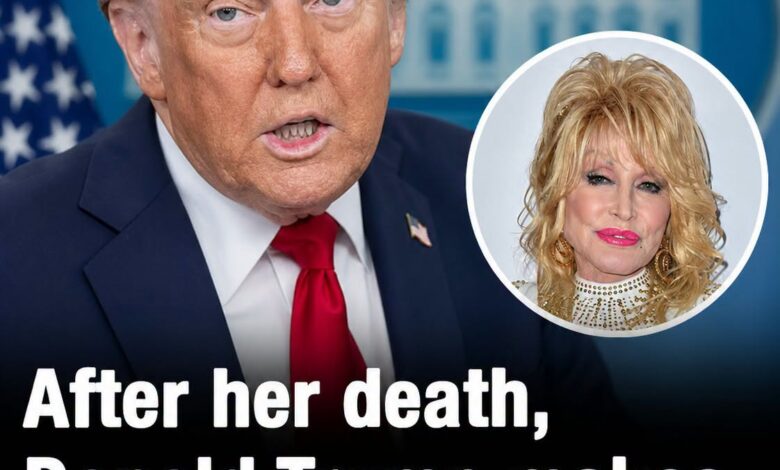
And then Donald Trump’s response transformed part of that mourning into something else entirely.
His tribute was enormous in symbolic terms.
Trump ordered American flags lowered to half-staff for an extended period, treating Dolly’s death not merely as the passing of an entertainer but as a national loss.
For many fans, that gesture seemed appropriate.
Dolly Parton had long ago become larger than country music.
She was part of America’s cultural vocabulary.
Her songs crossed genres.
Her philanthropy reached families who might never have purchased one of her albums.
Her Imagination Library put books into children’s hands.
Her story—from poverty in the Smoky Mountains to international fame—embodied a particularly American mythology about reinvention, ambition, and possibility.
Lowering flags for her therefore carried an understandable message:
The country had lost one of its own.
But then Trump went further.
He spoke about Dolly personally, claiming that she had liked him but had avoided saying so publicly because she feared alienating part of her audience.
And suddenly, the conversation changed.
People were no longer simply discussing Dolly’s life.
They were debating what Dolly secretly believed.
That was exactly the kind of argument she had spent years avoiding.
Throughout her career, Dolly displayed an extraordinary ability to discuss values without regularly endorsing candidates.
She could advocate generosity without demanding that listeners adopt a particular party label.
She could speak about acceptance without converting every interview into a political declaration.
She could celebrate working people without allowing herself to become the property of either political camp.
That balancing act became increasingly difficult as American culture grew more polarized.
People wanted to know.
Was Dolly conservative?
Was she liberal?
Who did she vote for?
What did she think about this president?
What about that candidate?
Which side was she really on?
Dolly’s answer, in one form or another, was usually that politics wasn’t where she wanted to live publicly.
She understood something celebrities sometimes learn painfully: the moment a universally loved figure attaches themselves firmly to one political faction, part of the audience stops hearing the person and starts hearing the party.
Dolly didn’t want that.
Her reluctance surrounding the Presidential Medal of Freedom illustrated the problem.
She had explained that she declined offers during Trump’s presidency for personal reasons and later hesitated about accepting one under President Joe Biden because doing so might appear political.
The distinction was important.
She wasn’t necessarily rejecting the honor.
She was protecting herself from becoming a political trophy.
That instinct had guided much of her public life.
Dolly wanted her work to travel into rooms where political arguments couldn’t.
A children’s book didn’t need to know how a parent voted.
A song about heartbreak didn’t require party registration.
A struggling family didn’t need to pass an ideological test before receiving compassion.
That was part of her unusual power.
People who couldn’t agree about Washington could agree about Dolly.
So when Trump suggested after her death that she privately favored him, the statement touched a nerve.
Supporters saw nothing inappropriate.
Perhaps, they argued, he was simply sharing a personal impression about someone he admired.
Politicians routinely speak about their encounters with famous people after those people die.
Maybe Dolly had indeed been warm toward him.
Warmth, after all, was hardly unusual for her.
But critics saw something different.
They saw a private political allegiance being assigned to a woman who was no longer alive to clarify it.
And that raised an uncomfortable question:
Who gets to speak for Dolly Parton when Dolly Parton can no longer speak for herself?
The answer should probably begin with what she actually chose to say while she was here.
Dolly’s public persona wasn’t apolitical because she lacked convictions.
Quite the opposite.
Her life reflected plenty of them.
She believed in literacy strongly enough to build a massive book-gifting program.
She invested in the region where she grew up.
She supported medical research.
She spoke repeatedly about kindness and acceptance.
She understood poverty because she had lived it.
She understood what it meant to be underestimated because she had spent decades watching people mistake rhinestones and blond wigs for a lack of intelligence.
But she generally resisted converting those convictions into partisan endorsements.
That was her boundary.
And boundaries become particularly vulnerable after death.
A living person can correct the record.
They can say, “That’s not what I meant.”
They can laugh off an interpretation.
They can refuse the question.
They can change the subject.
The dead cannot.
Their words become quotations other people arrange into whatever story they want to tell.
Their friendships become evidence.
Their silences become evidence.
Even their politeness can become evidence.
That is why Trump’s assertion became more significant than an ordinary celebrity anecdote.
If Dolly “really liked” him, what did that mean?
Liked him personally?
Supported him politically?
Was simply gracious toward him?
Would have voted for him?
Wouldn’t have?
Nobody should pretend those questions have the same answer.
Dolly was famously capable of being kind to people without publicly adopting their politics.
In fact, that ability was central to her appeal.
She could disagree without making disagreement the entire relationship.
Perhaps that’s why the debate following Trump’s remarks felt so contrary to her spirit.
One group wanted to claim her.
Another wanted to prove she could never have belonged to them.
Soon, people weren’t mourning Dolly.
They were fighting over Dolly.
The woman who had spent decades refusing to become another weapon in America’s political wars was being loaded into the chamber after she was gone.
There is an irony there that is difficult to miss.
Dolly’s broad popularity existed partly because she resisted demanding ideological conformity from the people who loved her.
She understood that an audience could contain contradictions.
The same concert might include Republicans and Democrats.
Conservatives and progressives.
Churchgoing grandmothers and queer teenagers.
Rural families and urban celebrities.
People who disagreed about almost everything could still know every word to “Jolene.”
That wasn’t weakness.
It was an extraordinary cultural achievement.
America has fewer and fewer spaces like that.
Perhaps Dolly herself was one of them.
Which makes the national mourning surrounding her death understandable.
Flags can be lowered for a public figure without determining which political faction gets to inherit her.
A president can honor her without owning her.
Fans can disagree about politics without requiring Dolly’s ghost to settle the argument.
Her legacy is already substantial enough to survive without anyone assigning her a posthumous party membership.
She wrote songs people will continue singing.
She built businesses that transformed her home region.
She gave millions of children books.
She created opportunities.
She made people laugh.
She showed generations of women that femininity and formidable intelligence were not opposites.
And perhaps most remarkably, she managed to remain beloved in a culture increasingly organized around deciding whom we’re supposed to hate.
That may be the Dolly worth protecting now.
Not the imaginary Republican Dolly.
Not the imaginary Democratic Dolly.
Not the version assembled from somebody else’s recollections after her death.
The Dolly who repeatedly chose not to tell millions of people how they should vote.
The woman who understood that kindness didn’t require agreement.
The entertainer who could walk into almost any room in America and somehow belong there.
Trump’s tribute may have been intended as praise.
The lowering of flags recognized the extraordinary scale of the loss.
But his comments also demonstrated how quickly even grief can become political property.
Dolly knew that danger while she was alive.
That’s why she was so careful.
And perhaps respecting her now means resisting the temptation she resisted herself.
We don’t need to decide whom Dolly secretly supported to understand what she publicly stood for.
Her life already told us.
Work hard.
Help people.
Remember where you came from.
Laugh whenever possible.
Don’t let other people define you.
And leave the world with more kindness than you found in it.
Those principles don’t fit neatly onto a campaign sign.
Maybe that was the point.
Dolly Parton spent a lifetime refusing to belong exclusively to one side of America.
In death, everyone may want to claim her.
But perhaps her greatest political statement was the one she made by refusing to become political property at all.
She belonged to herself.
And after that, she belonged to everyone.