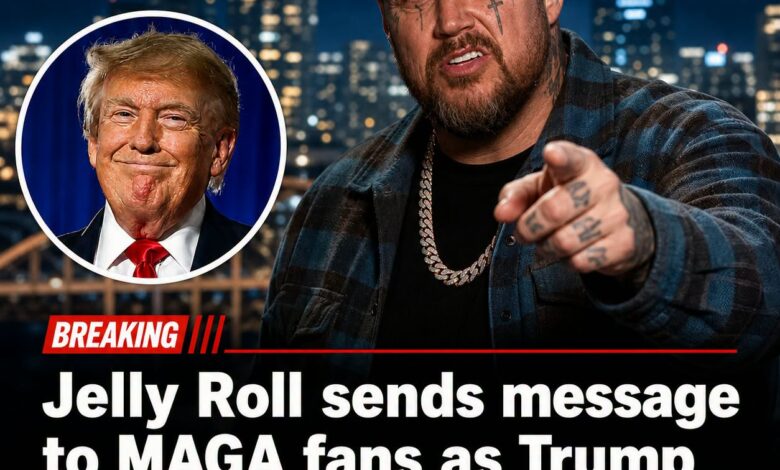
Jelly Roll walked onto the Jimmy Kimmel Live! stage knowing almost anything he said could become a headline.
He could have played it safe.
Tell a few harmless jokes. Talk about music. Charm the audience with the self-deprecating humor that has helped make him one of country music’s most unlikely stars. Thank everyone for letting him guest-host and get out before social media found something to fight about.
Instead, he went straight at Donald Trump.
Within minutes, what was supposed to be a celebrity guest-hosting appearance became something much larger: an argument about comedy, politics, celebrity, and whether the president of the United States should ever be considered off-limits.
Jelly Roll clearly had no interest in treating him that way.
The jokes came quickly.
He mocked Trump’s weight. He seized on the president’s “own race” remark. He ridiculed the spectacle surrounding what critics described as a “lap of honor” motorcade.
There was little attempt to disguise the target.
This wasn’t carefully neutral humor designed to leave every political faction equally satisfied.
Jelly Roll was taking swings.
And predictably, the reaction arrived almost immediately.
Some viewers loved it.
Others were furious.
Social media filled with people accusing the country star of insulting Trump, alienating conservative fans, and wandering into politics when he should have stuck to music.
That last criticism is familiar to almost every entertainer who publicly expresses a political opinion.
Sing.
Act.
Tell jokes.
But don’t tell us what you think.
Jelly Roll’s response suggested he wasn’t particularly interested in accepting those rules.
Rather than retreating from the controversy, he defended the basic premise behind the monologue: presidents should be able to withstand jokes.
That idea is hardly revolutionary.
American presidents have been mocked for generations.
Their voices, hair, age, intelligence, mistakes, marriages, policies, scandals, mannerisms, and physical appearance have all become material for comedians.
Power attracts satire.
That’s part of the arrangement.
Yet political comedy feels different in a deeply polarized country.
A joke about a president isn’t always received as a joke anymore.
For supporters, it can sound like an attack on them personally.
For opponents, laughter can become a form of political victory.
Every punch line gets drafted into a larger war.
Jelly Roll walked directly into that environment.
And when some fans threatened to stop supporting him, his answer was essentially that they were free to do exactly that.
If his opinions were unacceptable to them, they didn’t have to listen.
That response was unusually blunt for an artist whose career depends on maintaining an enormous audience.
Country music, in particular, has often forced performers to navigate political identity carefully. Its audience contains strong conservative constituencies, but it is far from politically uniform.
Jelly Roll understood the risk.
He spoke anyway.
That shouldn’t have been entirely surprising.
His career has been built around refusing to hide the messier pieces of himself.
Jelly Roll didn’t arrive in mainstream country music through the polished route traditionally associated with Nashville stardom.
His biography includes incarceration, addiction, poverty, mistakes, and years spent trying to build a career outside conventional industry machinery.
He has talked openly about his criminal past.
He’s talked about regret.
He’s talked about redemption.
He doesn’t present himself as someone who made all the correct choices.
He presents himself as someone who survived his incorrect ones.
That authenticity is a major part of why audiences connect with him.
So expecting him to suddenly become carefully sanitized while hosting a late-night show was probably unrealistic.
He wasn’t going to become somebody else because there was a desk in front of him.
But the most revealing part of the night came after the political fire.
The tone changed.
Jelly Roll began talking about Dolly Parton.
And suddenly the comedian throwing punches disappeared.
In his place was a Tennessee kid remembering home.
He talked about Dolly’s music being present around his family’s kitchen table.
That detail mattered.
For people who grew up in Tennessee, Dolly wasn’t simply a celebrity whose records happened to be popular.
She was woven into the cultural landscape.
Her voice existed in kitchens, cars, churches, family gatherings, television specials, and stories passed between generations.
She belonged to the place.
Jelly Roll understood that kind of belonging because Nashville shaped him too, albeit through a very different journey.
His Dolly tribute wasn’t built around industry statistics.
He didn’t need to recite chart positions.
He didn’t need to explain how many awards she’d won.
He remembered what she sounded like at home.
That was enough.
Then he described her in a way that captured something larger about the grief surrounding her death.
Dolly, he suggested, might have been “the last American that everyone liked.”
It was funny because it was exaggerated.
It was moving because it felt almost true.
America agrees on very little.
Politics divides families.
Culture wars turn entertainers into ideological symbols.
Even seemingly harmless subjects can become tests of allegiance.
Dolly somehow remained one of the rare people capable of moving through those divisions without being completely claimed by either side.
Conservatives loved her.
Liberals loved her.
Country traditionalists loved her.
Pop audiences loved her.
Churchgoing grandmothers loved her.
Drag performers loved her.
Children who received books from the Imagination Library knew her.
Presidents knew her.
People who couldn’t agree about practically anything else could still agree that Dolly was Dolly.
That made Jelly Roll’s tribute particularly striking after the Trump jokes.
Within the same monologue, he demonstrated the two Americas occupying the room.
One was combative.
Political.
Suspicious.
Ready to fight over a joke.
The other was grieving together.
Dolly temporarily collapsed the distance between them.
That contrast gave the night its emotional weight.
Jelly Roll could attack a president and instantly divide the audience.
Then he could say Dolly Parton’s name and almost reunite it.
Perhaps that tells us something about both politics and culture.
Presidents inevitably belong to factions.
Artists occasionally become something larger.
Dolly spent decades protecting that unusual position.
She had opinions and values, but she resisted becoming a partisan mascot. She understood that once an entertainer becomes political property, half the country can begin treating affection for that person as betrayal.
Her instinct was different.
She wanted the room to stay big.
Jelly Roll’s tribute acknowledged just how rare that had become.
“The last American that everyone liked.”
Behind the joke was something almost mournful.
Maybe America hadn’t simply lost a singer.
Maybe it had lost one of the remaining people around whom strangers could briefly stop fighting.
That doesn’t mean Dolly never generated controversy.
No public figure survives decades without criticism.
But her defining quality was generosity rather than combat.
She didn’t seem interested in winning every argument.
Jelly Roll, on the other hand, wasn’t pretending to be Dolly.
That was another reason the monologue worked.
He could admire her ability to unite people while acknowledging that his own personality operates differently.
Jelly Roll is rougher around the edges.
He talks like someone who has spent considerable time in places where carefully focus-grouped language isn’t especially useful.
His humor can be crude.
His opinions can irritate people.
His emotional openness can coexist with confrontation.
Those aren’t necessarily contradictions.
Human beings contain both.
The man cracking jokes about Trump could also be the kid remembering Dolly songs around the kitchen table.
The political provocateur could become sentimental without becoming fake.
The country star who told offended listeners they could walk away could simultaneously mourn a woman famous for making almost everybody feel welcome.
That complexity is what made the appearance more memorable than another celebrity monologue.
It also raised an uncomfortable question for fans.
How much of an artist are you required to agree with in order to love their work?
The answer should probably be: very little.
Songs aren’t ballots.
Enjoying someone’s voice doesn’t require adopting every opinion they hold.
And performers don’t surrender their right to political beliefs when people begin buying tickets.
Jelly Roll appeared unwilling to negotiate that point.
He wasn’t demanding that everyone agree.
He was accepting the consequence that some wouldn’t.
There is risk in that attitude.
Fans can leave.
Sales can change.
Brands can become nervous.
Political statements can follow entertainers for years.
But there is also something coherent about an artist whose entire career celebrates second chances and personal honesty refusing to manufacture a more convenient version of himself.
He has spent years telling audiences where he came from.
It would be strange if he suddenly started hiding where he stands.
And yet the Dolly tribute demonstrated that bluntness doesn’t have to eliminate tenderness.
Jelly Roll didn’t spend the entire night fighting.
When the moment required softness, he found it.
He spoke about memory.
Family.
Music.
Loss.
He allowed himself to sound like somebody who couldn’t quite believe one of the permanent fixtures of his childhood was gone.
That emotional shift may have been more revealing than any political joke.
Because beneath the tattoos, fame, controversy, and larger-than-life persona remains someone who remembers sitting around a kitchen table while Dolly Parton’s music played.
Before Jelly Roll became famous, Dolly was already there.
Before he had hit records, she was there.
Before television hosts handed him monologues and audiences debated his politics, her voice was part of the soundtrack.
Then he became famous enough to know her world professionally.
And eventually he became famous enough to stand on national television and say goodbye.
There is something bittersweet about that journey.
The kid at the kitchen table grew up.
The voice coming through the speakers became a person he could encounter within the same industry.
Then suddenly she was gone.
So Jelly Roll did what artists do.
He talked.
He joked.
He provoked.
And then he remembered.
Some viewers will remember the Trump jokes most.
Others will remember the backlash.
Political arguments will continue because political arguments always do.
Tomorrow there will be another statement, another controversy, another clip stripped of context and sent racing across social media.
But the Dolly moment may age differently.
Years from now, nobody may care very much about which particular Trump joke caused outrage that night.
They may remember Jelly Roll’s description instead.
“The last American that everyone liked.”
Because underneath all the noise, that sentence captured something people were struggling to articulate.
Dolly Parton’s death wasn’t simply the disappearance of another celebrity.
It felt like the loss of common ground.
Jelly Roll spent part of his monologue demonstrating exactly how divided that ground had become.
Then, for a few minutes, he reminded everyone that Dolly had once stood comfortably in the middle of it.
And perhaps that is why the night resonated.
It wasn’t one version of Jelly Roll replacing another.
Both were real.
The man willing to mock power.
The artist unwilling to apologize for his beliefs.
The former inmate who somehow reached network television.
The country kid mourning a woman whose songs once floated across his family’s kitchen.
He didn’t choose between those identities.
He carried all of them onto the stage.
And whether people applauded, complained, laughed, or threatened never to stream another song, he seemed prepared to accept the consequences.
Dolly taught generations of performers something similar in her own gentler way.
Know who you are.
Don’t shrink because someone else is uncomfortable.
And when the world tries to decide who you’re allowed to be, keep enough of yourself that the decision remains yours.
Jelly Roll’s version is louder.
Rougher.
More confrontational.
But on that night, somewhere between the political punches and the grief in his voice, the message was unmistakably his.
He wasn’t asking everyone to agree with him.
He was asking for the freedom to remain himself.
And when it came time to remember Dolly, that same unfiltered man didn’t reach for another punch line.
He reached backward, toward Tennessee, toward family, toward a kitchen table and a voice that had been there long before fame.
For all the controversy surrounding the monologue, that may have been its most honest moment.
A country star who wasn’t afraid to divide the room stopped for a moment to mourn the woman who somehow spent a lifetime bringing it together.