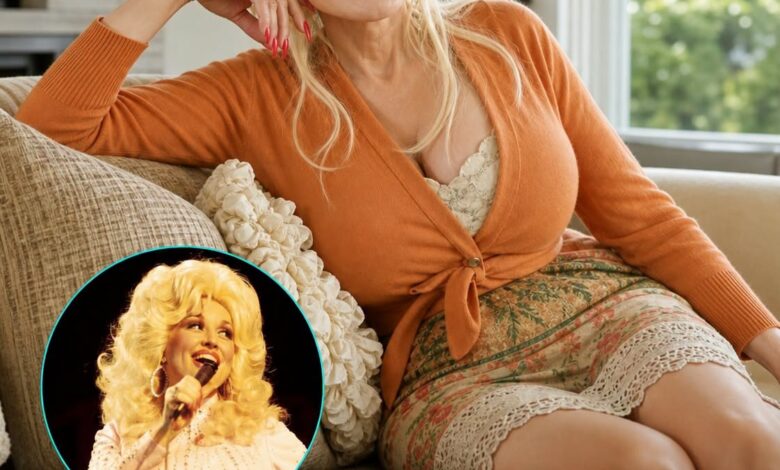
Dolly Parton spent more than six decades knowing exactly what she wanted the world to see.
The hair.
The rhinestones.
The smile.
The humor that could disarm an interviewer before the question had even finished.
So perhaps it was fitting that when her health began to fail, Dolly made one final choice about the story being told.
She kept much of the illness private.
There would be no prolonged public farewell.
No cameras following her through treatment.
No weekly medical updates turning her body into breaking news.
Instead, Dolly gave the world what she had always given it:
hope.
Even as appearances were canceled and concerns about her health intensified, she continued talking about tomorrow.
There were projects she wanted to finish.
Ideas she still wanted to explore.
A musical.
Museums.
Music.
Plans connected to Dollywood.
Things that sounded less like the reflections of someone approaching the end and more like another chapter in the extraordinary career of a woman who had never learned how to stop creating.
That optimism reassured fans.
It also concealed how serious things had become.
The first signs were easy to explain away.
Dolly was 80.
She had worked at a pace that would have exhausted people decades younger.
Canceling an appearance didn’t automatically mean catastrophe.
Neither did postponing plans.
When she stepped back from commitments connected to Dollywood and later altered anticipated Las Vegas appearances, concern grew, but Dolly resisted turning those changes into something ominous.
She described health issues as something that needed attention.
Something manageable.
Something temporary.
The message was essentially:
I’m taking care of myself.
Don’t worry.
I’ll be back.
People wanted to believe her.
Dolly had always seemed almost indestructible.
Not physically, of course, but culturally.
She had survived changing musical eras, shifting tastes, industry politics, criticism, heartbreak, business risks, and the strange pressures of being famous for most of her adult life.
She reinvented without appearing to abandon herself.
Country singer.
Pop crossover star.
Actor.
Songwriter.
Businesswoman.
Philanthropist.
Cultural institution.
By the time health problems began removing her from public view, Dolly Parton seemed less like a celebrity than a permanent feature of American life.
Then came one of the deepest losses of her own.
Carl Dean, her husband of nearly six decades, died.
For all the attention surrounding Dolly’s career, Carl had remained remarkably private.
He rarely appeared at industry events.
He didn’t build a public identity from his wife’s fame.
Their marriage existed largely outside the machinery that turned Dolly into an icon.
That privacy appeared to be part of what made it precious.
Dolly belonged to millions of people in public.
At home, she belonged to a much smaller world.
Losing Carl changed that world.
Yet even in grief, Dolly kept moving forward in the way she always had.
She spoke lovingly about him.
She acknowledged the pain.
But she did not present herself as finished.
There were still plans.
Still work.
Still things she wanted to build.
It would have been easy to interpret that as denial.
Perhaps it was something more deliberate.
Dolly had spent her career transforming difficult experiences into useful things.
Poverty became songs.
Her father’s struggles with literacy helped inspire the Imagination Library.
Heartbreak became music.
Criticism became jokes.
Pain rarely remained pain after passing through Dolly’s hands.
She reshaped it.
Maybe illness was the one thing she decided not to reshape publicly.
She simply kept it.
As her condition worsened, the circle around her reportedly became smaller.
Family knew more than fans.
Those closest to her protected the privacy she wanted.
The woman who had spent decades appearing before enormous crowds increasingly remained at home, away from cameras and public scrutiny.
There is something poignant about that reversal.
Dolly had built one of the most recognizable appearances in entertainment history.
Yet near the end, she apparently wanted fewer people looking.
She wasn’t ashamed of illness.
Privacy and shame are not the same thing.
She simply seemed unwilling to allow disease to become the final character the public associated with her.
That distinction mattered.
Serious illness has a way of swallowing identity.
Suddenly every conversation begins with treatment.
Every photograph is examined for weight loss or exhaustion.
Every canceled event becomes evidence.
People stop asking what you’re creating and start asking how long you have.
Dolly had spent too many years defining herself to surrender that authority easily.
So she continued sending hopeful messages.
She thanked fans.
She reassured people.
She talked about recovery and future possibilities.
The sparkle remained.
Not because nothing was wrong.
Because illness didn’t deserve ownership of everything that was still right.
Behind the optimism, however, cancer was advancing.
Eventually there was no new project capable of negotiating with biology.
No amount of determination could create another season.
The woman who had repeatedly promised there was more ahead reached the end at 80.
For fans, the news felt especially shocking because Dolly had not publicly prepared them for a long goodbye.
There had been clues.
Canceled appearances.
Health concerns.
A quieter schedule.
More time at home.
But clues are easy to reinterpret when hope is involved.
People heard “temporary” and believed temporary.
They heard “future plans” and imagined future years.
That may have been exactly what Dolly wanted.
Not deception.
Dignity.
There is a difference between lying about suffering and refusing to make suffering public property.
Fame had already taken enormous portions of her life.
People knew her childhood stories.
Her marriage fascinated them.
Her appearance was analyzed.
Her songs were dissected.
Her business decisions became headlines.
Her generosity was documented.
Her jokes traveled around the world.
But some things could still belong only to Dolly.
Her final illness was one of them.
Even her funeral reflected that boundary.
The public figure who had filled arenas and welcomed millions of visitors into the world she created at Dollywood was given a private goodbye.
No enormous spectacle was required to prove how much she mattered.
Her family could mourn the person rather than perform grief for the icon.
Outside that private circle, the public had something else.
The legacy.
And Dolly had spent a lifetime preparing it.
The songs were already there.
“Jolene.”
“Coat of Many Colors.”
“9 to 5.”
“I Will Always Love You.”
Thousands of recordings, performances, interviews, jokes, and stories.
Then there was the work beyond music.
Books mailed to children through the Imagination Library.
Jobs and tourism created through Dollywood.
Educational support.
Disaster relief.
Research funding.
Generosity given both publicly and quietly.
Dolly had built something illness could not dismantle.
Cancer could take the body.
It could cancel appearances.
It could narrow the future.
It could force a woman who loved working to remain home.
But it couldn’t go backward and remove what she had already placed into the world.
Perhaps Dolly understood that better than anyone.
She didn’t need to spend her final months proving she had lived.
The evidence was everywhere.
It was in a child opening a book.
A songwriter studying one of her compositions.
A woman going to work while “9 to 5” played on the radio.
A visitor seeing the Smoky Mountains for the first time.
A grieving person hearing “I Will Always Love You” and suddenly finding language for something they couldn’t say.
Those were the monuments.
Not hospital photographs.
Not medical bulletins.
Not a public countdown.
Dolly had always understood presentation, but reducing her final months to image management would miss the deeper point.
This was about agency.
Illness takes control.
It decides when you’re tired.
It changes plans.
It forces cancellations.
It rearranges priorities.
It makes choices for you.
Perhaps keeping the details private was one remaining choice Dolly could make for herself.
She could decide who entered that room.
She could decide what fans were told.
She could decide whether her last public identity would be “cancer patient” or simply Dolly.
She chose Dolly.
That doesn’t make the final months less sad.
If anything, it makes them more poignant.
Behind the cheerful messages was a woman saying goodbye to a life she had built with astonishing energy.
She had already lost Carl.
Her public world was shrinking.
Her body was asking for rest after a lifetime spent moving.
And still, when she looked outward, she talked about what might come next.
Maybe she believed there would be more time.
Maybe she needed to believe it.
Maybe she simply understood that hope remains worthwhile even when the ending cannot be changed.
In the end, Dolly Parton did not give the world a dramatic final act.
She gave it something more consistent with the life she had lived.
Grace.
Her family received the private woman.
The public kept the songs.
The illness remained largely behind closed doors.
And when the final curtain came down, cancer did not get to rewrite the entire story around itself.
Dolly had already written that story.
In music.
In generosity.
In laughter.
In millions of books placed into children’s hands.
In a marriage protected from the spotlight.
In the improbable journey from a poor Tennessee childhood to a name recognized almost everywhere.
Her final months may have grown quieter, but her life never did.
And perhaps that was the last boundary Dolly Parton drew between herself and fame:
The world could have her voice.
It could have the rhinestones, the stories, the songs, and the sparkle.
But when it came time to leave, the goodbye belonged to her.