In the hours after Dolly Parton’s death, people weren’t looking for spectacle.
They were looking for something gentler.
Confirmation.
Context.
A familiar photograph.
A few carefully chosen words about the woman whose voice had accompanied weddings, breakups, road trips, childhoods, funerals, and ordinary mornings for generations.
Instead, during coverage of the loss, viewers were confronted with something jarring: the face on the screen wasn’t Dolly Parton’s.
It belonged to Kelly Vohnn, a tribute artist whose admiration for Dolly had shaped a significant part of her own performing life.
The mistake lasted only briefly.
But grief measures time differently.
On an ordinary news day, an incorrect photograph might be dismissed as an embarrassing production error, corrected quickly and forgotten.
This wasn’t an ordinary news day.
Dolly had just died.
Fans were still struggling to absorb the news. Tributes were appearing across social media. Flowers were being placed outside locations associated with her life and career. Musicians were sharing memories. Families were replaying songs that suddenly sounded different because the woman who had sung them was gone.
People wanted the world to stop for a moment and look closely.
Then CNN showed the wrong woman.
For viewers who immediately recognized the error, confusion turned to disbelief.
How could one of the world’s largest news organizations, covering the death of one of America’s most recognizable entertainers, put someone else’s face on the screen?
The answer was probably far less dramatic than the reaction.
Breaking-news environments move quickly.
Producers search databases.
Images are pulled from archives and external sources.
Graphics are assembled under pressure.
Names, captions, photographs, and scripts pass through multiple hands while deadlines are measured in seconds.
Sometimes mistakes happen.
But explaining how an error happens isn’t the same as explaining why it hurts.
And this one hurt.
Because Dolly Parton’s face was not obscure.
The towering blonde hair.
The bright smile.
The rhinestones.
The unmistakable warmth in her expression.
Her appearance had been part of American popular culture for decades.
Fans felt they could recognize her instantly.
So when another woman’s photograph appeared during coverage of Dolly’s death, the mistake seemed to communicate something larger than a technical failure.
To grieving viewers, it felt careless.
As though the world had moved so quickly to package Dolly’s death that someone had forgotten to actually look at Dolly.
The situation was painful for another reason.
The woman mistakenly shown wasn’t some random stranger.
Kelly Vohnn had built part of her career around honoring Dolly.
Tribute artists occupy a peculiar space.
Their work depends on resemblance, performance, and affection. The best don’t simply imitate clothing or hairstyles; they study mannerisms, music, movement, and personality because audiences want to experience a recognizable echo of someone they admire.
For Kelly, Dolly wasn’t merely a visual reference.
She was an idol.
That meant Kelly was grieving too.
Then, on the very day she was trying to process Dolly’s death, her own image became tangled in the coverage.
There is an uncomfortable irony in that.
A tribute artist spends years trying to honor another person.
Then, during the most solemn moment imaginable, resemblance creates confusion.
Suddenly Kelly wasn’t being seen as herself.
She was being mistaken for the woman she was mourning.
And she hadn’t volunteered for that role.
She hadn’t asked to become part of a controversy.
She hadn’t chosen that day to attract attention.
The spotlight simply landed on her because somebody, somewhere, failed to verify an image carefully enough.
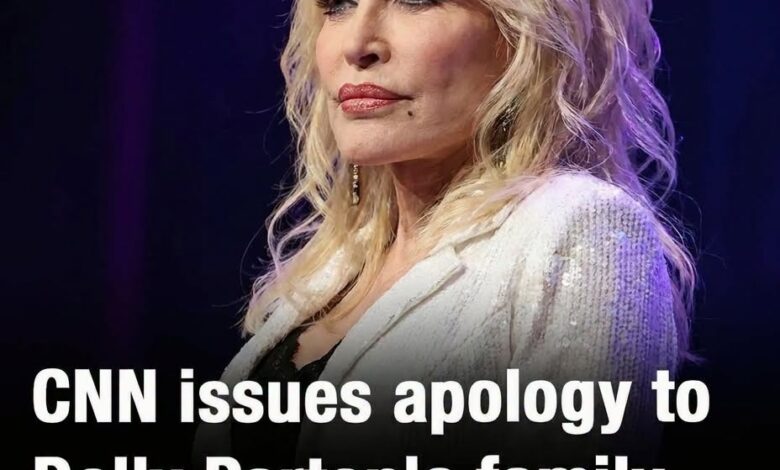
CNN issued a brief correction and apology.
Professionally, that was necessary.
Factually, it addressed the mistake.
But emotionally, corrections rarely travel as far as errors.
The original image had already been seen.
Screenshots existed.
People were discussing it.
Fans were angry.
A few seconds of television had become another story inside the much larger story of Dolly’s death.
That is one of the defining problems of modern breaking news.
Speed is rewarded immediately.
Accuracy is noticed most intensely when it fails.
News organizations compete to publish first, update first, broadcast first, and push alerts before audiences move elsewhere.
Most of the time, viewers never see the frantic machinery behind the finished product.
Then something goes wrong.
A photograph is mislabeled.
A name is misspelled.
A relative is incorrectly identified.
An unverified claim reaches air.
Suddenly the machinery becomes visible.
And trust, built over years, can be damaged in seconds.
During celebrity death coverage, the responsibility becomes especially delicate.
These aren’t merely stories about famous people.
They are also stories about families experiencing real loss.
Behind the public tributes are children, siblings, friends, colleagues, and loved ones seeing a person’s entire life transformed into headlines.
Imagine experiencing that grief while television networks replay photographs of someone you love.
Then imagine looking up and seeing the wrong face.
For Dolly’s family, already navigating an unbearable week, even a seemingly minor error could feel unnecessarily cruel.
For fans, it struck another nerve.
Dolly’s relationship with her audience had always felt unusually personal.
She had a gift for making enormous rooms feel intimate.
She could tell a joke at her own expense, sing about heartbreak, talk about growing up poor in East Tennessee, and somehow leave listeners feeling that they knew something genuine about her.
Millions had never met her.
Yet they had built memories around her.
That is why public mourning can become so intense.
People aren’t necessarily claiming the same grief as family.
They’re grieving what the person represented in their own lives.
A song their mother loved.
A movie watched with grandparents.
A childhood visit to Dollywood.
A book received through the Imagination Library.
A voice associated with home.
When someone occupies that much emotional territory, details matter.
The photograph matters.
The name matters.
The story matters.
Accuracy becomes part of respect.
That doesn’t mean journalists must become flawless.
No newsroom can eliminate every human error.
But certain moments demand slowing down precisely because everyone else is rushing.
Death is one of them.
There is no meaningful journalistic victory in being seconds faster if the information placed before millions of viewers is wrong.
And when an error occurs, the response matters too.
A correction can repair the factual record.
Repairing the emotional damage is harder.
Kelly Vohnn found herself caught in exactly that gap.
She was not responsible for CNN’s mistake.
She was not pretending to be Dolly in that broadcast.
She was simply a woman whose work had celebrated someone she deeply admired.
Now she had to process two realities simultaneously.
Dolly was gone.
And her own face had unexpectedly become part of the chaotic first draft of Dolly’s public memorial.
For a tribute artist, that must have been particularly painful.
The entire purpose of tribute is to direct attention toward the person being honored.
This mistake did the opposite.
It pulled attention away.
For a moment, people weren’t talking about Dolly’s songs, generosity, humor, career, or influence.
They were talking about a photograph.
Kelly became part of the headline when she would almost certainly have preferred to remain part of the mourning crowd.
Yet there is something revealing in the intensity of the reaction.
People were angry because Dolly mattered.
They noticed because they knew her face.
They demanded better because they believed her life deserved careful handling.
In that sense, the outrage wasn’t really about television graphics.
It was about reverence.
Fans wanted the world to treat Dolly with the same attention they felt she had given them.
They remembered an artist who could make people feel seen.
On the day of her death, they wanted her to be seen correctly.
Not approximately.
Not through someone who resembled her.
Her.
That expectation may seem small compared with the enormous legacy Dolly left behind.
But mourning often attaches itself to small things.
The right photograph in a frame.
The correct spelling on a program.
A favorite song played at the right moment.
A familiar dress.
A remembered phrase.
When someone is gone, details become precious because details are what remain.
The mistake will eventually become a footnote.
CNN will continue broadcasting.
Other stories will take over the news cycle.
Kelly Vohnn will continue carrying whatever Dolly’s influence has meant in her own life.
And Dolly’s legacy will remain vastly larger than a few mistaken seconds on television.
But the incident leaves behind a useful warning.
Breaking news is still about human beings.
Behind every alert is somebody’s mother, sister, friend, mentor, hero, or godmother.
Behind every photograph is a person whose identity deserves more than a hurried glance.
Technology may make news faster.
Competition may make it relentless.
Neither removes the obligation to look carefully.
Especially when the subject can no longer correct the record herself.
Dolly Parton spent decades creating an image so distinctive that millions could recognize her from across a room.
The hair.
The rhinestones.
The smile.
But beneath all of that was something more important: a life, a history, and a person people loved.
Kelly Vohnn understood that better than most.
Her work had been built around admiration, not replacement.
She never asked to become Dolly.
She only wanted to honor her.
And on the day Dolly’s admirers were trying to comprehend a world without her, that distinction deserved to be protected.
Because remembrance is not just about saying someone’s name after they’re gone.
It is about paying enough attention to remember them correctly.
The right face.
The right story.
The right woman.
Dolly.