I slid the second sheet across the conference table.
Blake reached for it with the same lazy confidence he had carried into the room.
Then he read the first paragraph.
His fingers slowed.
He read it again.
My father leaned forward.
“What exactly is this?”
I kept one hand resting on the yellow folder in front of me.
“It’s what you should’ve read before assuming I came here asking you for something.”
Five years earlier, I wouldn’t have been able to say that without hearing my own voice tighten.
Five years earlier, my father could still use three words—family, company, inheritance—and turn me back into the disappointing younger son before I even realized it was happening.
I wasn’t that man anymore.
Blake turned the page.
The documents laid out exactly what my company could provide for the expansion project his board had been discussing for months: commercial HVAC design, installation capacity, maintenance staffing, timelines, projected costs, and contingency coverage.
I wasn’t there to take over the family company.
I didn’t want shares.
I didn’t want Blake’s title.
I didn’t want the office my father had spent my childhood implying would someday belong to the “right” son.
What I had was simpler.
The project Blake had built his presentation around depended on specialized work my company was now qualified to perform.
The board already knew our record.
They knew replacing us would delay the schedule.
They knew changing contractors would alter the cost projections.
And they knew none of that had anything to do with who my father preferred at Christmas dinner.
That was the part Blake had never imagined.
I didn’t have control over him.
I had something better.
Control over my own yes.
My father glanced around the table as though waiting for one of the board members to remind everyone who I was supposed to be.
Nobody did.
They were looking at numbers.
Deadlines.
Staffing.
Performance.
Risk.
For once, being my father’s less-favored son meant absolutely nothing.
Blake closed the folder halfway.
“You seriously expect us to believe you built this?”
I almost laughed.
He had watched me spend years working with tools and somehow concluded that meant I would always be the person holding them for someone else.
That misunderstanding had started long before my daughter’s tenth birthday.
Growing up, Blake’s mistakes were called ambition.
Mine were called attitude.
When he missed dinner because he was working, Dad called him dedicated.
When I missed a family gathering because I was on an emergency service call, I had “forgotten where I came from.”
Blake never noticed the rules changing.
They always changed in his favor.
I noticed every time.
Still, I stayed.
Mostly because Rebecca believed people could become better if you gave them enough chances.
Rebecca had been my wife.
She was also the person who could make our daughter June laugh before June even understood the joke.
Years before Rebecca died, the three of us had been sitting in a little diner when she grabbed a paper placemat and drew June a castle.
The towers leaned in impossible directions.
The windows were crooked.
Rebecca shaded each one around the edges, leaving the centers pale so they looked like light was glowing from inside.
June loved it.
After Rebecca died, memories like that became almost unbearably valuable.
There would never be new ones.
That was why June’s tenth birthday mattered so much to me.
She asked for a castle cake.
A professional one cost more than I could justify at the time, so I decided to make it myself.
I was still working long days as an HVAC technician.
For three nights after service calls, I came home and taught myself how to make sugar windows.
The first batch cracked.
The second went cloudy.
The third finally caught the kitchen light the way I wanted.
I built vanilla towers.
Covered them in pale lavender frosting.
Made amber windows because June had once told me castles should look warm from the inside.
I even sold an old keepsake Rebecca had given me because I wanted June’s birthday to feel like something created for her, not another thing squeezed between bills.
When June walked into the kitchen and saw the finished cake, she stopped in the doorway.
“Dad.”
I looked up.
“You made the windows glow.”
I wiped frosting off my thumb.
“Every castle needs lights.”
The smile she gave me made three sleepless nights worth it.
Then Blake arrived.
Late.
He walked in wearing an expensive coat and the same expression he had carried through most of his adult life—the expression of someone certain everyone else would wait.
My father laughed.
“A man with real responsibilities doesn’t watch the clock.”
That was when I knew exactly how the afternoon would go.
Blake studied the cake.
“You made this?”
“Yes.”
He smirked.
“Look at Ethan. Fixing furnaces all week and playing pastry chef on weekends.”
I ignored him.
I told June to make her wish.
She leaned toward the candles.
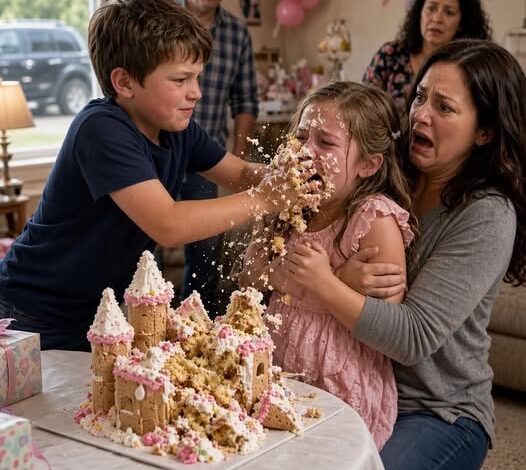
Blake stepped behind her.
“Come on, kiddo. Uncle Blake will make this memorable.”
Then he pushed her face toward the cake.
The sugar windows shattered.
June screamed.
I grabbed her immediately.
Frosting covered her hair.
A small cut had opened beneath her eye.
Her hands were shaking against my shirt.
“Dad, it hurts.”
I shoved Blake away from the table.
He stumbled two steps.
He wasn’t hurt.
June was.
My mother rushed forward.
But not toward June.
Toward Blake.
She began brushing frosting from the sleeve of his coat.
I still remember staring at her.
My daughter was crying in my arms while my mother worried about Blake’s jacket.
Then my father struck his signet ring against the table.
“You put your hands on your brother over a cake?”
“He hurt June.”
Dad barely looked at her.
“Apologize.”
I thought I had misunderstood.
“What?”
“Apologize to your brother, or walk away from this family and your inheritance.”
There it was.
The choice.
Not right and wrong.
Not adult and child.
Not harm and protection.
Blake or everything else.
I looked down at June.
That made the answer easy.
I carried her out.
I never apologized.
And I never went back.
At first, leaving felt expensive.
There were holidays without invitations.
Relatives sent messages saying my parents were devastated that I was “keeping June away.”
My father occasionally mentioned the inheritance, as though reminding me what I had given up might eventually make me crawl back.
I ignored all of it.
I had other things to build.
At first, the business was just survival.
Extra service calls.
Weekend installations.
Small contracts bigger companies didn’t want.
Then customers started remembering me.
They remembered that I showed up when I said I would.
They remembered that I explained a problem before handing them a bill.
They remembered that if something went wrong after a job, I answered the phone.
One customer became three.
Three became enough work to hire someone.
Then another.
Then another.
I learned payroll because people depended on me.
I learned estimating because one bad number could cost somebody a month’s wages.
I learned that owning a company was very different from criticizing the person above you.
And every evening, I came home to June.
That mattered more than any contract.
She stopped flinching when someone walked up behind her too quickly.
She stopped asking whether we were going to Hawthorne House for Christmas.
Eventually, she stopped asking why her grandparents never came to school events.
I never told her they didn’t love her.
I also never pretended what happened had been acceptable.
When she asked why we stayed away, I gave her the simplest answer I could.
“Adults are supposed to make children feel safe. I’m not taking you somewhere that failed that test.”
As she got older, she understood more.
I never made Blake the villain of every family story.
I didn’t want him taking up that much space in her mind.
I wanted us to build a life where he barely mattered.
Slowly, we did.
By the time my company began winning larger commercial contracts, my father’s inheritance no longer looked like security.
It looked like a leash I had stopped wearing years ago.
That was why the boardroom felt so different now.
Blake was still talking to the brother who used to swallow every insult because dinner was easier when Ethan stayed quiet.
That brother was gone.
Blake tapped the folder.
“So this is revenge?”
“No.”
He frowned.
“If I wanted revenge, I wouldn’t have come. I would’ve let you explain to the board why your project suddenly had no contractor.”
One of the board members interrupted.
“Mr. Hawthorne, can you explain the staffing assumptions?”
I turned toward him.
And explained them.
Another board member asked whether my history with Blake could interfere with the project.
“That’s exactly why the disclosure is included,” I said. “Nobody who works for me is getting dragged into a family dispute.”
My father leaned forward.
“You’re still my son.”
There it was again.
Family used as ownership.
I looked at him.
“I was your son when June was ten.”
His face tightened.
“You were also her grandfather. You chose Blake’s pride instead.”
Blake shook his head.
“It was a stupid joke.”
“You pushed a ten-year-old into a cake with hard sugar decorations.”
“It was an accident.”
“The cut was. The push wasn’t.”
He looked away.
My father changed tactics.
“It’s been five years, Ethan. People make mistakes.”
“They do.”
That surprised him.
I continued.
“And sometimes the consequence is that the person they hurt stops trusting them.”
The room went quiet.
That was the thing none of them had ever understood.
They thought forgiveness meant getting their old access back.
They thought family meant unlimited chances.
They thought inheritance could make silence look like loyalty.
I no longer believed any of it.
The board chair looked at me.
“Would your company proceed under the terms in this proposal?”
“Yes. With one condition.”
Blake gave a humorless laugh.
“There it is.”
I ignored him.
“All communication involving my company goes through the designated project teams. No private family calls. No requests through my father. No pressure outside the normal process. If Blake needs something from us, he uses the same channels everyone else uses.”
Blake stared at me.
“You’re humiliating me.”
“No. I’m protecting my employees from something that has nothing to do with them.”
That landed harder than anger would have.
Because it wasn’t revenge.
It was procedure.
My father looked at me.
“And if we refuse?”
I closed the folder.
“Then we don’t work together.”
He waited.
So did Blake.
There was nothing else.
No threat.
No dramatic speech.
No demand for an apology five years too late.
I had already proved I could walk away.
My father had spent my childhood convincing me that leaving the family meant losing everything.
Eventually, I tested the theory.
It wasn’t true.
I lost Christmas at Hawthorne House.
I lost the fantasy that my parents might someday treat Blake and me equally.
I lost an inheritance I no longer wanted badly enough to earn by keeping quiet.
But I gained other things.
Ordinary things.
A home where June didn’t tense before family gatherings.
A business I understood from the ground up.
Employees who knew exactly which version of me would show up Monday morning.
Bills that were sometimes uncomfortable but belonged to us.
Choices that were mine.
Blake eventually pushed the folder back toward the center of the table.
He didn’t apologize.
Neither did my father.
I hadn’t expected them to.
The meeting continued.
Schedules replaced accusations.
Costs replaced family history.
The board spoke to me like a contractor instead of someone’s disappointing son.
When it ended, Blake stayed seated.
My father stood.
He looked at the yellow folder.
Then at me.
“You really would leave again.”
“Yes.”
I wasn’t angry when I said it.
That seemed to bother him more than anger would have.
I gathered my papers and walked out.
Outside, I checked my phone.
June had sent me a message.
Are you home for dinner?
Nothing about Blake.
Nothing about Grandpa.
Nothing about the meeting.
Just dinner.
I wrote back.
Yeah. I’ll be there.
That evening, I found June at the kitchen counter doing homework.
She was fifteen now.
Taller.
Calmer.
Old enough to remember exactly why we had walked away from Hawthorne House.
She glanced up.
“How bad was the meeting?”
“Not terrible.”
“Was Uncle Blake still Uncle Blake?”
“Very much.”
She laughed.
Then looked at me more carefully.
“Did Grandpa mention the inheritance?”
“Not really.”
“Do you still want it?”
“No.”
She nodded.
No surprise.
No speech about how proud she was.
Just acceptance.
I put my keys on the counter.
That was when I noticed the edge of her notebook.
She had been doodling.
Four towers.
A crooked wall.
Small windows shaded around the edges so the centers looked bright.
A castle.
I stopped.
June noticed.
“Mom drew them better.”
I smiled.
“Your mother drew castles like gravity was optional.”
“She did not.”
“She absolutely did.”
June laughed and went back to her homework.
I opened the refrigerator.
“What do you want for dinner?”
“Whatever’s easy.”
I pulled out eggs, cheese, and vegetables.
Behind me, her pencil kept moving.
For years, I had thought that ruined birthday cake was the moment my family broke.
Standing there, listening to June draw quietly at the counter, I finally understood that wasn’t exactly true.
Something broke that day.
But something else began.
The sugar windows shattered.
The inheritance stopped mattering.
The fantasy that I could earn fairness by staying quiet finally died.
And in the space left behind, June and I built something better.
Not dramatic.
Not perfect.
Just ours.
June turned the notebook toward me.
“Does this window look weird?”
I studied it.
“A little.”
She frowned.
“Thanks.”
“You asked.”
She erased it and tried again.
I started dinner.
No final confrontation followed.
No dramatic apology arrived.
My father never called begging me to come back.
Blake never appeared at the door transformed by regret.
Real endings rarely work that way.
Sometimes closure is much smaller.
A quiet kitchen.
A daughter who feels safe enough to laugh.
A business nobody can threaten to take from you.
Dinner cooking while a pencil scratches across paper.
Five years earlier, I walked out of Hawthorne House believing I had lost my family.
That night, as the kitchen light fell across June’s crooked little castle, I finally understood the truth.
I hadn’t lost my family.
I had simply stopped begging to belong to the part that kept choosing someone else.
And in doing that, I finally chose the part that chose me back.