The morning Emily Torres gave up her seat on Route 78, she thought she was doing something small.
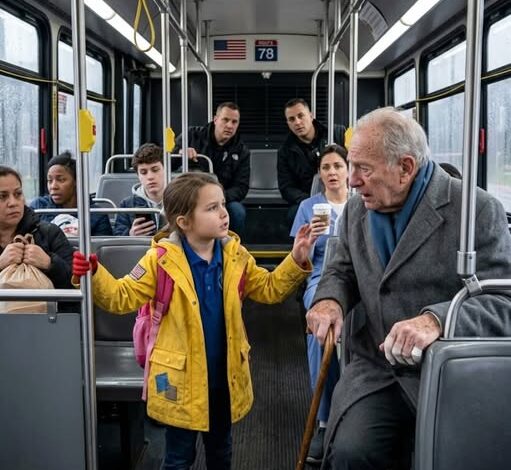
The city bus smelled like rain-soaked coats, old coffee, damp rubber, and the cold metal poles passengers grabbed whenever the driver braked too suddenly. Water streaked down the windows in thin silver lines, blurring storefronts and traffic lights into soft shapes. Every time the doors folded open, a gust of chilly air swept through the aisle, making Emily pull the sleeves of her patched yellow raincoat farther over her hands.
She was only seven years old.
She had never heard of Michael Harrison.
She didn’t know that the elderly man boarding the bus with a wooden cane controlled one of the largest charitable foundations in the county. She didn’t know that two security officers were quietly seated several rows behind him, watching the passengers with practiced attention. She didn’t know that a simple act of kindness would ripple far beyond that rainy morning.
All she knew was that someone looked like they needed help.
Earlier that morning, her mother had walked her to the bus stop before heading to work.
Sarah Torres had been awake since before dawn, preparing for another long shift at the market café. She wore the same worn work shoes she had repaired twice already, and her purse held more worry than money. Hidden among receipts and grocery coupons were overdue notices, unpaid bills, and reminders she kept folding smaller and smaller, as if reducing their size might somehow reduce their power.
Kneeling beside her daughter at the bus stop, Sarah adjusted Emily’s backpack straps for the third time.
“Remember,” she said gently, brushing rain from Emily’s hair. “Five stops after the bridge. Stay close to the driver. Don’t wander. And call me if anything feels wrong.”
“I know, Mom,” Emily replied with serious determination.
Sarah smiled, though it was the kind of smile people wear when they’re trying not to let fear show.
Emily climbed aboard and settled into the second-row seat near the front. She hugged her pink backpack tightly and counted each stop on her fingers.
One.
Two.
Three.
By the fourth stop, the bus had filled with commuters. There were construction workers heading downtown, students scrolling through phones, a nurse clutching a paper coffee cup, and tired office employees staring blankly out rain-covered windows.
Then the old man stepped aboard.
He wore a gray coat and a faded blue scarf. His cane tapped softly against the bus steps as he climbed inside.
Nothing about him suggested wealth or importance.
In fact, he looked tired.
Very tired.
The driver paused an extra moment to let him steady himself before pulling away from the curb.
The old man grasped a pole and tried to balance.
Nobody moved.
A teenager occupied the priority seat directly across from him, eyes fixed on a video playing on his phone.
Several passengers glanced up.
Then looked away.
The nurse lowered her eyes to her coffee.
A businessman suddenly seemed fascinated by the rain outside.
The teenager kept scrolling.
Everyone noticed.
Nobody acted.
Emily watched quietly.
She thought about her mother’s instructions.
Stay in your seat.
Stay near the driver.
Don’t move around.
She looked at the old man again.
His knuckles were white around the pole.
Every turn of the bus seemed to challenge his balance.
And somehow, that mattered more than the rules.
Before she could talk herself out of it, Emily stood.
“Sir?” she said softly.
The old man looked over.
“You can have my seat.”
For a moment, he simply stared at her.
Not because the offer was extraordinary.
But because it was unexpected.
“Are you sure?” he asked.
Emily nodded.
“You need it more than I do.”
The old man’s eyes softened.
He lowered himself carefully into the seat and released a quiet breath.
“Thank you,” he said.
“What’s your name?”
“Emily.”
“Emily,” he repeated thoughtfully. “That’s a beautiful name.”
“My mom picked it.”
“Then she has good taste.”
Emily smiled.
The old man glanced at the patch sewn onto her raincoat sleeve.
It was neatly stitched but impossible to miss.
Something flickered across his face.
Recognition.
Not of who she was.
But of what that patch represented.
The careful repairs.
The making-do.
The quiet struggle many families carried without ever speaking about it.
“What’s your name?” Emily asked.
“Michael.”
“Mr. Michael?”
He chuckled softly.
“If you’d like.”
“My grandma says I should call older people mister.”
“Your grandmother sounds wise.”
“She makes really good cornbread,” Emily replied confidently.
“Then I trust her judgment.”
For the next several minutes, the bus rolled through the rain while Emily stood holding the pole.
When her stop approached, she reached for the signal cord.
The bus slowed.
She adjusted her backpack and prepared to leave.
Before stepping off, she turned toward him.
“Have a good day, Mr. Michael.”
Something about those words struck him harder than she could possibly understand.
“You too, Emily.”
The doors folded open.
She hurried toward school.
The bus pulled away.
And through the rain-streaked window, Michael watched the little girl disappear down the sidewalk.
For a long moment, he said nothing.
One of the security officers leaned forward.
“She didn’t recognize you.”
Michael nodded.
“I know.”
The officer glanced toward the spot where Emily had vanished.
“Most people would have.”
Michael rested his hand on the worn patch of fabric where her sleeve had brushed against his coat.
“That’s what made it different.”
The bus continued through the city.
Passengers returned to their phones and conversations.
But Michael remained unusually quiet.
Finally, he looked toward the security officers.
“Find out who her mother is.”
The younger officer blinked.
“Sir?”
“Please.”
The officer immediately began taking notes.
Route 78.
Yellow raincoat.
Pink backpack.
Emily.
Across town, Sarah Torres spent the morning serving coffee and breakfast sandwiches while trying not to think about overdue bills.
She apologized to customers for delays she didn’t cause.
She smiled through exhaustion.
She worked because there was no alternative.
Shortly after eight o’clock, her manager approached her counter.
“Sarah?”
She looked up.
“There are two men here asking for you.”
Her stomach dropped instantly.
Every parent knows that particular fear.
The fear that something has happened to your child.
“Is Emily okay?” she asked before they could even introduce themselves.
One of the men nodded immediately.
“She’s perfectly fine.”
The relief nearly made her knees give out.
“Then what’s this about?”
The man exchanged a glance with his colleague.
“Your daughter met someone this morning.”
Sarah frowned.
“What did she do?”
The man smiled.
“She helped him.”
That answer confused her more than anything else.
A few minutes later, they handed her a white envelope.
Inside was a handwritten note.
Sarah read it once.
Then twice.
Then a third time.
Tears filled her eyes before she reached the end.
The note was simple.
It explained that her daughter had shown extraordinary kindness when many adults had chosen not to.
It thanked Sarah for raising a child who noticed others.
And it offered help.
Not charity.
Not publicity.
Help.
The electric bill would be paid.
Transportation would be arranged.
Additional support would be available if she chose to accept it.
Sarah sat alone in the employee hallway and cried.
Not because of the money.
Though that mattered.
Not because someone important had noticed her daughter.
Though that was surprising.
She cried because, for the first time in a very long time, someone had seen how hard she was trying.
That afternoon, she met Emily outside school.
The moment her daughter spotted her, she ran into her arms.
“Did I do something wrong?” Emily asked immediately.
Sarah laughed through tears.
“No, sweetheart.”
“Then what happened?”
Sarah held her face gently.
“You did something right.”
Emily looked confused.
“With Mr. Michael?”
Sarah nodded.
“Yes.”
The little girl thought for a moment.
“Because I gave him my seat?”
“Yes.”
“That’s all?”
Sarah smiled.
Sometimes children don’t realize the value of what they give because kindness comes naturally to them.
“That’s all,” she said.
Years later, people would tell the story differently.
They would talk about the powerful businessman who helped a struggling family after a chance encounter.
They would talk about generosity, opportunity, and the lives that changed afterward.
But Sarah always remembered it another way.
A crowded bus.
A rainy morning.
A tired old man struggling to stand.
And a little girl in a patched yellow raincoat who saw what everyone else saw—but chose to care.
Because the moment that changed everything was not when help arrived.
It was when kindness moved first.
And on Route 78, while a bus full of adults looked away, a seven-year-old child quietly reminded the world that compassion still exists—and that sometimes the smallest gestures create the biggest miracles.