The first time Arthur pushed the heavy leather lead rope toward my son, I thought the man was heartless.
Not rude.
Not insensitive.
Cruel.
There are different kinds of cruelty in this world.
Some people scream it loudly enough for neighbors to hear.
Some hide it behind smiles and expensive manners.
And some people are wealthy enough to disguise it as “help” while everyone else stands there swallowing humiliation because they don’t know how to fight back politely.
That afternoon, the air behind our house smelled like hot dirt, horse sweat, sunburned grass, and the gravel dust that always drifted from the driveway whenever trucks passed too fast.
The porch flag cracked once sharply in the wind before hanging still again.
My son Leo sat at the bottom of the wheelchair ramp with both hands resting motionless on the rims of his chair.
He was only twenty-two years old.
But grief had aged him strangely.
Not in his face exactly.
In his eyes.
He looked both younger and older than he should have at the same time.
Younger because there was a terrible helplessness in him — the kind you usually only see in children waiting for adults to stop discussing their future like they aren’t sitting there listening.
Older because some light had disappeared from him permanently after the accident.
No young man should carry silence that heavy.
Arthur stood beyond the fence line holding the lead rope of the biggest horse I had ever seen up close.
Dakota.
A chestnut mare with a dark mane and intelligent eyes that looked almost human when she stared directly at someone.
Sunlight flashed red across her coat.
Her nostrils flared white.
Her muscles twitched constantly beneath her skin.
The horse looked powerful enough to break fences apart if she decided to.
Arthur tightened both hands against the rope while Dakota fought him hard enough to drag his boots through the dirt.
Then he shoved the rope toward my son.
“I paid a fortune for this animal,” he shouted over Dakota’s snorting. “And she refuses to trust anybody. I heard you used to be some kind of riding champion. Tell me what I’m doing wrong.”
Used to be.
I watched those words hit Leo physically.
His jaw tightened instantly.
His fingers curled so hard against the wheelchair rims his knuckles lost color.
For two years nobody inside our house had said the words riding champion unless we absolutely had to move another storage box in the garage.
Before the accident, horses had been Leo’s entire world.
He practically lived at the barn.
He came home smelling like leather, hay, sweat, and terrible gas station coffee because competitions started before sunrise and ended after dark.
Blue ribbons hung above his bed.
Muddy boot prints stained the laundry room floor no matter how often I complained.
His truck constantly carried feed buckets, rope, and horse blankets.
Then one rainy highway.
One spinning truck.
One midnight phone call.
And suddenly our entire life split into before and after.
The hospital called it spinal trauma.
The insurance company called it permanent lower-body paralysis.
The rehabilitation center called it “life adjustment.”
But none of those places ever described what happened to my son’s face the first time he realized he would never swing naturally into a saddle again.
No paperwork mentioned the riding boots still drying beside our back door weeks after he stopped walking.
No discharge instructions explained what a mother should do with trophies that suddenly looked like relics from another person’s life.
Arthur didn’t know any of that, I reminded myself.
He was simply the wealthy stranger who purchased the neighboring property six months earlier.
The quiet man with the long driveway.
The expensive fencing.
The spotless black truck.
He waved politely from a distance but never lingered in conversation.
Never borrowed tools.
Never asked for favors.
Never stood gossiping beside mailboxes like ordinary neighbors.
And now here he was dragging a wild horse to my fence asking my broken son for help.
Leo spun his wheelchair sharply in the dirt.
Without speaking one word, he rolled up the ramp, shoved open the front door, and slammed it hard enough to shake the porch windows.
The sound went through my chest like impact.
I hurried toward Arthur immediately.
“I’m sorry,” I said breathlessly.
Though honestly, I wasn’t even sure who deserved the apology anymore.
Arthur didn’t look embarrassed.
Didn’t look offended.
He simply stared toward our closed front door with an unreadable expression before nodding once and leading Dakota back across the property line.
That should have been the end of it.
But it wasn’t.
The next afternoon, Arthur returned at exactly four o’clock.
I remember the time because the kitchen clock clicked from 3:59 to 4:00 while I stood rinsing coffee cups at the sink.
Dakota behaved even worse that day.
She pulled violently against the rope.
Backed away.
Snorted.
Tossed her head.
Arthur’s boots carved long tracks through the dirt while he struggled to control her.
But he didn’t ask for help.
Didn’t explain himself.
He simply stood there beside the fence waiting silently.
Leo sat on the porch pretending not to watch.
Ten minutes passed.
Then twenty.
The sunlight shifted slowly across the grass.
A grocery bag sagged forgotten on the kitchen counter beside melting butter.
The entire yard filled with tension nobody acknowledged aloud.
Finally Leo muttered something under his breath that sounded half furious and half exhausted.
Then he unlocked his wheelchair brakes and rolled down the ramp.
“Your grip is wrong,” he snapped. “You’re making her panic. Loosen the pressure.”
Arthur immediately loosened the rope.
Instantly.
No arguing.
No pride.
No hesitation.
And Dakota changed completely.
Not magically.
But enough.
The violent resistance softened.
Her breathing slowed.
Her ears turned toward Leo instead of away from him.
Then she stepped carefully forward until her nose touched his lap.
Leo froze.
Everything about him went still except one trembling hand slowly lifting from the wheel.
He placed it carefully against Dakota’s neck.
The horse released one long deep breath and closed her eyes.
I stood behind the kitchen window with soap still covering my hands and cried so hard I had to cover my mouth with both palms to stay quiet.
From that day forward, Arthur and Dakota arrived every afternoon at four.
Every single day.
Arthur played the confused amateur perfectly.
He asked ridiculous questions.
Which brush to use.
How much grain was too much.
Whether horses preferred apples or carrots.
Mistakes small enough for Leo to correct without feeling pitied.
And Leo corrected him every time.
At first sharply.
Then automatically.
Then eagerly.
Soon my son started rolling onto the porch before Arthur even reached the fence.
Then he began wearing his old riding gloves again.
One morning he asked me if I remembered where his curry comb was stored.
I nearly cried hearing the question.
I found it later inside a labeled plastic bin in the garage beneath stacks of old show numbers and a cracked riding helmet we never found the courage to throw away.
That evening Leo finished an entire dinner plate for the first time in months without me begging him.
A week later he shaved.
A month later he asked if the fence line could be widened slightly so Dakota would have more turning room.
Healing did not arrive dramatically.
It arrived disguised as chores.
Brush the horse.
Clean the feed bucket.
Check the straps.
Be outside by four.
Grief doesn’t always leave because someone loves you enough.
Sometimes it must be interrupted repeatedly by routine, responsibility, and something warm breathing against your hands.
Six months after Arthur first appeared beside our fence, he opened the gate instead of stopping there.
I noticed immediately from the kitchen window.
Dakota stepped into our yard carrying a saddle unlike anything I had ever seen.
Not a normal saddle.
This one had:
A high supportive back.
Thick security straps.
Specialized stirrups designed to stabilize weak legs.
Reinforced supports around the hips.
Every buckle looked custom made.
Arthur carried a riding helmet beneath one arm.
My stomach tightened instantly.
Leo saw it too.
The color drained from his face.
Arthur stopped several feet from the ramp.
“I’m tired of doing all the work,” he said calmly. “Show me how it’s done.”
Leo laughed once bitterly.
Then pointed downward toward his legs.
“I can’t balance anymore,” he snapped. “My core strength is gone. You think I don’t understand what happens if I fall?”
Arthur didn’t flinch.
“Dakota trusts you,” he answered quietly. “It’s time.”
Something in his voice stopped me.
Not arrogance.
Not stubbornness.
Something heavier.
Older.
I dropped the dish towel and hurried outside.
“Arthur, no.”
Neither man looked at me.
Leo’s breathing had become shallow.
Dakota stood perfectly still beside him waiting.
The same horse who fought every rope now looked patient enough to wait forever for one frightened boy to decide whether he wanted his life back.
I rushed across the grass.
“Arthur, stop!”
But he moved first.
Carefully.
Confidently.
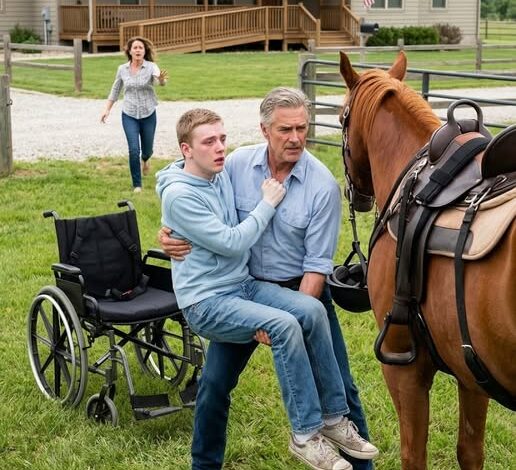
He slid one arm beneath Leo’s knees and another behind his back before lifting my son directly from the wheelchair.
For one horrifying second, Leo looked heartbreakingly vulnerable in Arthur’s arms.
His fingers grabbed Arthur’s shoulder tightly.
“I can’t,” he whispered.
Arthur carried him directly to Dakota.
The horse didn’t move away.
Didn’t panic.
Didn’t shift.
Arthur lowered Leo into the specialized saddle with practiced precision.
Then he fastened:
The waist strap.
The thigh supports.
The back stabilization system.
His hands knew every buckle automatically.
At the time, I only saw danger.
Only imagined ambulances.
Emergency rooms.
Doctors speaking softly about further damage.
I didn’t realize yet that Arthur had done this before.
“Please,” I whispered helplessly.
Leo looked down toward Dakota’s neck.
Dakota nudged his boot gently.
Such a tiny motion.
Yet somehow it changed everything.
Leo closed his eyes briefly.
Then opened them again, clicked his tongue softly, and adjusted the reins.
Dakota stepped forward.
One careful step.
Then another.
The saddle held.
Leo wobbled violently at first.
But he didn’t fall.
His hands steadied.
His posture lifted.
His shoulders straightened.
And for the very first time since the accident, my son moved across open ground without wheels beneath him.
I stopped breathing entirely.
Then Leo laughed.
Not politely.
Not nervously.
It was the kind of laugh people make when they suddenly realize something they mourned as dead may still be alive after all.
Arthur stood beside the empty wheelchair with his head lowered.
At the time, I thought he was watching Leo.
Now I know he was remembering someone else entirely.
One week later, I baked him a pie.
Apple.
Still warm when I placed it carefully inside a cardboard box and carried it toward Arthur’s enormous house.
The place looked even bigger up close.
Quiet wealth.
Clean stone.
Perfect windows.
The front door stood slightly open.
I should have left immediately.
Instead, I stepped inside.
“Arthur?” I called.
No answer.
The house smelled like old wood, coffee, and furniture polish.
Then I noticed light coming from downstairs.
Curiosity pulled me farther than politeness should have allowed.
What I found below nearly stopped my heart.
The basement wasn’t storage.
It was a memorial.
Blue ribbons covered the walls.
Silver trophies lined shelves.
Framed photographs sat everywhere.
And in every single picture stood a blond teenage girl riding Dakota.
Sometimes smiling wildly.
Sometimes concentrating seriously in competition gear.
Dakota looked younger then.
Arthur did too.
He appeared in some photos holding water buckets or standing proudly beside the horse and girl with the unmistakable expression of a father whose entire world lived in front of him.
Then I saw the newspaper clipping.
“LOCAL EQUESTRIAN STAR PARALYZED IN TRAGIC FALL.”
My knees weakened.
Below the article sat engineering blueprints.
For the saddle.
Three years old.
Not recently designed.
Not for Leo.
For her.
Arthur’s daughter.
Beside the blueprints rested an open leather journal.
I shouldn’t have read it.
But I did.
Arthur wrote about his daughter losing herself after the accident.
About building the adaptive saddle.
About begging her to try again.
About leaving Dakota outside her window hoping she’d come out.
She refused everything.
The saddle.
Therapy.
The horse.
Him.
Then the final entries described medical complications caused by depression and immobility.
The doctors used clinical terms.
Arthur used simpler ones.
“She died of heartbreak.”
My vision blurred completely.
Then I saw the newest journal entry.
“The boy next door has the same dead look in his eyes she had.”
I kept reading through tears.
“I failed her because I confused patience with love.”
And then:
“I will save this boy if it kills me.”
I backed away from the desk trembling.
That’s when Arthur’s voice came quietly from behind me.
“She would’ve liked him.”
I turned sharply.
Arthur stood at the bottom of the stairs staring not at me — but at a photograph of his daughter smiling atop Dakota.
His face looked hollowed out by grief.
“When she died,” he whispered, “the world went dark.”
Then he looked directly at me.
“I saw your son sitting on that porch and realized I was watching it happen all over again.”
No apology felt large enough for reading the journal.
No words felt useful at all.
Arthur looked toward the blueprints.
“Does the saddle feel secure?” he asked quietly.
I nodded.
“Is he happy?”
That question destroyed me completely.
Because it was so simple.
“Yes,” I whispered through tears. “He’s happy again.”
Arthur closed his eyes.
One tear escaped before he wiped it away quickly.
“It was supposed to save her,” he said softly.
I looked again at the carefully designed saddle plans.
Then at the grieving father standing before me.
“You gave my son his life back.”
Arthur shook his head slowly.
“No,” he answered. “I just refused to watch another child disappear.”
Outside later that evening, the setting sun painted the arena gold.
Leo rode Dakota confidently across the dirt while Arthur leaned silently against the fence beside me.
The horse moved beautifully beneath him.
Strong.
Steady.
Alive.
Leo guided Dakota around a barrel turn and laughed loudly when she responded perfectly.
Arthur smiled then.
The first genuine smile I had ever seen on his face.
Not polite.
Not guarded.
Real.
And suddenly I understood something important.
Dakota wasn’t simply carrying my son.
She was carrying memory.
Regret.
Hope.
The saddle holding Leo upright had once been built from another father’s desperate love for a daughter he couldn’t save in time.
And somehow, through grief and coincidence and stubborn compassion, that same love reached my son before he disappeared too.
After that, Arthur still came every afternoon at four.
Sometimes he still asked foolish questions on purpose just to hear Leo argue with him.
Sometimes I caught him watching Dakota and Leo together with tears hidden carefully behind quiet smiles.
Healing still didn’t arrive like miracles do in movies.
It came slowly.
Like chores.
Like routine.
Like pie cooling beside fence posts.
Like one grieving father refusing to let another family lose someone still alive.
And every evening when I watched Leo ride across that arena sitting tall in a saddle built from another child’s unfinished future, I understood something I never understood before.
Sometimes the thing meant to save one broken heart arrives too late.
And sometimes, if grace is merciful enough…
it arrives just in time to save another one instead.