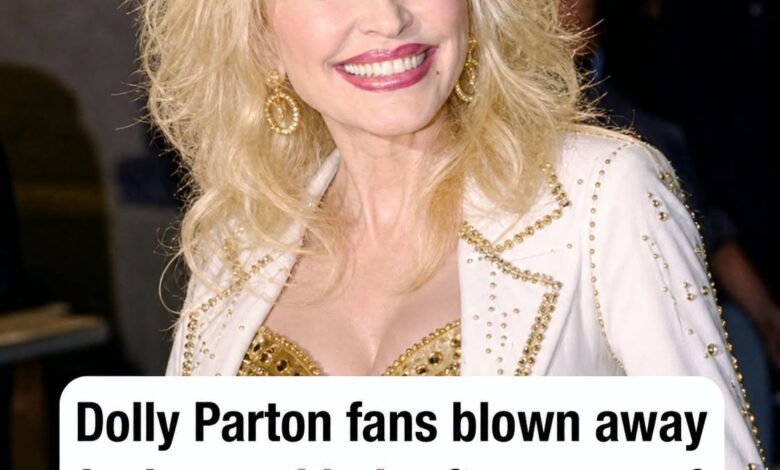
Before the towering wigs, before the rhinestones, before the silhouette became so recognizable that millions could identify her from across a room, there was simply Dolly.
A young woman with soft blonde hair brushing her shoulders.
No exaggerated height.
No theatrical curls.
No carefully constructed wall of glamour between herself and the world.
In an early black-and-white photograph, she looks almost startlingly ordinary.
Not plain.
Not forgettable.
Just human.
Her hair falls naturally around her face. Her expression is calm. There is none of the visual spectacle that would later become inseparable from the name Dolly Parton.
She looks like someone you might have passed in a small-town diner.
Someone humming while waiting for coffee.
Someone carrying a notebook full of songs nobody else had heard yet.
Someone who still had to convince the world to listen.
That is what made the photograph so moving when fans began revisiting it after her death.
They were not simply seeing Dolly without a wig.
They were seeing Dolly before the armor.
She had used that word herself in different ways over the years when talking about appearance.
The hair.
The makeup.
The clothes.
The impossible heels.
All of it helped create a version of Dolly that could walk into a room before insecurity did.
That image gave her control.
People were going to stare anyway.
So she decided what they would stare at.
If they wanted to laugh at the hair, she would make the joke first.
If they thought the clothes were too much, she would add more sparkle.
If they assumed a woman dressed like that could not possibly be serious, intelligent, or business-minded, Dolly often let them make the mistake.
Then she outwrote them.
Outworked them.
Outlasted them.
The wigs became part of that strategy.
But seeing the natural hair underneath reminds us that the public image was never compensation for a lack of beauty.
That was never the point.
Dolly did not wear wigs because she needed them to become attractive.
She wore them because she loved transformation.
She loved theatricality.
She loved having control over the version of herself she presented.
There is an important difference.
The woman in that early photograph is already beautiful.
That is exactly why the later exaggeration feels so revealing.
Dolly could have relied on natural beauty.
She chose invention instead.
She took something recognizable and pushed it until it became myth.
Bigger hair.
Brighter clothes.
More makeup.
More rhinestones.
Eventually, Dolly Parton did not merely enter a room.
She arrived.
But long before all of that, there was the young woman in the photograph.
The dream had not yet fully happened.
That gives the image its tenderness.
We know the future.
She did not.
We know about “Jolene.”
She did not.
We know about “9 to 5.”
She did not.
We know “I Will Always Love You” would become one of the most recognizable songs she ever wrote.
She did not.
We know she would build Dollywood, create an enormous literacy program, become a businesswoman, an actor, a philanthropist, and one of the most beloved entertainers in the world.
She was still trying to get there.
That is what old photographs of famous people do.
They expose uncertainty history has erased.
Success makes the past look inevitable.
It rarely was.
At the moment that photograph was taken, Dolly Parton was not yet protected by decades of achievement.
She was a young artist carrying ambition large enough to be embarrassing if it failed.
That is courage of a different kind.
Later, the wigs would become visible courage.
The young Dolly had another kind.
She had to believe in herself before everyone else supplied the proof.
Fans responding to the photograph often focused on how different she looked.
Some were surprised by the softness of her natural hair.
Others wondered why she had ever bothered with wigs.
But that question misunderstands what the wigs meant.
They were not there to improve Dolly.
They were there to express Dolly.
She had been fascinated by extravagant femininity since childhood.
Growing up in East Tennessee, she noticed women others might have dismissed as too flashy, too painted, too provocative, too much.
Dolly saw glamour.
She wanted the hair.
The lipstick.
The bright clothes.
She wanted the fantasy.
And once she had the freedom to choose, she created her own version.
That decision carried defiance.
Women are frequently told to look beautiful without looking as though they tried.
Be glamorous, but effortless.
Sexy, but tasteful.
Young, but natural.
Elegant, but not intimidating.
Dolly rejected the entire impossible equation.
Nothing about her look was pretending to be effortless.
That was the joke.
The hair was high because she wanted it high.
The makeup was dramatic because she liked drama.
The clothes sparkled because sparkle made her happy.
She never needed anyone to believe she woke up that way.
And that honesty made the artificiality strangely authentic.
Still, the world did not often get to see the quieter version.
That is why the early photograph feels almost intimate.
There is no character between Dolly and the camera.
Or at least, far less of one.
The famous armor had not yet hardened into tradition.
You can see the face without first processing the iconography.
And once Dolly was gone, that simplicity became almost unbearable.
Grief changes photographs.
A young face becomes evidence of everything still ahead.
An ordinary expression becomes precious.
You look at someone who has died and realize they had no idea how much life was still coming.
That creates a strange ache.
The Dolly in the photograph does not know about Carl Dean growing old beside her.
She does not know about the years of marriage.
She does not know how deeply she will someday grieve him.
She does not know that millions of strangers will one day mourn her too.
She simply exists inside the moment.
That may be why Carl belongs so naturally in the conversation about Dolly’s private appearance.
He knew the woman beneath the performance better than almost anyone.
The public knew Dolly prepared for the world.
Carl knew what happened after the preparation came off.
The wig removed.
The makeup softened.
The stage clothes replaced by something ordinary.
Their marriage lasted nearly six decades largely outside public view.
That privacy was deliberate.
Dolly could belong to the audience professionally.
Carl did not have to.
He was famous for staying away from red carpets and industry spectacle.
And Dolly protected that choice.
She also joked about the way he reacted to her changing appearance.
At times, Carl teased her mercilessly.
The famous “Q-Tip” joke reflected the kind of marriage where two people could puncture glamour without threatening love.
That mattered.
Imagine spending your professional life surrounded by people praising your appearance.
Stylists.
Photographers.
Fans.
Journalists.
Then going home to someone who can look at a carefully designed hairstyle and compare you to a cotton swab.
There is intimacy in that.
Carl did not worship the image.
He loved the person inside it.
Maybe that helped Dolly preserve her sense of proportion.
The world could treat Dolly Parton like a legend.
At home, someone was still willing to make fun of her hair.
That balance may have been one of the hidden strengths of their relationship.
It is easy to become trapped inside a public persona when millions reward you for maintaining it.
Dolly certainly understood that danger.
Her image became valuable.
People expected the hair.
They expected rhinestones.
They expected jokes.
They expected Dolly to look like Dolly.
But she seemed to know there was still a private self that did not belong to the audience.
That private self is what fans imagine when they look at the early natural-hair photograph.
Of course, no photograph can tell us who someone truly was.
Natural hair does not automatically equal honesty.
A wig does not equal disguise.
The reality is more interesting.
Both versions were real.
The young woman with soft hair was Dolly.
The woman beneath enormous platinum curls was Dolly too.
One was not genuine while the other was fake.
The construction itself was genuine.
Dolly made an artistic choice about how she wanted to exist in public and then lived inside it confidently.
That is what makes the natural photograph so valuable.
It does not expose the later Dolly as artificial.
It reveals the range.
The same woman could appear almost approachable in one image and mythological in another.
The difference was styling.
The essence remained.
That essence was songwriting.
Humor.
Discipline.
Ambition.
Tenderness.
And an extraordinary instinct for turning suffering into something other people could use.
Dolly wrote about poverty without asking listeners to pity her.
She wrote about heartbreak without becoming bitter.
She could take a painful memory and build melody around it until someone else heard the song and thought:
That is exactly how I feel.
That ability had nothing to do with hair.
The wigs attracted attention.
The songs kept it.
That is perhaps the simplest way to understand the balance.
The spectacle brought people closer.
The vulnerability made them stay.
Fans may have loved the dresses.
They remembered the lyrics.
They may have laughed at the jokes about plastic surgery.
They cried when she sang goodbye.
They may have recognized the silhouette.
But what they carried home was often something much smaller.
A line.
A melody.
A feeling.
Permission to survive something.
That is the unguarded Dolly people are mourning.
Not necessarily the woman without makeup or wigs.
The woman who allowed emotional truth into the songs.
The songwriter who could take something humiliating or painful and turn it into beauty without pretending the pain never happened.
In that sense, the wigs really were armor.
But armor does not mean the person wearing it is afraid.
Armor can be chosen because the person knows exactly what the battlefield looks like.
Dolly had spent decades in an industry eager to judge women by appearance, age, sexuality, class, accent, and ambition.
She understood the rules.
Then she built a version of herself so exaggerated that the rules became almost useless.
Call her too much?
She already knew.
That was deliberate.
Mock the hair?
She could make the joke better.
Assume she was unintelligent because she looked like a cartoon fantasy of femininity?
That mistake usually benefited her.
The armor worked.
But eventually, photographs survive longer than the person wearing it.
And now fans can place the two images side by side.
Young Dolly.
Natural hair.
Soft face.
Then superstar Dolly.
Towering wig.
Rhinestones.
Impossible glamour.
It is tempting to ask which one was the real woman.
That is the wrong question.
The answer is both.
The girl from Tennessee was real.
The icon she created was real.
The wife Carl teased was real.
The songwriter writing alone was real.
The businesswoman sitting across from executives was real.
The performer stepping into light was real.
Human beings are allowed to contain more than one version of themselves.
Dolly simply made that truth visible.
Perhaps that is why the early photograph feels so tender now.
It shows the beginning before the mythology.
A young woman with ordinary hair and extraordinary nerve.
Someone who had not yet built the armor but already possessed the courage that would eventually wear it.
The wigs would come later.
So would the rhinestones.
The fame.
The money.
The marriage stretching across decades.
The losses.
The books sent to children.
The enormous legacy.
But the essential thing was already there.
A woman with something to say.
A dream large enough to carry her beyond the mountains.
And the stubborn belief that she had the right to become exactly who she imagined.
The world remembers the big hair because it was impossible to ignore.
But beneath it was the same woman in that quiet photograph.
Soft waves.
No spectacle.
No legend yet.
Just Dolly.
And perhaps that is what people miss most now.
Not the armor.
The person brave enough to wear it.