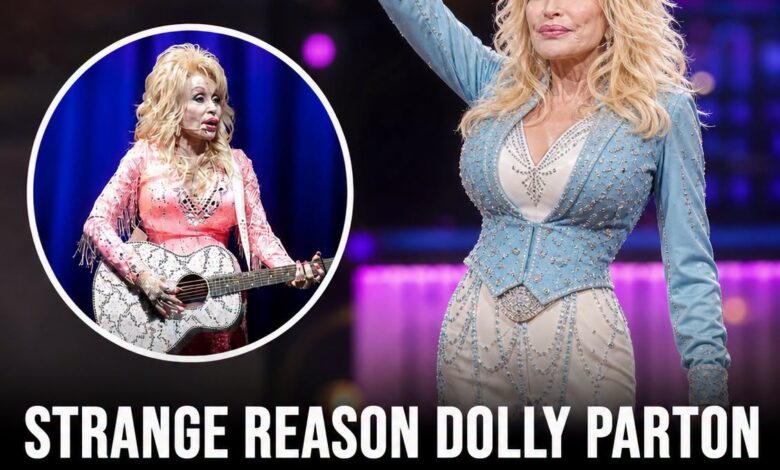
After Dolly Parton died, the world reached instinctively for the pieces of her it already knew.
The songs.
The stories.
The rhinestones.
The enormous blond hair.
The jokes delivered with perfect timing.
The photographs from every era.
The interviews where she could turn a difficult question into laughter before anyone realized she had changed the subject.
People played “Jolene.”
They played “9 to 5.”
They played “I Will Always Love You” and discovered that a song they had heard hundreds of times could suddenly sound almost unbearable.
They talked about Dollywood.
The Imagination Library.
The money she gave away.
The careers she helped.
The communities she supported.
It was natural.
When someone larger than life dies, public grief tends to begin with the largest things.
The accomplishments.
The milestones.
The proof that the life mattered.
But after the first wave of mourning softened, smaller details began to feel different.
One of them was Dolly’s sleeves.
For years, fans had noticed them.
Long sleeves.
Gloves.
Carefully covered arms.
Even in warm weather, even beneath stage lights, Dolly often dressed in ways that concealed more than people expected.
That created mystery.
And mystery, around a celebrity as famous as Dolly, inevitably became gossip.
What was she hiding?
Was it tattoos?
Scars?
Cosmetic procedures?
Age?
Something medical?
For years, people speculated.
Dolly occasionally answered just enough to satisfy curiosity without surrendering everything.
Yes, she had tattoos.
No, they were not the enormous, elaborate designs some people imagined.
They were delicate.
Pastel.
Butterflies.
Flowers.
Small decorative images.
And beneath some of them, she explained, were scars.
Dolly’s skin was prone to keloids.
Keloid scars form when scar tissue grows beyond the original injury. They can become raised, thick, darker than the surrounding skin, and difficult to ignore.
For someone whose body had been publicly examined for decades, those scars became part of a deeply personal story.
Dolly chose to cover some of them with tattoos.
That detail changes the way the sleeves look.
What once seemed eccentric can begin to feel intentional.
Not merely fashion.
A boundary.
Dolly Parton had spent nearly her entire adult life being looked at.
Not casually.
Professionally.
Commercially.
Relentlessly.
Her face appeared on album covers.
Her body was discussed in interviews.
Her breasts became punch lines and questions.
Her hair became mythology.
Her waist became part of the visual brand.
Her cosmetic procedures were analyzed.
Her age was monitored.
Every change in appearance became available for public interpretation.
She handled much of that scrutiny with humor.
That was one of her great defensive talents.
If someone wanted to joke about her appearance, Dolly often got there first.
She joked about wigs.
Plastic surgery.
Makeup.
Her figure.
She could make an audience laugh before anyone had the chance to make her feel small.
But humor should never be confused with unlimited access.
Dolly was open.
She was not public property.
That distinction is easy to forget when a celebrity spends decades sharing parts of herself.
People begin to assume every remaining detail is simply another mystery waiting to be solved.
The marriage.
The house.
The health history.
The scars.
The tattoos.
The last days.
But Dolly understood something fame often tries to erase.
A person can be generous without being completely available.
She could tell millions of strangers intimate stories through music and still reserve the right to keep some physical wounds private.
That is what makes the tattoos feel especially meaningful.
They were not primarily designed to shock.
They were not rebellion in the conventional celebrity sense.
They were soft.
Flowers.
Butterflies.
Color placed over places where the body had healed imperfectly.
There is something almost poetic in that choice.
A scar says:
Something happened here.
A tattoo can say:
And I decide what happens next.
That does not erase pain.
It transforms the relationship to it.
Dolly spent her entire life doing something similar.
Poverty became “Coat of Many Colors.”
Heartbreak became songs.
Humiliation became humor.
Rejection became determination.
The things that wounded her rarely disappeared.
She gave them another shape.
Why should the body have been different?
A keloid scar cannot simply be willed away.
It remains.
Raised.
Visible.
A physical record of healing that did not happen neatly.
Dolly could have spent years hating those marks.
Instead, she sometimes placed beauty over them.
Not to pretend they never existed.
To reclaim the surface.
That is a subtle kind of power.
The culture often treats scars in one of two ways.
Either they must be hidden because they are ugly.
Or they must be displayed proudly as proof of strength.
Dolly seemed to choose a third option.
They could be hers.
She could cover them.
Decorate them.
Show them selectively.
Mention them when she wanted.
Refuse to explain them when she didn’t.
There is freedom in that.
A wound does not become more authentic because strangers are allowed to inspect it.
Privacy is not shame.
Sometimes privacy is ownership.
That lesson becomes especially powerful when applied to women whose bodies are treated as public conversation.
Female celebrities are expected to perform impossible contradictions.
Age naturally, but remain youthful.
Use cosmetic procedures, but never look “done.”
Be glamorous, but pretend it is effortless.
Show confidence, but not vanity.
Reveal vulnerability, but not enough to make people uncomfortable.
Dolly refused most of those rules.
She admitted the wigs were wigs.
She admitted makeup was work.
She admitted she liked looking exaggerated.
She deliberately built a version of femininity that was too much by conventional standards and then made “too much” inseparable from success.
Yet even someone that visually bold could still say:
This part is mine.
That is what the sleeves may have represented.
A woman famous for revealing herself emotionally choosing to conceal herself physically.
Not because one version was real and the other false.
Because human beings are allowed to choose different levels of access.
Dolly gave the world plenty.
Songs drawn from private hurt.
Stories from childhood.
Memories of poverty.
Accounts of marriage.
Faith.
Ambition.
Regret.
She spoke about aging with humor.
She spoke about her appearance more openly than many celebrities ever would.
But openness is not a contract obligating endless disclosure.
The tattoos sat somewhere behind that line.
Small pieces of art placed over small pieces of pain.
The public could know they existed.
It did not need a complete map.
Perhaps that is why those details became more moving after her death.
While Dolly was alive, curiosity dominated.
What is under the sleeve?
Where exactly are the tattoos?
How many are there?
After death, the questions change.
They become less about access and more about meaning.
Why did she need them?
What did they help her live with?
What did they allow her to keep for herself?
The answer may be simpler than the mystery.
She wanted to feel comfortable in her own body.
That is enough.
Dolly’s life is often described in enormous terms.
Global icon.
Legend.
Songwriting genius.
Philanthropist.
Businesswoman.
But perhaps one reason people connected with her so deeply was that beneath those labels were ordinary human negotiations.
How do I live with what happened to me?
How do I age?
How much of myself do I show?
How do I remain recognizable without becoming trapped by other people’s expectations?
How do I turn something painful into something I can bear looking at?
The tattoos were one answer.
Not the only answer.
Not a grand public statement.
A personal one.
There is also something fitting about the imagery she reportedly chose.
Butterflies.
Flowers.
Soft colors.
Transformation.
Growth.
Fragility.
Beauty that does not deny the existence of damage.
A butterfly is not beautiful because nothing happened to it.
Its entire existence depends on transformation.
Dolly understood transformation better than most.
She transformed a poor mountain childhood into global fame.
Transformed songwriting into an empire.
Transformed exaggerated femininity into authority.
Transformed money into books, jobs, relief, and opportunity.
And on her skin, she transformed scars into art.
That does not mean the scars ceased to exist.
Transformation is not erasure.
That may be the deeper lesson.
People often talk about overcoming pain as though healing means returning to the person you were before.
Bodies know better.
Sometimes healing leaves a mark.
So do lives.
You are not restored to an untouched state.
You become someone who carries evidence.
Dolly carried evidence.
She simply chose how it would be framed.
The long sleeves therefore begin to look less like concealment and more like control.
The world already saw so much.
She decided what else it was allowed to see.
And that choice becomes more meaningful in death because public mourning often creates its own kind of intrusion.
After a famous person dies, audiences become hungry for final details.
The last photograph.
The final conversation.
The exact diagnosis.
The hospital room.
The private suffering.
Grief can make people feel entitled to proximity.
But love is not the same as access.
Perhaps the most respectful way to remember Dolly is to allow some mysteries to remain mysteries.
The exact placement of every tattoo does not change the songs.
The precise story behind every scar does not increase the value of her generosity.
We do not need complete access to understand the essential truth.
Dolly Parton’s body carried pain.
She did what human beings do.
She found ways to live with it.
Sometimes that meant humor.
Sometimes glamour.
Sometimes privacy.
Sometimes a flower tattoo placed gently over a scar.
And somehow, even those small decisions echoed the philosophy that ran through the rest of her life.
Pain does not have to be the final design.
You can add something.
Color.
Meaning.
Kindness.
Beauty.
A song.
A book.
A joke.
A butterfly.
That may be why the memory of the sleeves feels less mysterious now.
They were not simply hiding something.
They were protecting something.
A woman who had already given the world enormous pieces of herself still had the right to decide where the giving stopped.
There is courage in revelation.
There is also courage in saying:
This remains mine.
Dolly practiced both.
She gave the world her voice.
She gave it her stories.
She gave it laughter, music, money, and hope.
But she kept some wounds behind fabric.
And rather than making her less authentic, that boundary made her more human.
After all the stage lights dimmed, perhaps that is one of the quieter truths worth carrying forward.
Healing does not require public proof.
Strength does not require displaying every scar.
And grace can grow in places nobody else is ever invited to see.