Dolly Parton’s Final Appearance Looked Serene—Only Days Later, Fans Realized How Ill She Had Become

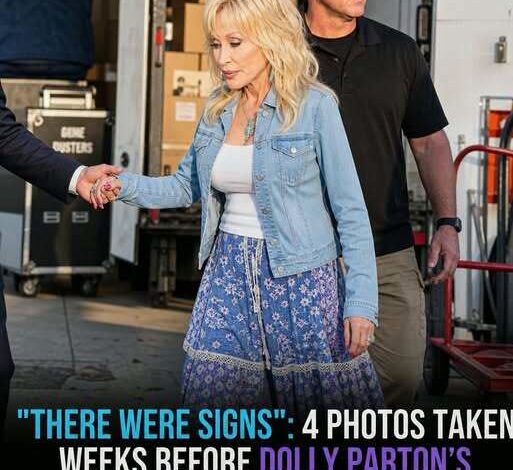
Dolly Parton was saying goodbye, and almost nobody knew it.
Dressed in white beneath the lights, she smiled into the camera with the unmistakable warmth that had carried her through decades of performances, interviews, awards, and celebrations. She thanked the Academy of Country Music gracefully, looking polished and composed.
To viewers, it was simply another Dolly moment.
Then, days later, she was gone.
And the footage changed.
Fans returned to it with the painful attention people give to ordinary moments once they discover those moments were among the last.
They replayed her words.
Paused on her expression.
Studied her movements.
Looked for hesitation in her voice.
Suddenly, details that had seemed insignificant felt enormous.
Had she known?
Had she been saying goodbye without saying the words?
Had something been hidden in plain sight?
Hindsight does that to us. It takes a smile we barely noticed and makes us stare at it. It turns a simple thank-you into something resembling a farewell.
Yet perhaps the most revealing thing about Dolly’s final public chapter was not what she might have been hiding.
It was what she chose to give.
For decades, Dolly had understood the difference between being famous and being completely accessible. She gave audiences enormous pieces of herself—her childhood, heartbreaks, ambitions, humor, faith, music and memories—but she never surrendered ownership of everything.
Some things belonged to the stage.
Others belonged behind closed doors.
That boundary appears to have remained important as her health declined.
When changes to her schedule required explanations, Dolly offered the public pieces it could understand: dizziness, dehydration, difficult recoveries and other manageable descriptions.
She could make discomfort sound almost funny.
She joked.
She smiled.
She redirected attention.
That was one of Dolly’s extraordinary gifts. She knew how to carry something heavy without automatically placing its full weight into somebody else’s hands.
She had done it in songs for years.
Pain became melody.
Poverty became storytelling.
Heartbreak became poetry.
Embarrassment became humor.
She did not deny difficult things. She transformed them before offering them to the audience.
Perhaps silence became another version of that transformation.
Only a small circle apparently saw the full reality of her final struggles.
To outsiders, that might look like secrecy.
But privacy is not necessarily deception.
Sometimes it is protection.
Dolly knew what fame could do to suffering. A medical problem could become a headline before the patient had finished understanding it. A difficult photograph could circulate endlessly. A private fear could become entertainment.
She had spent decades allowing people to look at her.
She did not owe them the right to watch her die.
That distinction gives those final images their extraordinary emotional force.
The white clothes.
The familiar smile.
The carefully prepared appearance.
The calm gratitude.
Knowing what came afterward makes the scene feel almost cinematic, but Dolly herself did not seem interested in turning death into the final spectacle.
She was still presenting life.
And while her own future was narrowing, she was continuing to invest in futures that did not belong to her.
That may be the most important part of the story.
Dolly had spent years creating things designed to survive her.
Music was only the beginning.
There were books reaching children through her literacy work.
There were plans connected to her story and legacy.
A Broadway musical.
A museum.
A hotel.
Places where visitors could encounter the world she had built.
Projects that could employ people, inspire performers and introduce future generations to a woman they might never have seen alive.
Viewed separately, they look like business ventures or legacy projects.
Viewed together, they reveal a philosophy.
Build something that keeps moving after you stop.
Give something that travels farther than you can.
Plant something whose shade you may never personally sit beneath.
Dolly had always understood that kind of generosity.
A child receiving a book did not need to meet Dolly Parton for the gift to matter.
A struggling songwriter did not need to know her personally to learn from her music.
Someone grieving decades from now will not need to have lived during Dolly’s lifetime for “I Will Always Love You” to break their heart.
That is how a life continues.
Not physically.
Through consequences.
Perhaps that is why Dolly’s final months now feel less like a disappearance and more like a handoff.
She was still building tomorrow while facing the possibility that she might not be there to see it.
There is something astonishing about that.
When time becomes scarce, the natural instinct is to hold tighter.
Dolly’s instinct had always been to send something outward.
A song.
A joke.
A check.
A book.
An opportunity.
A little hope.
And near the end, that instinct apparently remained.
It changes the meaning of that final public appearance.
Maybe she was exhausted.
Maybe she was afraid.
Maybe she understood exactly how serious things had become.
Maybe there were uncertainties even she could not answer.
We cannot know everything happening inside a person simply by studying their face.
That is important to remember.
A smile is not proof that someone feels no pain.
Composure is not evidence that nothing is wrong.
But neither should dignity automatically be interpreted as pretending.
Dolly was entitled to choose how she wanted to appear.
And she chose beauty.
Not because beauty could defeat death.
Because death did not deserve ownership of every remaining moment.
That is different.
There is a profound difference between denying mortality and refusing to let mortality become your entire identity.
Dolly’s identity had always been crowded with life.
Music.
Family.
Faith.
Laughter.
Work.
Children receiving books.
People chasing improbable dreams.
Stories from the Tennessee mountains.
Carl.
Her sisters.
Her audience.
Why should illness suddenly become the only thing worth discussing?
So she apparently kept the worst of it close.
And when she stepped before the public, she remained recognizably herself.
That is why fans went searching afterward.
They had assumed there would be another appearance.
Another interview.
Another joke.
Another photograph.
Another Christmas message.
Another song.
Another chance.
That assumption is painfully human.
We almost never recognize the final ordinary moment while we are inside it.
The last phone call usually sounds like a phone call.
The last dinner looks like dinner.
The last wave is just someone raising a hand.
Only afterward does memory place a frame around it.
Suddenly every detail becomes sacred.
That happened with Dolly.
A thank-you became a farewell.
A smile became something fans wanted to preserve.
A white outfit became part of the final visual memory of a woman who had spent her entire career understanding exactly how images endure.
But perhaps fans searching the footage for evidence of dying are looking in the wrong direction.
Maybe the real message is evidence of living.
She was there.
Still participating.
Still thanking people.
Still choosing how to meet the audience.
Still refusing to let suffering consume the entire frame.
That does not make the suffering smaller.
It makes the choice larger.
Dolly had never promised people a life without pain.
Her best songs proved the opposite.
She understood rejection.
Poverty.
Heartbreak.
Loss.
She understood that sometimes life hurts badly and cannot be repaired by optimism.
What she repeatedly demonstrated was something more useful:
Pain does not have to receive the final word.
You can make something beside it.
That principle ran through her career.
Beside poverty, she made songs.
Beside hardship, humor.
Beside illiteracy, books.
Beside grief, melody.
And beside mortality, she kept building.
That is why her unfinished or continuing projects matter so much now.
The musical can continue.
The museum can preserve stories.
The hotel can welcome strangers.
The literacy work can keep putting books into small hands.
Her recordings can travel into homes she never entered.
Young performers can discover her decades from now and hear possibility in that unmistakable Tennessee voice.
None of those things erase death.
They answer it.
Not with denial.
With continuation.
That may be the deeper meaning hidden inside those final photographs.
Dolly was nearing an ending, but she had spent a lifetime creating beginnings for other people.
Her absence could stop her from making another personal appearance.
It could not stop a child from opening a book she helped provide.
It could not stop someone from hearing one of her songs for the first time.
It could not stop the laughter preserved in an interview.
It could not undo the courage she had already planted in people who watched a poor mountain girl turn impossible ambition into reality.
That is legacy at its most powerful.
Not being remembered because everyone refuses to let you go.
Being useful after you are gone.
And perhaps that explains why Dolly’s final public grace feels so consistent with everything that came before it.
She did not give death the microphone.
She gave the audience gratitude.
She gave them sparkle.
She gave them the Dolly they recognized.
Then she left behind enough work, generosity and possibility to keep pointing beyond herself.
We may never know precisely what she was thinking beneath those lights.
Perhaps she knew the goodbye was near.
Perhaps she hoped there would still be another appearance.
Human beings rarely receive perfect certainty about endings.
But the intention visible across her larger life is unmistakable.
Keep creating.
Keep giving.
Keep planting.
Keep finding beauty even when beauty cannot fix everything.
That is why those final images can be heartbreaking without being hopeless.
Yes, her body was failing.
Yes, time was running out.
Yes, the world was unknowingly watching one of its final glimpses of Dolly Parton.
But she was still herself.
Still smiling.
Still grateful.
Still looking outward.
The world thought it was watching another appearance.
Only later did it recognize a goodbye.
And even then, Dolly seemed to leave one final choice behind for everyone who loved her:
Don’t stare only at the ending.
Look at what continues.
The songs continue.
The books continue.
The stories continue.
The laughter continues.
The dreams she encouraged continue.
That was the handoff.
Dolly Parton spent a lifetime turning difficult things into something other people could carry more easily.
And when the final difficult thing arrived, she appeared to do it one last time.
She did not leave the world watching death.
She left it watching Dolly.
White clothes.
A familiar smile.
A little sparkle beneath the lights.
And behind it all, a lifetime’s worth of evidence that even when you cannot choose how your story ends, you can still choose what keeps growing after you are gone.