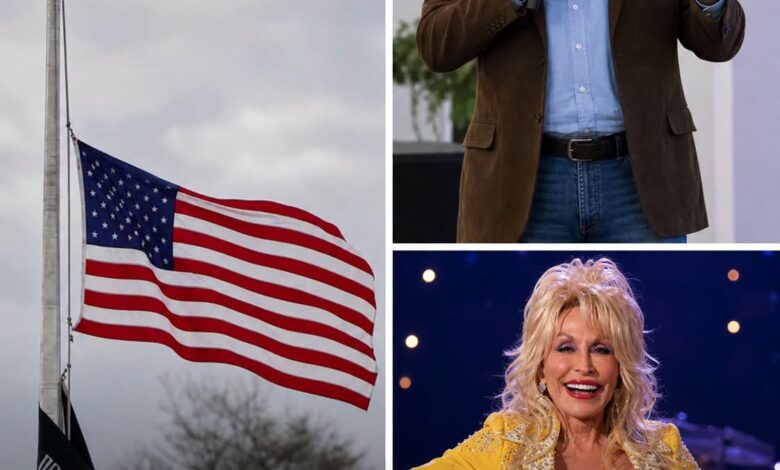
In Olive Branch, Mississippi, a flag became more than a flag.
It became an argument about who America believes deserves to be mourned in public.
The dispute began with a seemingly simple decision. Mayor Ken Adams declined to lower municipal flags to half-staff for Dolly Parton despite a presidential order calling for the tribute. His reasoning was rooted not in an expressed dislike of Dolly, but in his interpretation of what half-staff should mean.
To Adams, the gesture belongs to a particularly solemn category of national remembrance.
Fallen soldiers.
First responders.
Presidents and major statesmen.
Victims of extraordinary national tragedy.
People whose deaths, in his view, connect directly to public service, sacrifice, or the functioning of the nation itself.
Dolly Parton, however extraordinary her career and however beloved she had become, was an entertainer.
For the mayor, that distinction mattered.
His argument was essentially about scarcity.
If every enormously popular cultural figure receives one of the country’s highest symbolic honors, does the gesture eventually lose some of its meaning?
A symbol derives power partly from the limits placed around its use.
Half-staff is visually striking precisely because it interrupts the ordinary appearance of the flag. It tells people passing beneath it that something has happened.
Someone has been lost.
Something deserves collective attention.
Adams appeared determined to protect that seriousness.
But then came the question that transformed a procedural decision into something emotional:
Who decides what counts as service?
Because to millions of people, describing Dolly Parton as merely a celebrity missed almost everything that made her important.
Yes, she was famous.
Spectacularly famous.
She wrote songs recognized around the world, built businesses, appeared in films, became a television personality, and turned herself into one of the most recognizable figures in American culture.
But celebrity was only one part of the story.
Her supporters pointed instead to the books.
Through Dolly Parton’s Imagination Library, hundreds of millions of books have been distributed to children, helping families build home libraries and encouraging early literacy on a scale few entertainers ever attempt.
That work complicated the mayor’s distinction.
If service must involve a uniform or elected office, Dolly did not qualify.
But if service can mean using private success to improve millions of lives, the line becomes harder to draw.
Her defenders also highlighted her charitable work and her support for military communities and other causes.
Their argument was not that singing country songs made someone equivalent to a fallen soldier.
It was that Dolly’s public contribution could not fairly be reduced to singing.
She had spent decades converting fame into something useful.
Attention became literacy.
Money became philanthropy.
A childhood in rural Tennessee became motivation to expand opportunity for children growing up with limited resources.
That is why the refusal in Olive Branch landed painfully for some people.
They did not hear:
“We reserve this symbol for a narrow category.”
They heard:
“She didn’t do enough.”
And grief is particularly sensitive to perceived rankings.
When people love a public figure, they are not necessarily grieving fame.
They may be grieving what that person represented.
A childhood song.
A parent’s favorite record.
A book that arrived in the mail for their child.
A woman who seemed able to speak across cultural divisions that increasingly define American life.
Dolly occupied an unusual place.
She could feel deeply Southern without belonging exclusively to one political tribe.
Traditional and unconventional.
Christian and welcoming.
Commercially enormous and personally associated with generosity.
People who agreed on almost nothing could often agree on Dolly.
So when supporters asked why someone like that did not deserve the gesture, they were really asking a larger question:
What kind of contribution counts as national service?
The debate became sharper when critics accused Adams of inconsistency.
Commenters pointed toward previous occasions when half-staff honors appeared to extend beyond the categories he now emphasized.
Once that accusation enters a dispute, symbolism becomes political very quickly.
If exceptions have been made before, why not Dolly?
If the president ordered the tribute, why should a local mayor decide differently?
Was this genuinely about protecting tradition?
Or was Dolly being subjected to a standard others had escaped?
Those questions fueled anger.
But Adams also had defenders.
Some veterans and residents agreed that half-staff should remain closely tied to military sacrifice, first responders, public officials, and national tragedy.
For them, supporting the mayor did not require disliking Dolly.
They could admire her music, respect her philanthropy, and mourn her death while still believing the American flag should not function as a general marker of celebrity loss.
That distinction deserves to be heard too.
A soldier killed in service and a beloved entertainer can both matter enormously without being honored identically.
Different forms of contribution can receive different forms of remembrance.
The disagreement, then, was not necessarily between people who loved Dolly and people who did not.
It was between competing definitions of what a national symbol is supposed to communicate.
One side emphasized tradition.
The other emphasized contribution.
One asked:
What has half-staff historically been reserved for?
The other asked:
What did this person give to the country?
Both questions lead somewhere important.
And neither becomes easier because politics surrounds the decision.
President Trump’s involvement inevitably added another layer.
In a less polarized era, perhaps the dispute could have remained mostly ceremonial.
But almost any presidential action now arrives carrying partisan meaning, even when the person being honored had spent decades avoiding easy political categorization.
That is part of what made Dolly such an unusual figure in the first place.
People wanted to claim her.
She often resisted being reduced to a political mascot.
Her broad appeal came partly from her ability to speak about kindness, poverty, opportunity, faith, and dignity without turning every statement into a partisan loyalty test.
That may explain why the Olive Branch dispute became so revealing.
Dolly united people.
The argument over how to honor her divided them.
Yet beneath the anger lies a question worth considering without immediately choosing a side.
What makes someone a hero?
Uniform?
Office?
Sacrifice?
Courage?
Service?
Cultural influence?
Generosity?
The answer changes depending on whom you ask.
For a veteran, the word may evoke someone who never came home.
For a child from a low-income household, it might someday evoke the woman whose program put books in their hands.
For a mayor, civic symbolism may require formal boundaries.
For a grieving fan, those boundaries can feel painfully inadequate.
That does not mean every beloved entertainer should automatically receive every national honor.
Nor does it mean traditional standards should be immune from reconsideration.
Symbols survive because societies protect their meaning.
But meanings also evolve because societies repeatedly ask whom those symbols are meant to include.
That tension is older than this controversy.
America constantly renegotiates its public memory.
Whose statues remain?
Whose names go on buildings?
Who receives state funerals?
Who appears on currency?
Who receives flags at half-staff?
These decisions are never merely administrative because remembrance is a statement of values.
To honor someone publicly is to say:
This life represented something we believe mattered.
That is why a disagreement over flag height could become emotionally enormous.
The argument was never really about several feet of fabric moving down a pole.
It was about recognition.
Dolly’s supporters wanted acknowledgment that service does not always arrive in uniform.
Adams’ supporters wanted acknowledgment that not every admirable life belongs inside the same ceremonial category.
Between them stood a community forced to confront the uncomfortable possibility that both concerns could be sincere.
Perhaps the mistake is assuming that respect must always look identical.
A nation can honor fallen soldiers with profound distinction while also recognizing extraordinary civilian contribution.
It can protect solemn traditions while debating whether those traditions have room to expand.
And people can disagree over the proper use of a symbol without concluding that everyone on the other side lacks patriotism, compassion, or respect.
Dolly herself might have understood that complexity.
Her legacy was never contained in one category.
Singer.
Songwriter.
Businesswoman.
Philanthropist.
Literacy advocate.
Daughter of Appalachia.
National icon.
To call her only a celebrity was incomplete.
To pretend her achievements were equivalent to every other form of public sacrifice would also flatten important differences.
Her life deserves something more thoughtful than either simplification.
Long after the argument in Olive Branch fades, the books will remain.
Children will continue opening them.
Songs will continue playing.
Families will continue telling stories about what Dolly meant to them.
Flags eventually return to the top of their poles.
That is built into the ritual.
Legacy works differently.
It remains wherever someone’s actions continue producing consequences after they are gone.
And perhaps that is the final irony of the entire controversy.
People were fighting over whether Dolly Parton deserved to be honored by lowering something.
Meanwhile, much of her life’s work had been devoted to lifting people up.