PART 3: THE DOOR HE LOCKED HIMSELF
The first thing I did was ask the social worker to write down Eli’s statement exactly as he gave it.
Not what she thought he meant.
Not what I thought he meant.
His words.
I also asked her to document that I had not questioned him before she entered the room.
Then I did something that felt almost impossible.
I stopped asking questions.
There were dozens screaming inside my head. I wanted to know exactly what my father had said, what my brother had done, how long Eli had been frightened, and why nobody had stopped it sooner.
But those answers could wait.
My son needed a father more than I needed an investigation.
That night, the hospital restricted my father and brother from receiving information about Eli or entering his room without my permission.
I denied permission.
Near midnight, Eli woke.
The room was dark except for the glow from the monitors. I was sitting beside him when his eyes opened.
“Dad?”
“I’m here.”
He stared at the ceiling for a moment.
Then he asked the question I had been dreading.
“Can they make me go back?”
Every instinct in me wanted to say no.
Never.
Not after this.
But I had spent too much of my life around adults who made promises they had no authority to keep.
I wasn’t going to become one of them simply because my intentions were better.
“Not tonight,” I said.
His eyes moved toward me.
“What about tomorrow?”
That hurt more.
I couldn’t promise what a court would decide. I couldn’t predict what an investigator would recommend or what paperwork might arrive.
So I promised only what belonged to me.
“Tomorrow I’ll still be here,” I said. “And I’m not agreeing to send you back.”
He watched my face as if checking for something.
Then he closed his eyes.
By morning, I had filed the formal report.
I provided everything I had preserved: recordings, photographs, medical documentation, call records, dates, messages.
I resisted the temptation to describe my father.
I didn’t call him cruel.
I didn’t call him manipulative.
I didn’t call him evil.
I wrote down what happened.
Times.
Statements.
Injuries.
Actions.
Facts didn’t need adjectives.
Eventually, someone asked about my own treatment history.
I knew that question was coming.
Once, it would have terrified me.
My father had spent years teaching people that my having needed help meant anything I said afterward could be dismissed.
So I answered plainly.
Yes, I had needed treatment.
Yes, I completed it.
Yes, I still used what I learned there.
I wasn’t ashamed of any of that.
Then I asked for one thing.
Judge everyone by the same standard.
Not by who sounded calmest.
Not by who looked most respectable.
Not by who could tell the smoothest story in a quiet voice.
Look at what each person actually did.
The temporary no-contact order remained in place.
Three days later, Eli came home.
I thought bringing him through our front door would feel like the ending.
It wasn’t.
Safety can be restored on paper much faster than the body learns to believe in it.
For the first week, every car became a threat.
If headlights slowed outside the house, Eli woke.
If a door slammed somewhere down the street, his shoulders tightened.
Once, a vehicle stopped near our driveway and he appeared in the hallway before I had even gotten out of my chair.
I never told him he was overreacting.
I never said, “You’re safe now,” as though saying it should make his nervous system obey.
Instead, I checked.
The front door.
The back door.
The windows.
Then I sat beside him until he could sleep again.
Sometimes recovery looked like that.
Not bravery.
Verification.
Weeks later, Eli was sitting at the kitchen table when he asked, almost casually, “Why did Grandpa want people to think you were sick?”
I stopped what I was doing.
There were answers a child could carry and answers that belonged to adults.
I chose the smallest honest one.
“Because when people believe his version first, he feels like he gets to decide what happens next.”
Eli considered that.
“Did he do that to you?”
There was no useful lie available.
“Yes.”
He nodded once.
Then he asked for another glass of water.
That was all.
Children sometimes place enormous truths beside ordinary requests because they don’t yet know adults expect dramatic pauses between them.
Months passed.
Eli’s ribs healed.
The bruises disappeared.
He went back to school.
Slowly, our house became irritatingly normal again.
Cups appeared in the living room despite my repeated requests that they migrate back to the kitchen.
Homework waited until later than it should.
Every morning became a frantic search for something that had supposedly been “right there.”
Usually his shoes.
One morning, after we’d spent several minutes searching, I finally said, “Eli, how do you lose your shoes every single day?”
Silence.
We both looked toward the entryway.
And suddenly neither of us was thinking about the sneakers we were searching for.
We were thinking about the shoe that never came home.
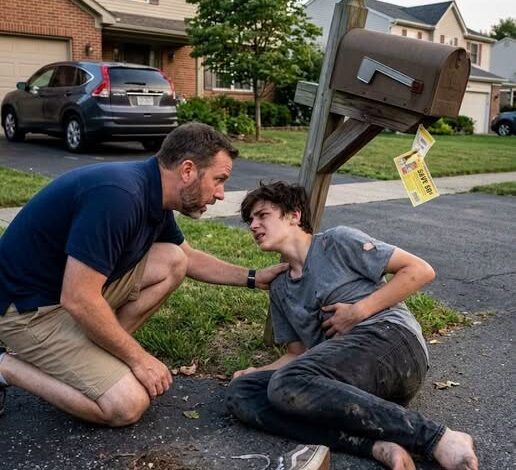
The one Eli had lost climbing through the laundry-room window while escaping.
We never recovered it.
For a long time, that missing shoe became one of those strange objects that existed precisely because it didn’t exist.
There should have been two.
There was only one.
Proof of the moment my son had decided that getting out mattered more than what he left behind.
“I’ll keep looking,” I said quietly.
Eli shook his head.
“They’re under the couch.”
They were.
We laughed.
Not much.
But enough.
That became our life.
Healing didn’t arrive as one enormous moment.
It came disguised as ordinary things.
A full night of sleep.
A car slowing outside without Eli getting up.
A slammed door that didn’t make him freeze.
Complaining about homework.
Forgetting a cup.
Losing his shoes.
Being a kid again.
Then one evening, long after his ribs had healed, I came downstairs and found him standing at the front door.
He was wearing socks.
The porch light was on.
A new pair of sneakers sat neatly on the mat.
For a moment, I didn’t say anything.
Neither did he.
Eli looked through the glass toward the driveway.
Months earlier, that same darkness had represented danger.
I could still hear his frightened voice from that July evening.
Dad, lock the door.
I had locked it then because my son needed me to.
Because somebody was coming after him.
Because he had escaped frightened and injured and needed to know there was something solid between him and the people he feared.
But this night was different.
Nobody was outside.
No car was approaching.
Nobody was demanding entry.
The driveway was empty.
Eli reached for the deadbolt.
He checked it once.
Then he turned the lock himself.
Click.
Such a small sound.
I had heard it thousands of times in my life.
That night, it sounded different.
Eli opened the door just long enough to pick up the sneakers.
Then he closed it again.
He placed both shoes carefully on the floor.
Side by side.
A complete pair.
He didn’t check the driveway again.
He didn’t ask me whether anyone was coming.
He didn’t ask me to make sure the windows were locked.
He simply looked at the shoes, satisfied with their position, and started upstairs.
“Night, Dad.”
“Good night.”
I stood there after he disappeared.
For months, I had believed my job was to lock every door between Eli and what had happened.
But maybe that was never the final goal.
A locked door can mean fear.
It can mean someone dangerous is outside.
It can mean hiding.
But it can also mean something else.
Choice.
This is my home.
I decide who enters.
That was the difference my father had never understood.
Protection without choice can become another form of control.
Real safety gives something back.
Agency.
I had spent years letting other people tell my story because challenging them seemed impossible.
Eli had been caught inside that same machinery.
But he was learning earlier than I had.
You can ask questions.
You can tell what happened.
You can refuse to return somewhere you are afraid.
You can close a door.
And eventually, when you’re ready, you can be the one who turns the lock.
That July evening, Eli had whispered, “Dad, lock the door.”
Months later, he didn’t need to ask.
He locked it himself, lined up both shoes beside each other, and walked upstairs without looking back.
That was when I finally understood.
My son wasn’t hiding anymore.
He was home.