I knew something was wrong before Lily ever said the words.
Not because of the bruises.
Not because of Sarah’s frantic messages.
Because my sixteen-year-old niece sat in the back of my SUV outside the children’s hospital, clutching a damp blue towel across her lap like it was the last thing standing between her and the rest of the world.
My hand was still on the door handle when Lily leaned forward between the seats.
“Aunt Claire?”
I turned only enough to let her know I was listening.
“I’m here.”
Her voice dropped to a whisper.
“Please don’t make me go home tonight.”
Everything inside me went cold.
Beside her, my daughter Emma stopped moving.
My phone vibrated again in the cup holder.
Sarah.
My sister had called repeatedly during the drive.
Her first text had said only:
TURN AROUND. NOW.
Not Is Lily okay?
Not What happened?
Just an order.
I turned the phone facedown.
“Okay,” I said.
Lily blinked.
“Okay?”
“Yes.”
Her eyes filled so quickly that I nearly reached for her.
I stopped myself.
She had spent the last hour flinching whenever anyone came too close.
“We’re going inside,” I said. “The doctors will check you. You can tell them whatever you want when you’re ready.”
Then Lily whispered, “Mom knows.”
That was when fear turned into something heavier.
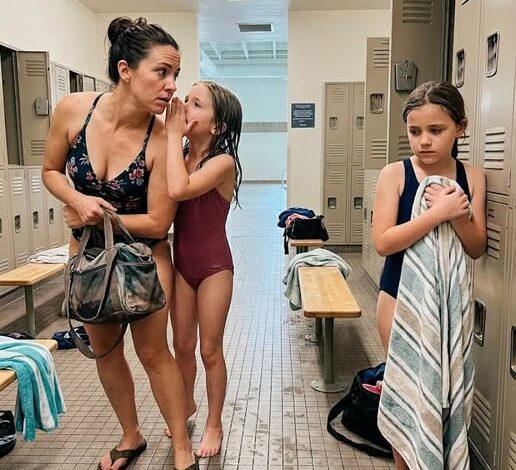
A few hours earlier, we had been at the community pool.
Nothing about the afternoon had seemed unusual.
Chlorine.
Wet flip-flops.
Kids begging for snacks.
Emma complaining that I had forgotten the good sunscreen.
I was packing our things when she said quietly, “Mom… look at Lily.”
Lily stood beside the changing-room bench with her towel wrapped tightly around her middle.
I assumed she was cold.
Then I reached toward a twisted swimsuit strap.
She recoiled so violently I froze.
“Did I hurt you?”
“No.”
“Do you need help?”
Lily stared at the floor.
Then whispered, “Turn around.”
I did.
A few seconds later, she asked me to help her change.
When I turned back, she shifted the towel.
There were marks along her torso.
Not one bruise.
Several.
Some were dark.
Others were fading.
And beneath them, her skin looked raw and irritated.
Every alarm inside me went off at once.
My first instinct was to ask who had done it.
I nearly did.
Then I saw Lily’s face.
She looked like someone waiting to find out whether telling the truth would make things worse.
So I changed course.
“You don’t have to explain this here.”
She looked at me.
“You didn’t do anything wrong.”
Her shoulders dropped slightly.
That was enough.
I helped her dress.
Packed everything.
And drove straight to the hospital.
Now, in the parking lot, Lily finally began talking.
“Mom says I’m getting too big.”
I stared at her.
Lily was athletic.
She played volleyball.
She swam twice a week.
“What caused the marks?”
She swallowed.
“Mom bought this thing online.”
“What thing?”
“A waist belt.”
I waited.
“She makes me wear it really tight.”
My stomach twisted.
“She puts cream underneath it too.”
“The irritated skin?”
Lily nodded.
“It burns.”
Emma tightened her grip around Lily’s hand.
“How long?”
“A few months.”
“And the bruises?”
Lily’s voice became almost inaudible.
“If I loosen it, she tightens it again.”
I closed my eyes for one second.
“What does she say?”
“That I’m embarrassing her.”
The words landed harder than I expected.
“She tells me nobody needs to see what I’m becoming.”
My anger rose so quickly it frightened me.
Then Lily added:
“She told me never to let anyone see the marks.”
Sarah’s message flashed through my mind.
TURN AROUND. NOW.
I opened the car door.
“We’re going inside.”
Lily grabbed my sleeve.
“What if Mom says I’m lying?”
I crouched beside her.
“She can say whatever she wants.”
Lily stared at me.
“But the doctors are still going to do their job.”
Inside, I gave the nurse only what I knew.
What I had seen.
What Lily had disclosed.
The messages from Sarah.
Then I stopped talking.
The medical team interviewed Lily privately.
That mattered.
She deserved to tell her story without watching me for approval.
Emma and I waited in a family room.
Sarah called eleven times.
On the twelfth, I answered.
“Where is she?”
“At the hospital.”
“What have you done?”
I stared at the wall.
“She needed medical attention.”
“She does not need a hospital.”
“Doctors will decide that.”
“Bring her home.”
“No.”
Sarah went silent.
Then her voice changed.
“You don’t understand what she’s been doing.”
“What has she been doing?”
“She sneaks food. She refuses to exercise. She lies about what she eats.”
“She is sixteen.”
“And I’m her mother.”
“Yes.”
I took a breath.
“That doesn’t make everything you do acceptable.”
Then she said the sentence that removed the last doubt.
“She showed you, didn’t she?”
I froze.
Not What marks?
Not What are you talking about?
“She showed you.”
“You knew.”
“It looks worse than it is.”
“How long have you been forcing her to wear that belt?”
“You’re making this sound abusive.”
“How long?”
“She needed discipline.”
For a second, I couldn’t speak.
Then I said, “Do not come here.”
“She is my daughter.”
“And tonight I’m making sure she is safe.”
I ended the call.
Sarah came anyway.
Hospital security stopped her in reception.
Through the secured doors, I watched my sister shout my name.
The same sister whose wedding bouquet I had held.
The woman who had sat beside me after Emma was born.
Someone I had trusted without hesitation.
“What are you doing?” she demanded.
“She told them.”
“Children exaggerate.”
“She’s sixteen.”
“She’s angry because I set rules.”
“Then let the professionals decide what happened.”
“I was helping her.”
That sentence hurt more than her anger.
“Then why did you tell her to hide it?”
Sarah stopped.
No answer.
Because there wasn’t one.
That night, child-safety authorities became involved.
Lily was not sent home with Sarah.
She stayed with me temporarily.
There were interviews.
Photographs.
Medical reports.
Follow-up appointments.
I was grateful for every tedious piece of procedure because procedure meant Lily’s future would not be decided by whoever shouted loudest.
The first night at my house, Emma placed clean pajamas on the guest-room bed.
No questions.
No speech.
Just pajamas.
Around midnight, I found Lily in the kitchen drinking water.
“Can’t sleep?”
She shook her head.
Then she asked, “Do you think Mom hates me?”
I refused to lie just because the truth was uncomfortable.
“I don’t know what your mother is thinking.”
Lily looked down.
“But I know this.”
She looked up.
“Love does not make hurting you acceptable.”
Her face crumpled.
“She said she was helping.”
“People can believe they’re helping and still cause harm.”
Over the next months, Sarah cycled through every defense.
Denial.
Minimizing.
Stress.
Lily’s attitude.
Her own fear that Lily would gain weight.
Then, eventually, something broke.
She called me late one evening.
“My mother did the same thing to me.”
I stayed quiet.
“She watched everything I ate. Weighed me. Told me nobody would love me if I got fat.”
There it was.
The inheritance no one wanted.
“I promised Lily would never feel like that.”
I closed my eyes.
“But you taught her the same fear.”
Sarah started crying.
“Yes.”
No excuse followed.
That was the first real change.
Still, Lily did not immediately move home.
An apology was not treated like a reset button.
Visits were supervised.
Therapy came next.
Some meetings went badly.
One ended with Lily refusing to speak to Sarah for three weeks.
Nobody forced her.
Trust returned according to Lily’s timetable.
Almost a year after the pool, Lily asked to meet her mother for lunch.
Emma and I sat across the street.
Forty-eight minutes later, Lily walked out.
I stood immediately.
She rolled her eyes.
“Sit down.”
“How was it?”
“She apologized.”
“Do you believe her?”
Lily thought carefully.
“I believe she’s sorry.”
That answer mattered.
Sorry and safe were not the same thing.
On Lily’s seventeenth birthday, Sarah came to our house.
She knocked.
She waited.
That mattered too.
She brought a badly wrapped box.
Inside was a camera Lily had wanted.
Sarah said quietly, “I thought you might want something that helps you look at the world instead of worrying about how the world looks at you.”
Lily cried.
Then hugged her.
Not like nothing had happened.
Like something new might.
Years later, Emma found that old blue towel in my linen closet.
She held it up.
“This one for the pool?”
I froze.
Then Lily walked into the hallway.
She recognized it instantly.
For a moment, nobody spoke.
Emma lowered it.
“I can grab another.”
Lily took the towel.
Looked at it.
Then shrugged.
“It’s a towel.”
She threw it into the beach bag.
That nearly broke me.
Because for years, I had remembered it as armor.
The thing a frightened girl wrapped around herself because she believed her body was something dangerous people might inspect.
To Lily, eventually, it became fabric again.
That afternoon we returned to the same community pool.
I asked her once if she wanted somewhere different.
“No.”
“You sure?”
“Aunt Claire, ask again and I’m pushing you in.”
So I stopped.
Later, Lily and Emma raced toward the deep end, laughing so loudly the lifeguard shouted at them to stop running.
Lily had no towel around her middle.
No careful posture.
No fear about who might look.
I sat beneath an umbrella and remembered the promise I had made without understanding what it would cost:
You’re safe with me.
I used to think safety was something you said.
I know better now.
Safety is what happens after the promise.
It is keeping the car pointed toward the hospital when someone orders you to turn around.
It is knowing when not to interrogate a frightened child.
It is choosing truth over family reputation.
It is allowing professionals to document what happened.
It is accepting that someone you love may have caused harm.
And sometimes, years later, safety looks almost insultingly ordinary.
Two girls laughing beside a swimming pool.
A mother learning to knock.
And a faded blue towel tossed carelessly onto a chair because nobody needs it for protection anymore.