I almost ran past it.
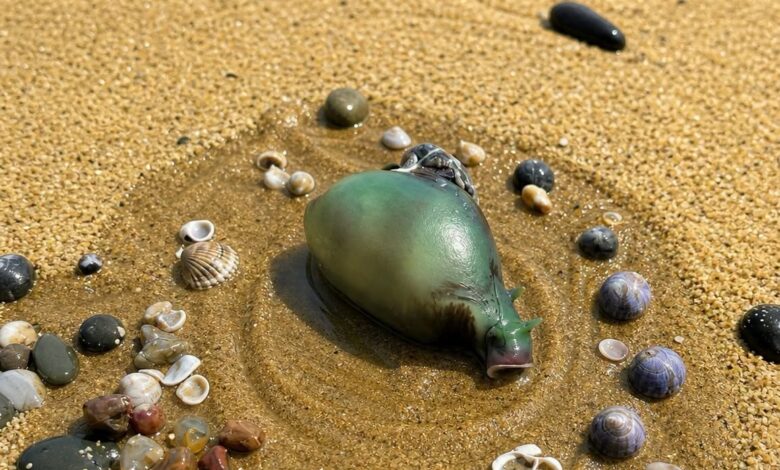
At first, it looked like a dark scrap of something the tide had abandoned—a clump of seaweed, perhaps, or part of some unfortunate fish washed onto the sand during the night.
Then it moved.
Not much.
Just a soft contraction as a thin wash of seawater reached it, followed by a slow unfolding that made me stop in the middle of my morning run.
I stepped closer.
Whatever it was, it didn’t resemble anything I expected to find on the beach.
It wasn’t shaped like a fish. There were no obvious scales, fins, or hard edges. It wasn’t a crab or another creature protected by a visible shell. Instead, its body looked soft and strangely fluid, almost as though someone had taken a piece of the ocean itself and given it enough structure to breathe.
Another wave slid around it.
The creature shifted gently.
For a moment, I had the ridiculous impression that it was deciding whether to return to the sea or remain there and let me stare.
I stayed several feet away.
The longer I watched, the less frightening it became.
Strange, yes.
Almost alien, certainly.
But there was something vulnerable about it.
Its body seemed poorly designed for the exposed beach. Out in the water, perhaps those flowing shapes would have looked graceful. On wet sand beneath an open sky, they made the animal seem delicate and misplaced.
I took out my phone.
The first photograph looked useless.
The second was better.
I moved slightly to one side, careful not to touch the creature, and took several more.
My brain immediately began cycling through possibilities.
Some kind of slug?
A damaged jellyfish?
A juvenile ray?
A piece of marine life I had somehow never encountered?
Every theory lasted only seconds.
The creature refused to fit neatly into any familiar category.
That’s one of the peculiar things about encountering an unfamiliar animal. Your mind doesn’t like leaving the space blank.
It wants a name.
A name transforms What is that thing? into Oh, that’s what that is.
Without one, imagination rushes in.
The creature suddenly seemed prehistoric.
Then extraterrestrial.
Then potentially dangerous.
I knew none of those things were supported by anything I was seeing.
I simply didn’t know what it was.
So I did something surprisingly difficult in the age of instant answers.
I left it alone.
I watched for another minute, took a final photograph, and continued down the beach.
But the run had changed.
I kept thinking about the creature.
By the time I got home, curiosity had completely replaced whatever exercise-related discipline had gotten me out of bed that morning.
I sent the photographs to a couple of people more knowledgeable about marine life than I was.
Then I started searching.
Descriptions were surprisingly difficult.
“Soft black sea creature washed ashore.”
Too broad.
“Strange marine slug beach.”
Closer.
I looked through photographs, identification pages, and online discussions where people had posted their own mysterious beach discoveries.
Some images looked vaguely similar.
Others sent me down completely wrong paths.
Then a suggestion appeared that finally matched.
Sea hare.
I stared at the name.
A sea hare?
That was the creature?
The answer somehow sounded almost as strange as the mystery.
But the more photographs I examined, the clearer it became.
What I had encountered was not an alien, a malformed fish, or some unknown monster from deep water.
It was a marine gastropod—a relative of snails and slugs.
A sea hare.
The name comes from structures on the animal’s head that can resemble rabbit ears, although there is nothing particularly rabbit-like about the creature when you encounter one unexpectedly on wet sand.
Unlike the familiar garden snail carrying its spiral house on its back, sea hares have greatly reduced shells that are internal or largely concealed by their soft bodies.
That explained the feature that had confused me most.
I had been looking for armor.
There wasn’t any obvious armor to find.
The flowing folds and soft body weren’t signs that something was wrong with it.
That was simply what the animal was.
Suddenly every strange detail had a place.
The softness.
The movement.
The almost fabric-like appearance.
What had looked so bizarre outside its proper context made perfect sense once I understood the environment it belonged to.
And that changed how I thought about those few minutes on the beach.
My first instinct had been to classify the animal according to creatures I already knew.
Fish have fins.
Crabs have shells.
Jellyfish have recognizable translucent bodies.
This had matched none of my mental templates, so my imagination had interpreted unfamiliarity as something extraordinary.
But nature doesn’t organize itself according to what happens to be familiar to us.
The ocean certainly doesn’t.
It contains animals that look like leaves, ribbons, rocks, flowers, tubes, balloons, branches, feathers, and things for which everyday language barely has a comparison.
We call them bizarre because we’re looking from the outside.
To the ecosystem that produced them, they’re perfectly ordinary.
That may have been what stayed with me most.
An hour earlier, the creature had been a mystery capable of stopping me in my tracks.
Now it had a name.
Sea hare.
Knowing that didn’t make it less remarkable.
It made it more remarkable.
There was an actual lineage, biology, habitat, and way of living behind the strange body I had briefly encountered.
The mystery hadn’t disappeared.
It had deepened into curiosity.
I also felt relieved that I hadn’t poked it, picked it up, or tried to “rescue” it based solely on my own assumptions.
Wild animals don’t necessarily benefit from human intervention simply because we don’t understand what they’re doing. When an unfamiliar marine creature appears stranded or distressed, keeping some distance and contacting local wildlife or marine experts is often wiser than improvising.
Sometimes curiosity is best expressed by not touching.
That morning, I had gone to the beach expecting nothing more memorable than a run.
Same route.
Same tide.
Same sound of water collapsing onto sand.
Then something unfamiliar interrupted the routine.
For perhaps five minutes, the world became mysterious again.
That feeling is rarer than it should be.
We carry devices capable of identifying songs in seconds, translating languages instantly, mapping almost any road, and answering questions before we’ve finished wondering about them.
It can create the illusion that everything has already been named, photographed, categorized, and explained.
Then you find a sea hare breathing with the tide.
Suddenly you’re a child again.
You don’t know.
You have to look.
You have to ask.
You have to resist turning uncertainty into fear.
Eventually, an answer arrives.
But the answer doesn’t erase the wonder.
It changes it.
What I found that morning wasn’t a monster.
It wasn’t an alien.
It wasn’t even something particularly rare or impossible.
It was simply a creature I had never learned to recognize.
And perhaps that’s why I still think about it.
The world doesn’t have to produce something undiscovered to surprise us.
Sometimes it only has to place something ordinary outside the boundaries of our own experience.
For a few minutes on that beach, I couldn’t name what was in front of me.
That uncertainty made it strange.
Learning its name made it beautiful.
A sea hare.
A soft, shell-hidden relative of the snail, carried close enough to shore for our worlds to briefly overlap.
Then the tide moved again.
And what had looked like something from another planet belonged to the ocean once more.
Wonder often begins exactly there:
with something weird enough to make us stop—and enough curiosity to keep looking until weird becomes wonderful.