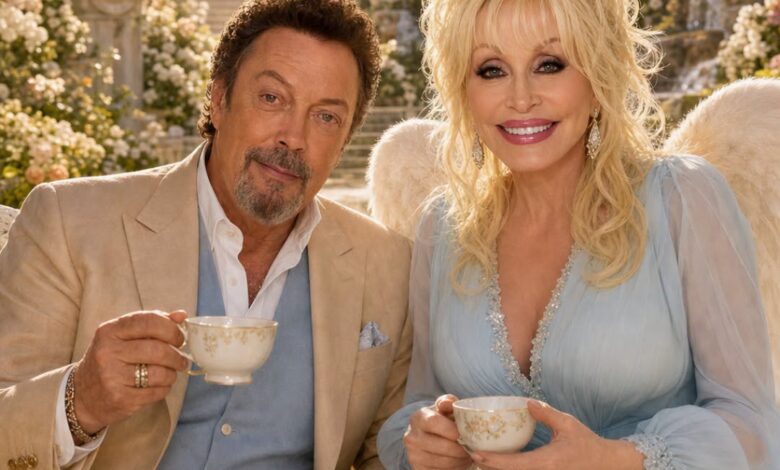
The rumor arrives already dressed like news.
A familiar photograph.
A date.
An age.
A cause of death.
Perhaps even a line claiming that a “manager” or “family representative” has confirmed everything.
Within seconds, grief begins moving faster than verification.
That is exactly how celebrity death hoaxes work.
They do not succeed because they are obviously ridiculous. They succeed because they contain just enough detail to create the feeling of credibility. The details are often carefully chosen: recognizable names such as Tim Curry or Dolly Parton, biographical coincidences, specific dates and unnamed insiders supposedly close enough to know the truth.
Specificity creates an illusion of authority.
But detail is not evidence.
Someone can invent “August 27” as easily as they can invent “Tuesday.”
They can write “his manager confirmed” without naming a manager.
They can manufacture a cause of death, add an age, attach an old photograph and place everything over a solemn black background.
Then social media does the rest.
People see a beloved artist’s face beside the words “BREAKING” or “REST IN PEACE,” and the emotional response begins before the skeptical one has time to catch up.
That reaction is deeply human.
We do not encounter famous artists only as names.
We attach them to pieces of our own lives.
Tim Curry may mean The Rocky Horror Picture Show to one person, Clue to another, and a voice from childhood to someone else.
Dolly Parton may remind someone of a grandmother singing in the kitchen, a first concert, a difficult breakup, a childhood road trip or a song that helped them through grief.
So when a post announces that someone like that has died, people rarely process it as an abstract piece of information.
They feel something.
And that feeling is precisely what false reports exploit.
Shock encourages sharing.
Nostalgia makes the claim personal.
Grief lowers the impulse to stop and investigate.
Soon the comments fill with broken-heart emojis and memories.
Someone reposts the claim.
Another person sees several friends sharing it and assumes that repetition means confirmation.
Before long, the rumor begins citing itself.
“I’ve seen this everywhere.”
But everywhere is not a source.
That distinction becomes especially important with internationally famous public figures.
A genuine death involving someone as prominent as Tim Curry or Dolly Parton would not reasonably remain trapped inside anonymous Facebook posts, screenshots, recycled videos or accounts nobody can identify.
There would be a chain of accountability.
Family members or authorized representatives would issue statements.
Major news organizations would independently confirm the information.
Reputable outlets would identify where their information came from.
Obituaries would contain documented biographical details rather than vague emotional language.
The news would become verifiable beyond the original post.
That gives us one of the simplest tests for evaluating a celebrity death rumor:
Move away from the post.
Do not ask how convincing the graphic looks.
Ask who is actually making the claim.
Is there a named representative?
Can the supposed statement be found somewhere official?
Are established news organizations reporting the death independently?
Or are dozens of pages simply repeating the same unverified sentence?
That last scenario is where misinformation often disguises itself as consensus.
Twenty accounts repeating one unsupported claim do not create twenty sources.
They create one rumor with twenty copies.
And the damage is not limited to embarrassment when someone discovers they shared false information.
Death hoaxes manipulate genuine emotion.
A fan may see the announcement and immediately think about childhood.
They may call a parent.
They may cry.
They may spend an hour watching old performances.
They may write a tribute to someone they sincerely believe is gone.
Then the correction appears.
The person never died.
The grief was real.
The event producing it was not.
That emotional whiplash has consequences.
Repeated enough times, false alarms train people to distrust everything.
Eventually, a genuine announcement appears and the first reaction becomes:
“Is this another hoax?”
That is one of misinformation’s quieter forms of damage.
It does not merely persuade people to believe false things.
It weakens their confidence in true things.
When fabricated stories repeatedly imitate legitimate reporting, the visual language of real news begins to lose meaning.
A photograph proves nothing.
A screenshot proves almost nothing.
Quotation marks do not prove someone said the words inside them.
A specific date does not establish authenticity.
And “confirmed by his manager” means very little when the manager is never identified.
The most useful question is often painfully simple:
Who can be held accountable for this claim?
Real journalism leaves fingerprints.
Reporter names.
News organizations.
Direct quotations.
Official statements.
Named representatives.
Multiple independent confirmations.
Corrections when mistakes occur.
Hoaxes often offer the opposite.
“Sources say.”
“A close friend revealed.”
“According to reports.”
“His team confirmed.”
Which sources?
Which reports?
Which member of the team?
Where was the confirmation published?
If those questions cannot be answered, certainty should immediately fall.
There is also something unsettling about the business model behind many celebrity death rumors.
The subject’s life becomes bait.
Their face becomes a thumbnail.
Their supposed death becomes a mechanism for generating clicks, comments, advertising impressions and shares.
The more beloved the celebrity, the more valuable the fabricated tragedy becomes.
That is why refusing to share unverified death reports is more than a media-literacy habit.
It can be an act of respect.
If we genuinely admire an artist, their mortality should not become entertainment before it becomes fact.
Their family should not have to compete with fabricated announcements.
Fans should not be emotionally manipulated simply because grief performs well in an algorithm.
And a person’s legacy deserves more care than a viral screenshot can provide.
The solution does not require becoming suspicious of everything.
It requires slowing down at exactly the moment a post is designed to make us hurry.
Before sharing, pause.
Look at the source.
Search for independent confirmation.
Find the original statement rather than someone’s screenshot of it.
Ask whether anyone with direct knowledge has actually put their name behind the claim.
And pay attention to what is missing.
A nameless “manager” is not stronger evidence because the post also provides a specific date.
An invented detail does not authenticate another invented detail.
Sometimes the absence of accountable sourcing tells you more than all the dramatic language surrounding it.
There is no shame in initially believing something that was deliberately constructed to deceive.
The important moment comes afterward.
Do we amplify it immediately because it made us feel something?
Or do we give truth enough time to catch up with emotion?
That choice matters.
Especially when death is involved.
The artists people love deserve to have their lives remembered accurately.
Their real struggles deserve truth.
Their real achievements deserve context.
And when death eventually comes, their real passing deserves something better than an audience already exhausted by fabricated goodbyes.
Shock travels quickly.
Grief travels even faster.
Truth sometimes needs another minute.
Give it that minute.
Because in a feed engineered to make us react first and verify later, one of the most caring things we can do—for artists, their families and one another—is refuse to mourn a headline until we know it is real.