SHOCKING MOTEL MIDNIGHT RAID What Are Authorities Hiding About the Elderly Man Taken Into Custody?

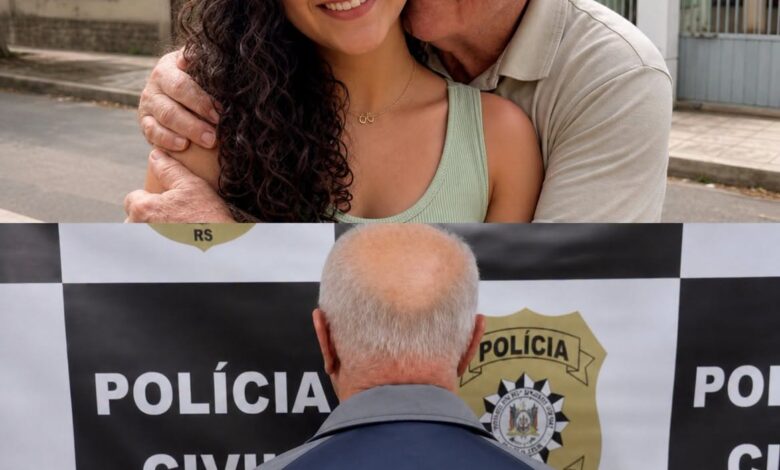
By the morning after the arrest, the motel was no longer just a motel.
It had become an argument.
Police tape fluttered across the property. Patrol cars had come and gone. Reporters gathered wherever they could stand without being moved along, while residents slowed their cars as they passed, searching the windows for some clue that might explain what had happened inside.
Everyone wanted answers.
Almost nobody had them.
That absence created a vacuum, and the town filled it immediately.
One person claimed officers had known for weeks.
Another insisted the arrest had been planned to silence someone.
Someone else had heard that evidence discovered in the room would “change everything.”
Screenshots circulated without context. Old photographs resurfaced. Anonymous posts were repeated as though repetition transformed rumor into confirmation.
Within hours, people were no longer discussing the same event.
They were discussing competing versions of it.
For some residents, the arrest confirmed their deepest suspicion: that people with authority could act first and explain themselves later.
For others, the police tape represented something different. They believed investigators had uncovered something serious and were doing exactly what they were supposed to do—protecting evidence, witnesses and a case that could collapse if officials spoke recklessly.
Both groups looked at the same silence.
Each saw proof.
That was the problem.
Outside the motel, silence felt like concealment.
Inside the investigation, silence was being defended as procedure.
The two realities collided every day.
While social media demanded immediate answers, the actual case moved at an almost painfully slow pace.
Files were opened.
Reports were compared.
Video was replayed.
A few seconds of footage could consume hours as investigators tried to determine who entered a room, when someone left, what could be seen and what remained outside the camera’s frame.
Timelines were constructed, challenged and rebuilt.
A statement that sounded straightforward at first could become complicated when placed beside another witness account.
A timestamp could raise a question nobody had initially thought to ask.
Every answer seemed capable of producing three more questions.
That is the frustrating truth about serious investigations.
From outside, nothing appears to be happening.
Inside, almost everything depends on refusing to move faster than the evidence allows.
But procedure offers little comfort to people who are frightened.
Every quiet day increased suspicion.
Every carefully worded official statement sounded evasive to someone.
Every “we cannot comment on an active investigation” became another reason to believe authorities were hiding something.
Families wanted clarity.
Residents wanted reassurance.
Reporters wanted facts they could verify.
Officials kept repeating that releasing information prematurely might compromise interviews, contaminate witness accounts or damage a future prosecution.
Legally and strategically, that explanation could make sense.
Emotionally, it sounded like another locked door.
And the longer that door remained closed, the more people imagined what might be behind it.
The motel became shorthand for all of it.
Fear.
Power.
Distrust.
Justice.
Rumor.
Depending on who was speaking, it represented either proof that authorities had finally acted or proof that they could not be trusted to explain their actions.
That transformation mattered because communities rarely experience major cases only through evidence.
They experience them through memory.
Someone remembers another investigation that never produced satisfying answers.
Someone remembers being dismissed by an officer.
Someone else remembers a loved one protected by police intervention.
People bring those histories with them.
So when officials ask for patience, they are not speaking to a blank audience.
They are speaking to people who already have reasons to trust—or distrust—the institutions asking them to wait.
That is why transparency matters even when complete disclosure is impossible.
Transparency does not require investigators to publish every piece of evidence while a case is active.
It does require acknowledging what people are afraid of.
Officials can explain process without revealing protected facts.
They can say what stage an investigation has reached.
They can clarify which agency is responsible for which decisions.
They can correct demonstrably false rumors when doing so will not compromise the case.
Most importantly, they can recognize that silence has consequences of its own.
Because information vacuums do not remain empty.
Rumor moves in.
Rumor is faster than evidence because rumor does not need to be careful.
It does not need corroboration.
It does not have to survive cross-examination.
It only needs to sound plausible to someone already frightened enough to believe it.
By the time verified facts emerge, the fictional versions may have traveled farther.
That is how communities fracture around cases they barely understand.
People begin choosing sides before they know what happened.
Questions become accusations.
Uncertainty becomes certainty.
And anyone asking for patience is treated as though they have already chosen a camp.
Meanwhile, somewhere behind closed doors, investigators continue doing work that looks almost absurdly mundane compared with the emotional storm outside.
Watch the video again.
Check the timestamp.
Read the statement.
Compare the report.
Call the witness.
Ask the question differently.
Go back.
Check again.
Justice, when it functions properly, can be frustratingly uncinematic.
There is rarely one brilliant revelation.
More often there are hundreds of small facts that must fit together without being forced.
That caution is necessary because an arrest is not a conviction.
Suspicion is not proof.
A rumor is not testimony.
A motel room is not a verdict.
Those distinctions can feel painfully inadequate when a town is demanding certainty, but they are precisely the distinctions that fairness requires.
The harder question is whether institutions can protect those standards without treating the public as an inconvenience.
“Trust us” is not transparency.
Neither is dumping incomplete evidence into public view simply to satisfy pressure.
Real accountability lives somewhere between those extremes.
It means explaining what can be explained.
Admitting what remains unknown.
Correcting misinformation.
Respecting legal limits.
And understanding that people who ask difficult questions are not necessarily enemies of an investigation.
Sometimes they are simply afraid.
Eventually, the police tape will come down.
The parking lot will return to being a parking lot.
Travelers who know nothing about the case may sleep in those rooms.
The building itself will become ordinary again.
But the town may not.
Because whatever happened inside that motel is now connected to a larger question:
What happens when people become frightened of the institutions responsible for telling them the truth?
The answer cannot come from rumor.
It cannot come from social-media certainty.
And it cannot come from official silence stretched so long that silence itself begins to feel like the message.
Facts will have to emerge carefully.
Evidence will have to be tested.
People accused of wrongdoing will have to receive due process.
Those harmed will deserve to be heard.
And officials will eventually have to explain not merely what they concluded, but how they reached that conclusion.
That may be the difference between a case being closed and a community actually healing.
Because healing will not depend only on what investigators say they found behind a motel door.
It will depend on whether people believe the process that brought those facts into daylight.
For now, the town waits.
Behind closed doors, investigators move frame by frame.
Outside them, fear moves much faster.
Eventually those two timelines must meet.
And when they do, the people holding power will face a responsibility larger than solving one case.
They will have to prove that silence was used to protect the truth—not to hide from it.