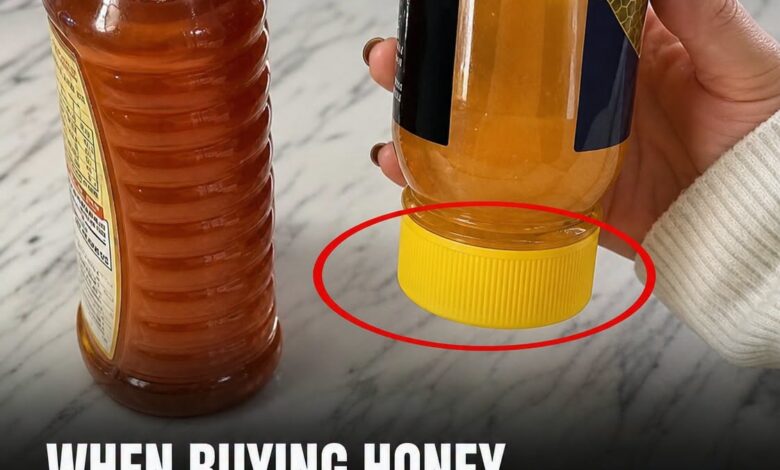
The bottle turns upside down.
A golden bubble begins its slow journey through the honey.
It moves reluctantly, almost lazily, and for a moment the conclusion feels irresistible:
This must be real honey.
After all, everyone has heard some version of the trick. Pure honey is supposed to be thick. Fake honey is supposed to run quickly. Therefore, if the bubble creeps slowly enough, the bottle has passed the test.
There is only one problem.
The bubble is testing thickness.
It is not testing honesty.
Honey’s viscosity can change dramatically depending on temperature. Take a perfectly authentic jar and warm it, and the honey becomes noticeably more fluid. Cool another product and it may become much thicker.
Run the same viral “purity test” under different conditions and the same honey can appear to give different answers.
That alone should make us cautious about kitchen tricks promising certainty.
But temperature is only part of the story.
Honey is not one perfectly standardized substance produced identically everywhere.
Its characteristics vary with floral source, moisture content, processing, storage conditions and age. Some honeys naturally pour more freely than others. Some are extremely thick. Some crystallize quickly, while others remain liquid much longer.
Crystallization itself is frequently misunderstood.
A jar that develops crystals has not necessarily spoiled, nor does crystallization automatically prove exceptional purity. It is a natural process influenced by the honey’s composition and storage conditions.
In other words, texture contains information.
It simply does not contain the information viral videos often claim it does.
The same problem appears with many popular home tests.
Put honey in water and watch what happens.
Place a drop on your thumb.
Try to burn it.
Spread it on a plate and look for a pattern.
Observe whether it dissolves immediately.
Each demonstration can look wonderfully scientific because something visible happens.
But visible is not the same as diagnostic.
These tricks usually demonstrate ordinary physical properties—viscosity, moisture behavior, combustion conditions, surface tension or dissolution.
Then comes the leap.
A physical observation gets converted into a verdict about authenticity.
That is where the method breaks down.
Consider the burn test.
Versions of it claim that pure honey will burn while adulterated honey will not, supposedly because added water prevents ignition.
But combustion depends on multiple factors, including moisture, the material being ignited and the exact procedure. More importantly, playing with flame is hardly a sensible food-authentication technique when the result cannot reliably answer the question anyway.
The thumb test has a similar problem.
If the honey stays in a neat blob, it is declared pure.
If it spreads, supposedly it has been adulterated.
But once again, viscosity is affected by temperature, moisture and the honey’s natural composition.
A spreading drop is not a chemical confession.
The water test may be the most visually persuasive.
Honey is dropped into a glass, and viewers are told to watch whether it sinks, holds together or dissolves.
The resulting swirls can be beautiful.
They can also tell you remarkably little about whether sophisticated sweeteners have been added.
The uncomfortable reality is that honey fraud can be much more complicated than these demonstrations suggest.
If identifying adulteration were as easy as turning a bottle upside down, laboratories would not need specialized analytical methods.
Scientists may use multiple techniques because distinguishing authentic honey from cleverly adulterated products can require examining chemical signatures rather than simply watching how quickly something pours.
And sophisticated adulteration is designed precisely to avoid being obvious.
That does not mean consumers are helpless.
It means our most useful tools are less theatrical.
Start with the seller.
A beekeeper who can explain where the honey came from, when it was harvested and how it was handled provides something a bubble test cannot:
traceability.
The same principle applies to larger brands.
Look for companies that clearly identify origins and provide meaningful batch or lot information. Packaging alone does not guarantee authenticity, but transparency makes accountability easier.
Price deserves attention too.
Honey requires bees, forage, land, labor, harvesting, processing, packaging and transportation.
That does not mean expensive honey is automatically genuine or inexpensive honey automatically fraudulent.
Price alone proves nothing.
But an implausibly low price can be a reason to ask questions, especially when a product claims an origin or quality level that would normally be costly to produce.
Read labels carefully.
Where was the honey produced?
Is the origin clearly stated?
Can the company be identified?
Is there a batch or lot number?
Does the label provide enough information that someone could actually investigate the product if a problem arose?
Those questions are less exciting than watching honey make geometric shapes in water.
They are also far more useful.
And if something genuinely seems wrong, preserve the evidence.
Keep the container.
Keep the receipt.
Photograph the label.
Record the batch or lot number.
Then contact the retailer, producer or appropriate consumer or food-safety authority.
That creates a trail.
A formal complaint tied to a specific product and batch can potentially be investigated. Other complaints can be compared. Samples can be tested properly. A producer or distributor can be asked to explain where the product originated.
That is accountability.
A viral video showing a bubble moving through a bottle is not.
There is a broader lesson here that reaches beyond honey.
We love simple tests because uncertainty is uncomfortable.
We want one trick that separates real from fake.
One visual clue.
One dramatic reveal.
Turn the bottle over and know the truth.
Unfortunately, authenticity rarely works that way.
Nature contains variation.
Temperature changes behavior.
Food chemistry is complicated.
Fraud can be sophisticated.
And scientific conclusions usually require controls, validated methods and evidence that eliminates alternative explanations.
The kitchen experiment may still be interesting.
Turn the bottle upside down.
Watch the bubble rise.
Notice how beautifully the honey moves.
Warm the jar slightly and observe how the flow changes.
Let crystallized honey remind you that food is chemistry happening in real time.
Just do not ask those observations to prove something they cannot.
A slow bubble can tell you that the honey is thick under those particular conditions.
Nothing more.
The most powerful consumer habits are far less photogenic:
Know who sold you the product.
Look for traceable origins.
Read the label.
Keep batch information.
Be skeptical of impossible bargains.
And when there is a legitimate concern, report it through channels capable of investigating it.
That may not produce a satisfying 20-second video.
There is no dramatic flame.
No magical pattern.
No triumphant moment when a drop of honey supposedly reveals its secrets.
But truth does not become less valuable because discovering it is boring.
Sometimes the smartest test is recognizing when there is no trustworthy home test at all.
So enjoy the slow-moving bubble.
Just remember what you are actually watching.
Not proof of purity.
Not evidence of fraud.
Just honey obeying physics.
And when honesty is the question, physics alone cannot give the verdict.